
The best LED shop lights for garages are the linkable 4ft fixtures that put out 4,400 to 7,500 lumens each at 40W to 50W, run at 5000K, and carry an ETL or UL listing. Our Barrina 4FT T5 6-Pack is the pick most garages should start with, the hykolity 42W is the strongest single-fixture value, and the Sunco 10-Pack wins on warranty length.
Most garages still run on 40W or 70W fluorescent strips that hum, flicker in cold weather, and render paint and wood grain badly. Swapping them for LED shop lights cuts the power draw dramatically, reaches full brightness the instant you flip the switch, and lasts long enough that you will not think about it again.
I spent weeks reading the review histories on twelve popular fixtures, cross-checking every spec against the listing data, and mining the one-star reviews for failure patterns. This guide covers what actually matters in a garage: lumen output per fixture, color temperature, how many fixtures you can daisy-chain from a single outlet, and whether the listing carries the safety certifications that keep your garage door remote working.
Last updated for October 2026. Every lumen, wattage, color temperature, warranty length, and review figure below comes straight from the current product listings.
Table of Contents
- Top 3 LED Shop Lights for Garages in 2026
- All 12 Best LED Shop Lights for Garages at a Glance (October 2026)
- 1. Barrina 4FT T5 LED Shop Light 6-Pack – Best Overall
- 2. hykolity 4FT 42W 4400LM LED Shop Light – Best Value
- 3. Sunco 4FT Linkable LED Shop Light 10-Pack – Best Warranty Coverage
- 4. BBOUNDER 10-Pack 4FT 4400LM LED Shop Light – Best for Bulk Value
- 5. OOOLED 4FT 4800LM LED Shop Light with Pull Chain – Best for Pull-Chain Control
- 6. hykolity 4FT 120W 13000LM High Output Shop Light – Best for High Output
- 7. XLNYUUI 4FT 50W 7000LM V-Shape Shop Light – Best for Slim Ceiling Profile
- 8. CNSUNWAY 4FT 50W 7500LM D Shape Shop Light – Best for Wide Coverage
- 9. Phiwicsh 8FT 90W 12000LM LED Shop Light – Best for Long Runs
- 10. Skymoatled 4FT 50W 7500LM Shop Light 8-Pack – Best for Big-Pack Coverage
- 11. ELEKICO 6-Pack 4FT 50W 7500LM V Shape Shop Light – Best for Sturdier Hardware
- 12. Lithonia Lighting 4FT Low-Profile LED Wraparound – Best for Hardwired Installs
- How Many LED Shop Lights Does Your Garage Need?
- 5000K vs 6500K for Garage Lighting
- Garage Door Opener Interference and Flickering Lights
- LED Shop Light Buyer’s Guide for Garages
- Frequently Asked Questions
- Final Verdict
Top 3 LED Shop Lights for Garages in 2026
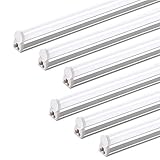
Barrina 4FT T5 LED Shop…
- 2200 lumens at 20W
- 6500K daylight
- Linkable up to 8 fixtures
- Plug-and-play snap joint mounting

hykolity 4FT 42W 4400LM…
- 4400 lumens at 42W
- 105 lumens per watt
- ETL certified 50000 hour life
- Linkable up to 6 fixtures

Sunco 4FT Linkable Shop…
- 4100 lumens at 40W
- 5000K with frosted diffuser
- ETL FCC and RoHS certified
- 7 year manufacturer warranty
All 12 Best LED Shop Lights for Garages at a Glance (October 2026)
| Product | Specs | Action |
|---|---|---|
| Barrina 4FT T5 LED Shop Light 6-Pack |
|
Check Latest Price |
| hykolity 4FT 42W 4400LM Shop Light |
|
Check Latest Price |
| Sunco 4FT Linkable Shop Light 10-Pack |
|
Check Latest Price |
 BBOUNDER 10-Pack 4FT 4400LM Shop Light BBOUNDER 10-Pack 4FT 4400LM Shop Light |
|
Check Latest Price |
 OOOLED 4FT 4800LM Shop Light with Pull Chain OOOLED 4FT 4800LM Shop Light with Pull Chain |
|
Check Latest Price |
 hykolity 4FT 120W 13000LM High Output Shop Light hykolity 4FT 120W 13000LM High Output Shop Light |
|
Check Latest Price |
 XLNYUUI 4FT 50W 7000LM V-Shape Shop Light 4-Pack XLNYUUI 4FT 50W 7000LM V-Shape Shop Light 4-Pack |
|
Check Latest Price |
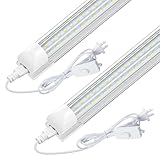 CNSUNWAY 4FT 50W 7500LM D Shape Shop Light 2-Pack CNSUNWAY 4FT 50W 7500LM D Shape Shop Light 2-Pack |
|
Check Latest Price |
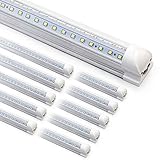 Phiwicsh 8FT 90W 12000LM Shop Light 10-Pack Phiwicsh 8FT 90W 12000LM Shop Light 10-Pack |
|
Check Latest Price |
 Skymoatled 4FT 50W 7500LM Shop Light 8-Pack Skymoatled 4FT 50W 7500LM Shop Light 8-Pack |
|
Check Latest Price |
 ELEKICO 6-Pack 4FT 50W 7500LM V Shape Shop Light ELEKICO 6-Pack 4FT 50W 7500LM V Shape Shop Light |
|
Check Latest Price |
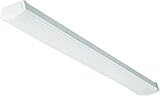 Lithonia Lighting 4FT Low-Profile LED Wraparound Lithonia Lighting 4FT Low-Profile LED Wraparound |
|
Check Latest Price |
1. Barrina 4FT T5 LED Shop Light 6-Pack – Best Overall
Barrina LED T5 Integrated Single Fixture, 4FT, 2200lm, 6500K 20W, 6 Packs
2200 lumens
20W draw
6500K
Linkable to 8
ETL
3 year warranty
Pros
- Very bright for a 20W fixture
- Plug and play with two metal clips per light
- Easy linking between fixtures
- No flicker reported by owners
- Low profile barely visible on a ceiling
Cons
- Included mounting screws strip easily
- Hardwire cord only 6 inches long
- Feels thin and light in the hand
This is the fixture I keep coming back to, and the one I would put in a garage with no other information. Six 4ft T5 fixtures at 20W and 2200 lumens each, linkable eight deep, ETL listed, backed by a 3 year manufacturer warranty, and sitting on a 4.6 star average across more than 21k reviews. That review depth is the point. When a product has that many owners behind it, the failure pattern is already known, and for this fixture it is the hardware rather than the electronics.
Install is genuinely fast. Each light uses two metal clips, so mounting a row across joists takes minutes, and the fixtures connect end to end with the included snap joints or the 20 inch connector cords. The pack ships with six power cords that have an inline on/off switch, two hardwire cords, five connector cables, end caps, and the mounting accessories, so nothing else needs a second trip to the hardware store.
What the reviews praise is the ratio. Owners keep calling a 20W fixture unusually bright, and the low profile means the lights disappear visually when you mount them tight to the ceiling. Several buyers note they have never seen flicker from these, which is the single most common complaint about cheaper LED tubes.
The weak points are all physical. Multiple owners report the included screws stripping, and the hardwire cord at 6 inches is far too short for a clean hardwired run, so a number of people ended up using the plug-in cords with cable management instead. The housing also reads as thin to the touch, which matters if you are working above them on a ladder.
Check the link limit and the cord length before you buy
Eight fixtures is the stated link limit, and at 20W each that is 160W on a single power drop, which most residential garage circuits handle without complaint. The 20 inch connector cords are the real constraint. If you plan to space fixtures more than about 18 inches apart in a grid rather than end to end, budget for longer link cables separately.
One more practical check: confirm you have a ceiling surface that suits clip mounting. These are semi flush mount fixtures, so they need a solid joist or a drywall anchor directly above each position, not a thin panel between joists.
When to skip this pack
Skip it if you want warmer light. At 6500K this is on the cool end of the scale, and owners who prefer a neutral tone for extended bench work tend to move to a 5000K fixture. It is also worth skipping if your ceiling is above 10 feet, since these hang tight to the surface and throw less usable light downward from that height.
For a 20×20 garage working toward 50 to 75 lumens per square foot, six of these 2200 lumen fixtures delivers 13,200 lumens, which is short of the 20,000 to 30,000 lumens that target implies. Six is a sensible count for a 12×20 single bay or a workshop bay rather than a full two-car.
2. hykolity 4FT 42W 4400LM LED Shop Light – Best Value
hykolity 4FT LED Shop Light, 42W [250W Equivalent],4400LM,5000K Daylight
4400 lumens
42W draw
5000K
105 lumens per watt
ETL
50,000 hours
5 year warranty
Pros
- 4400 lumens of 5000K daylight from 42W
- ETL certified with 50000 hour rated life
- Open frame design avoids trapping heat
- Long 59 inch cord with inline switch
- Hanging chains and screws included
Cons
- Not dimmable
- Open frame leaves the tubes exposed
- Link limit is 6 fixtures
If you want one fixture that does most of the work, this is the one. At 105 lumens per watt it converts 42W into 4400 lumens of 5000K daylight, and at that efficiency it delivers more light per watt than any other standard-output 4ft fixture in this roundup. The 5000K tone is the one most garage owners land on, and the review record of more than 16k ratings gives you confidence the driver will not quit in year two.
The open frame design is the decision people argue about. With no plastic cover, the tubes throw more light than covered fixtures and heat dissipates instead of collecting, but you can see the tubes from below, which reads as more industrial than finished. If your garage doubles as a gym or a finished room, that look may bother you.
Owners highlight how simple it is to mount either way. Each fixture ships with a 59 inch power cord that has an inline on/off switch, plus hanging chains and screws, so you can chain-hang from a 9 or 10 foot ceiling or surface mount it flat. The ETL listing and 50,000 hour rated life are the two details that make it feel like a commercial part rather than a marketplace import.
The criticisms are short and practical. It is not dimmable, which matters if you want mood control or a workbench zone. And the open frame, while efficient, leaves nothing between you and the LED tubes if you are doing fine detail work directly underneath.
What 4400 lumens actually covers
At 4400 lumens, two of these handle a 12×20 single bay at roughly 73 lumens per square foot, which is the middle of the range where a garage stops feeling dim. Three handle a 20×20 at 66 lumens per square foot, and that is the count most two-car owners settle on.
The link limit of six means one 59 inch cord can feed a run of up to six fixtures at 42W each, so a 20×20 garage can be lit end to end from a single outlet. Beyond six you need a second power drop, and the circuit math later in this guide explains how many fixtures that budget allows.
Where this fixture falls short
It is not bright enough for a three-car garage or a workshop with a high ceiling. At 4400 lumens on a 10 foot ceiling, a lot of the output lands on the joists rather than the floor, and owners of tall shops usually end up doubling up.
It is also not the pick if you need a pull chain. The inline switch on the power cord is the only control, so a fixture mounted in the back of a deep garage means walking over to the cord. If that is your situation, the OOOLED pick further down has a chain on every fixture.
3. Sunco 4FT Linkable LED Shop Light 10-Pack – Best Warranty Coverage
Sunco 10 Pack LED Shop Lights 4FT, Plug in Linkable, White, 40W=150W
4100 lumens
40W draw
5000K
Frosted diffuser
ETL FCC RoHS
7 year warranty
Pros
- Backed by a 7 year manufacturer warranty
- ETL FCC and RoHS certified commercial grade
- Frosted cover reduces glare
- Bulk pack lights a whole garage at once
- Supports plug in and hanging chain mounting
Cons
- Frosted cover dims the perceived output
- Linking limited to 4 fixtures
- Heavier plastic housing than metal competitors
The Sunco pack earns its place on warranty length and certification depth rather than raw output. A 7 year manufacturer warranty is the longest in this roundup, and ETL, FCC, and RoHS certification together is a stronger claim than most of the marketplace brands can make. For a homeowner who expects these fixtures to still be replaceable in five years, that matters as much as the lumen number.
Each 4ft fixture puts out 4100 lumens at 40W in 5000K, and the ten pack means you have enough for a large garage plus a storage area or a workbench run without a second order. Owners report plugging in and hanging multiple fixtures quickly, and the pack works whether you surface mount or suspend from the included hanging chains.
The one consistent complaint is brightness perception. The frosted cover diffuses the light and cuts glare, which is genuinely better for a garage where you are looking at a car or at your eyes from multiple angles, but it also makes the fixtures look dimmer than bare LED tubes at the same lumen count. Some buyers read that as underperformance and moved to higher-lumen alternatives.
That is a fair trade to make consciously. If you spend hours under these lights inspecting paint, working on a car, or sanding wood, a frosted diffuser reduces the ghost shadows and hard specular highlights that make close-up work tiring.
Two smaller notes. Linking is capped at four fixtures in series even though the pack holds ten, so a full garage will need multiple power feeds. And the housing is plastic rather than aluminum, which is a downgrade in heat dissipation compared with the metal options further down.
Why the warranty should influence your choice
Forum discussion about garage lighting keeps circling the same worry: buying a one-year-warranty fixture from a brand that may not exist in five years. A 7 year warranty from an established lighting manufacturer is a direct answer to that, and it is the reason this pack ranks here despite a lower 4.5 average than the leaders.
The certification listing matters for a second reason that has nothing to do with paperwork. Fixtures that carry FCC Part 15 Class B compliance are filtered for radiated emissions, which is the property that most often decides whether a garage door remote misbehaves in the same room as the lights.
Who should look elsewhere
Skip this pack if you are lighting a small bay. Ten 4100 lumen fixtures overshoot a one-car garage badly, and over-lighting a low ceiling makes the space feel flat and shadowless rather than bright. Three of the ten is the sensible count there.
Skip it if you need a pull chain or a motion sensor. The only control is the cord switch, and this category has no sensor option.
4. BBOUNDER 10-Pack 4FT 4400LM LED Shop Light – Best for Bulk Value
BBOUNDER 10 Pack 4FT LED Shop Light, 6500K, 40W=250W, 4400LM, 4 Linkable
4400 lumens
40W draw
6500K
110 lumens per watt
D-shape tube
5 year warranty
Pros
- 4400 lumens of 6500K light from 40W
- Very light so one person can install a full row
- Plug and play linking simplifies wiring
- Owners report fixtures still strong after two years
- D-shape design resists dark spots
Cons
- Body measures short of a true 4ft so old screw spacing misses
- Housing and clips feel cheap
- Not dimmable
- Occasional dead unit out of the box
Ten 4ft fixtures at 4400 lumens each and 110 lumens per watt give a 24×20 garage about 92 lumens per square foot, and the light weight means the install is fast because you can carry several at once.
The D-shaped tube is the technical story here. A D profile with an internal reflector resists bending and reduces the dark spots and dead sections that show up in cheap linear fixtures after a few seasons, and the 5 year warranty is longer than most of the high-output alternatives in this roundup.
The most useful thing owners mention is the weight. At this mass a single person can mount a full row of ten on ladders without help, and the 56 inch power cord with plug means most garages can be done without touching a wire. Several buyers report fixtures still running strong well past the two-year mark.
They also consistently describe the light as even and shadow-free across the whole floor, which is what you want when the car is the work surface.
Two practical problems. The body measures 46.85 inches rather than a full 48, so if you are replacing existing fluorescent fixtures and hoping to reuse the screw holes, the spacing will not line up and you are drilling new holes. And the housing and clips feel cheap enough to bend if you clip them the wrong way, so the mounting matters more than it would with a metal fixture.
A few buyers also reported a dead fixture straight out of the box, which is the pattern the certification guidance in this guide is designed to help you avoid.
Verify your existing screw spacing before ordering
Measure two holes on a current fixture and compare them to the template on the box. T8 fluorescent housings are commonly drilled at a few different spacings, and a short body means the mounting holes land in fresh drywall every time. If you are starting from bare joists this is irrelevant, but if you are doing a retrofit it decides whether you need an electricians drill or a stud finder.
Check the link limit too. Linking is capped at four fixtures here, so a ten pack needs three separate power drops across a large garage. That is fine for a plug-in install, but plan the cord routing before you mount anything.
When this is the wrong buy
Pass on it if you are hanging these from a 10 foot ceiling. At 6500K with 4400 lumens from a wide body, these are good flat-ceiling fixtures, and owners of high-ceiling shops tend to find they need a second row to get usable light at bench height.
Pass on it for color-critical work where a cool tone is distracting. 6500K is at the cold end and, in a small enclosed garage, some owners find it harsh over long sessions. The 5000K picks read more neutral for the same reason people move away from fluorescent.
5. OOOLED 4FT 4800LM LED Shop Light with Pull Chain – Best for Pull-Chain Control
OOOLED 4FT Linkable LED Shop Light for Garages, 42W 4800LM 5000K Daylight Led Shop Lights, Ceiling Light with Pull Chain (ON/Off), Linear Worklight Fixture with Plug, 2 Pack
4800 lumens
42W draw
5000K
Pull chain on off
Linkable to 10
3 year warranty
Pros
- 4800 lumens of 5000K light at 42W
- Pull chain on every fixture so no wall switch needed
- Linked fixtures can be run independently
- Very light at 1.9 lb per pair
- Highest link limit here at 10 fixtures
Cons
- 5000K reads sterile to some owners
- Top metal cover is thin
- Some buyers expected a heavier fixture
- One report of a dim residual glow after switch off
This solves a problem most roundups ignore: how do you turn a light on in the back of a garage with no wall switch. Every fixture has its own pull chain, and because the linked fixtures operate independently, you can light the whole run or just the bay you are standing in.
The output is strong for the class. At 4800 lumens from 42W, these are among the brighter 4ft fixtures in the roundup, and the 10 fixture link limit is the highest here, so a single power drop can cover nearly any residential garage.
Owners like the low weight. At 1.9 pounds for the pair, one person can hang them from eye hooks or anchors without a second set of hands, and the plug-and-play design means no wiring work at all. That makes this the most renter-friendly option in the roundup, and it is a good fit for a basement workshop where pulling a new circuit is not realistic.
It is also a sensible pairing with a smart plug if you want phone control without touching the wiring.
The complaints are about character rather than performance. Several owners describe the 5000K output as a cold or clinical white, and the thin top cover reads lighter than they expected. One reviewer reported a fixture with a residual dim glow after switching off, which points to a driver fault rather than a design flaw.
Pull chains versus a wall switch
A pull chain is a poor control on a 9 or 10 foot ceiling, because you need a ladder or a broom handle to reach it. On an 8 foot ceiling, or on fixtures hung down on chains to about 7 feet, it works well. If your garage has a 10 foot ceiling and an existing wall switch, a fixture with a cord switch like the hykolity is the better call.
There is a middle option worth knowing: the pull chain extension kits sold for high bay fixtures let you add 4 feet of chain to an existing pull switch. Several owners of the high-output hykolity in this roundup do exactly that.
Where this pick loses ground
The 4800 lumen figure is measured at the fixture, and on a high ceiling a meaningful share of it lands on the joists. In a 20×20 garage with a 10 foot ceiling, owners tend to add a row rather than increase wattage.
It is also the weakest certification story in the roundup. No ETL or UL listing is stated on the product details, so if garage door remote reliability is a concern in your space, choose one of the ETL-listed options instead.
6. hykolity 4FT 120W 13000LM High Output Shop Light – Best for High Output
hykolity 4FT 120W LED Shop Light Linkable,13000LM(400w Equivalent)
13000 lumens
120W draw
5000K
108 lumens per watt
ETL
50,000 hours
Pros
- 13000 lumens per fixture at 120W
- Highest average rating in the roundup at 4.7
- Single power feed daisy chains the whole run
- Installs in about ten minutes with included hardware
- Diffuser spreads light evenly over a workbench
Cons
- Output overwhelms small rooms
- Top housing runs hot
- Ten inch pull cord is short on high ceilings
- 60 inch cord is short for parallel mounting
This is the brightest fixture in the roundup and the highest rated at 4.7 stars. A single 4ft unit pushes 13,000 lumens at 120W, which is the output a 20×20 two-car garage needs for general lighting on its own, and it is the reason owners with large shops call it daylight-equivalent.
The efficiency is what makes that possible. At 108 lumens per watt it replaces a 400W fluorescent fixture with a fraction of the energy, it is ETL certified with a 50,000 hour rated life, and the diffuser spreads the output evenly enough to work under directly.
Installation is well thought out. The 60.2 inch cord has a three-prong grounded plug and a pass-through outlet on the fixture itself, so a daisy-chained run needs one wall outlet rather than four. Mounting hardware, hanging chains, and sheetrock anchors are all included, and owners report a ten minute install per fixture.
Linking is limited to three or four fixtures in series, which works out to 480W at the top end. That is a meaningful chunk of a 20 amp circuit, so the circuit math later in this guide applies here more than anywhere else.
Owners are candid about the tradeoffs. The output is genuinely overwhelming in a small room, and several buyers say it is too much light for a single-bay garage. The top housing runs hot to the touch, and a few describe the shell as cheap and slightly flexible when warm.
The 10 inch pull cord is also too short to reach comfortably on a high ceiling, so several owners add an extension. And the 60 inch cord suits end-to-end runs but leaves you short when mounting fixtures side by side.
How much light is too much light
Rule of thumb: aim for 50 lumens per square foot for general garage use, 75 for a bench, and 100 for color-critical work. One of these fixtures in a 20×20 garage delivers 32 lumens per square foot on its own, so it works as a single general-lighting unit but leaves the workshop tier to a second fixture. Two of them in a 20×20 gives 65 lumens per square foot, a very well-lit working garage at 240W total.
That two-fixture configuration is the one most owners land on, and it is the sweet spot between lighting the floor evenly and over-lighting a room where you need shadows to read depth on a panel or a joint.
Best paired with a second circuit
Because 120W is double the draw of a standard 4ft fixture, run these on a dedicated circuit if you are also powering a door opener or a compressor. Two fixtures plus an opener stays well inside a 20 amp circuit, but four fixtures plus a compressor does not, and the breaker will tell you so before anything fails.
7. XLNYUUI 4FT 50W 7000LM V-Shape Shop Light – Best for Slim Ceiling Profile
XLNYUUI Led Shop Lights, 4FT LED Light 50W 6500K 7000LM Daylight,Led Garage Light,Linkable Clear Cover Integrated V-Shape for Garage Warehouse Workbench Workshop(4-Pack)
7000 lumens
50W draw
6500K
270 degree V shape
ETL
2 year warranty
Pros
- 7000 lumens of 6500K light from 50W
- V shape double row chips give 270 degree coverage
- Aluminum housing dissipates heat well
- Only 1.2 inches tall so it is barely visible
- Plug in or hardwire capable
Cons
- 25000 hour rated life is half the 50000 hour claims elsewhere
- Warranty is only 2 years
- Link limit of 6 fixtures
- No stated FCC listing
At 1.2 inches wide and 1.3 inches tall, this is one of the least visible fixtures in the roundup. If your garage has an exposed ceiling and you care about how the room looks with the lights on, that thin profile does more for the space than a fixture with another 2000 lumens.
The V-shaped design is the technical explanation. Double-row LED chips fire at a 270 degree emitting angle, so light leaves the fixture over a much wider spread than a straight tube, which is how a 50W fixture covers 7000 lumens across a wide floor area without needing a row of lower-output lights. The aluminum body handles the heat that comes with that output.
Owners rate it 4.7 stars and attribute that to the combination of output, coverage, and a body that does not flex. The fixture links up to six in series, ships with an on/off switch cord and an extension cord, and works as either a plug-in or hardwired install, which is unusual at this price point and useful if you would rather not run a cord across the ceiling.
It is also one of the few picks here that can be installed permanently, which matters for a garage where the cord is a trip hazard near a workbench.
The reservation owners raise is longevity. The rated lifespan is 25,000 hours, roughly half the 50,000 hour figure the hykolity, Sunco, and BBOUNDER options claim, and the warranty is 2 years, the shortest of the higher-output fixtures here. Five thousand hours a year at 13 hours of daily use puts that rated life at under two years of continuous operation, which is the number to weigh if you plan to run these for a decade.
Decide between thin profile and long rated life
If you are hanging these in a finished garage gym or a space people look at, the 1.2 inch profile is worth more than the rated hour figure. If you are lighting a workshop where scuffs and vibration are normal and replacement is inconvenient, the fixtures with 50,000 hour claims are the safer bet.
One more note: this listing states ETL certification but does not state an FCC listing, so if your garage door remote has been unreliable, move to one of the fixtures that names FCC Part 15 Class B compliance.
Where the 7000 lumens lands
One fixture covers a 12×20 single bay at about 58 lumens per square foot, which is a well-lit single bay. Two handle a 20×20 at 70 lumens per square foot, comfortably in workshop territory, and three push a 24×24 to about 73.
Because the beam is 270 degrees rather than straight down, these work well lower on the ceiling than a narrow-beam fixture would. Mount them where the light lands on the work surface, not high above the door.
8. CNSUNWAY 4FT 50W 7500LM D Shape Shop Light – Best for Wide Coverage
CNSUNWAY 4FT LED Shop Lights, 50W 7500LM D Shape, ETL Listed 2 Pack
7500 lumens
50W draw
6500K
300 degree beam
ETL
3 year warranty
Pros
- 7500 lumens with 50W of power draw
- 300 degree D shape beam gives very wide even coverage
- Some owners reused housings from old fluorescent fixtures
- Lightweight but sturdy once mounted
- Manufacturer replaced faulty fixtures quickly
Cons
- A few units failed on first power up
- Mounting clips described as flimsy
- Some orders included fewer switched cords than fixtures
- One buyer received 5000K instead of 6500K
The widest beam angle in the roundup belongs to this fixture. A 300 degree D-shape design throws light across the full width of the room, and the listing rates it at covering 40 to 60 square feet per fixture, which is more coverage per fixture than any other option here.
At 50W and 7500 lumens, four of these cover a 20×20 garage at 75 lumens per square foot. That is workshop-grade output from one pack, and the wide spread means owners consistently treat it as the value pick.
The 60 percent recycled post-consumer ABS mixed with aluminum alloy body is unusual, and the practical benefit is weight. It mounts overhead on a ladder without feeling unstable, and several buyers mention that the wide beam means fewer fixtures than they originally planned.
One owner reported reusing the housings and reflectors from their old fluorescent fixtures, which tells you the footprint is close enough to standard T8 geometry to make a partial retrofit possible. Extension and power cords are included, and the fixtures are linkable for wider coverage.
Quality control is the real story here. A small number of buyers received fixtures that did not light on first power up, some orders included fewer on/off switched power cords than fixtures, and one order arrived in 5000K when 6500K was ordered. Those are all fixable problems, and the manufacturer is praised for replacing faulty units quickly, but they are real.
The mounting clips are the other recurring complaint, described as flimsy more than once. If you are mounting into drywall rather than into joists, use proper anchors.
Why wide beam beats raw lumens in a garage
Two fixtures with 7500 lumens each and a 300 degree spread do not deliver the same result as two fixtures with 7500 lumens and a 150 degree spread. The wide version puts more of that output on the floor and the work surface instead of losing it to the walls and the ceiling plane between joists.
That is also why the coverage claim of 40 to 60 square feet per fixture matters more than the lumen headline. Compare it against your garage size before you multiply.
What to check on arrival
Test every fixture before you mount it. Plug each one in, let it run for a minute, and confirm the output matches and there is no flicker or dead section. That takes ten minutes and it is the difference between a smooth Sunday install and a return.
Count your cords against your fixtures on delivery, and confirm the color temperature by looking at it under the light rather than trusting the box. It is a 6500K fixture, so it should read distinctly cool.
9. Phiwicsh 8FT 90W 12000LM LED Shop Light – Best for Long Runs
10-Pack 8ft LED Shop Light Fixture – 90W T8 Integrated LED Tube Light – 6500K 12000LM V-Shape Linkable – High Output – Clear Cover – Plug and Play – 270 Degree Lighting for Garage, Shop, Barn
12000 lumens per fixture
90W draw
6500K
8ft T8 style
60000 hour life
Pros
- 8ft fixtures cover a ceiling in far fewer pieces
- 12000 lumens at 90W is about 135 lumens per watt
- 60000 hour rated life is the longest here
- Full hardware pack included with clips screws and cords
- Clear cover V shape spreads light 270 degrees
Cons
- Heaviest and largest pack in the roundup
- Linking limited to 4 fixtures
- Ten pack is far more than one garage needs
- 22.3 lb per pack makes it a two person job
Eight feet long changes the installation arithmetic. A 24×24 garage needs six or eight 4ft fixtures, but four 8ft fixtures cover the same ceiling with fewer mounts, fewer cords, and a much cleaner ceiling line. Owners with shops and barns consistently say coverage per fixture is the reason they chose this.
Each tube pushes 12,000 lumens at 90W, which works out to 135 lumens per watt. The rated operating life of 60,000 hours is also the longest on offer, which at six hours a day works out to more than two decades.
The pack is unusually complete. Ten fixtures arrive with end caps, connectors, 40 screws, 40 mount clips, connector cables, and 5 switched 59 inch power cords, so the whole install is one box. The clear cover and V-shape 270 degree design spread light wide rather than concentrating it into a hot spot, and there is no UV or IR radiation from the output.
For a garage with a 10 foot or higher ceiling, this is the fixture people end up regretting not buying earlier, because the wide coverage means you need far fewer of them.
It is also the heaviest commitment. The pack weighs 22.3 pounds, so installing it is a two person job on ladders, and ten fixtures is far more than a single garage needs. If your garage is one or two bays, this is oversizing.
There is an odd constraint worth planning around: linking is limited to four fixtures in series despite the ten in the pack, so most installations need multiple power drops regardless.
When 8ft beats 4ft
Choose 8ft when you have a 20×20 or larger floor, a ceiling above 9 feet, or a shop with exposed joists where visual clutter matters. An 8ft tube spreads roughly twice the floor coverage of a 4ft fixture at the same mounting height, so the fixture count drops by more than half.
Stay with 4ft when the space is small, the joists are dense, or you need to run a fixture along a narrow wall. An 8ft tube needs a clear 8 foot run with nothing in the way, including door tracks and storage racks.
Budget for a second circuit
At 90W per fixture, four linked tubes draw 360W, which leaves plenty of room on a 20 amp circuit. Eight tubes at 720W is the point where the door opener and a compressor on the same run push past the 1920 watt ceiling, and you would want a second circuit by then.
10. Skymoatled 4FT 50W 7500LM Shop Light 8-Pack – Best for Big-Pack Coverage
Skymoatled 8Pack 4FT LED Shop Light Garage Lights,50W 6000K 7500LM White Light,Hanging/Surface Mount,T8 4FT Tube Lamp for Warehouse Workshop Basement,Linkable LED Shop Lights,Plug and Play
7500 lumens
50W draw
6000K
270 degree beam
50,000 hour life
2 year warranty
Pros
- 7500 lumens per 50W fixture
- Revised driver design targets partial and full failures
- Mounting screws cover wood drywall and concrete
- Flicker free and silent operation
- Largest pack among the 4ft linkable options here
Cons
- 6000K is cooler than the usual 5000K choice
- Color temperature does not match existing 5000K or 4000K fixtures
- 8 pack is more than most single garages need
- 2 year warranty is the shortest here
Eight 4ft fixtures at 7500 lumens each gives you 60k lumens in one order, which covers a 24×24 garage at 104 lumens per square foot or lights a two-car garage plus a workshop area in a single purchase. That scale is why the pack exists.
The revision that stands out is the driver. This listing describes a revised driving principle with double power protection intended to prevent partially lit or fully dead fixtures, which is the failure mode that turns a bulk pack into a box of half-dead lights a year later. Owners credit the design with stable, flicker-free, silent output.
The mounting hardware is unusually thoughtful for a marketplace pack. Screws are included for wood, gypsum board, and concrete, so the same pack works on a finished ceiling or an unfinished garage.
Using 5730 0.5W LEDs rather than the smaller 2835 chips is the other technical choice, and it is why 7500 lumens from 50W is achievable in a 4ft body.
The consistent caveat is color. At 6000K these are cooler than the 5000K most people settle on, and buyers report it does not match existing 4000K or 5000K fixtures already in the shop. Mixing color temperatures in one room is more noticeable than most people expect before they buy.
The 2 year warranty is the shortest offered here, and eight fixtures is more than most single-garage buyers will use.
Matching color temperature across a room
If you are adding lights to a garage that already has fixtures, match the Kelvin value before you order. A 6000K fixture next to a 5000K one creates a visible patchwork on a white car, and no amount of extra lumens fixes it.
If you are starting from scratch, this is a reasonable pick at 6000K. The argument for 5000K is simply that it is the tone the largest number of garage owners describe as comfortable for extended time on a bench.
How many of the eight you will actually use
Three fixtures give a 20×20 garage 56 lumens per square foot, which is a solidly lit working space. Four push it to 75. Anything beyond four belongs in a garage with a workshop bay or a second wall of storage, and the remainder of the pack is best split between a workbench run and a utility room.
Treat the pack as a garage plus utility building kit rather than a single-room purchase, and you will get the most out of it.
11. ELEKICO 6-Pack 4FT 50W 7500LM V Shape Shop Light – Best for Sturdier Hardware
ELEKICO 6 Pack 50w 4ft Led Shop Light, Super Bright 7500lm 5000k V Shape 4′ Led Shop Lights, Linkable 4 Foot Led Shop Lights for Garage Warehouse, Supermarket, Basement, Barn, Storage Area
7500 lumens
50W draw
5000K
150 lumens per watt
V shape
Linkable to 3
Pros
- 7500 lumens at 50W for 150 lumens per watt
- Larger mounting clips hold the fixture securely
- Connectors seat properly on the contacts
- Well packaged and protected
- Owners routinely use fewer fixtures than planned
Cons
- Small connectors can be finicky to seat
- Included screws are weak and strip out
- Link limit of 3 fixtures
- Only 1 inch male connectors limit longer runs
At 150 lumens per watt, this is the most efficient fixture in the roundup. Fifty watts produces 7500 lumens, and the 5000K tone is the version most garage owners actually want for bench work. Six of them give a 24×20 garage 94 lumens per square foot, which puts that room at the high end of workshop lighting from a single order.
384 LED chips per fixture and a V-shape housing with 270 degree output get you there. The aluminium body also runs cooler than the plastic options, which matters when you are working directly under one for hours.
What buyers consistently single out is the hardware, and that is usually where budget packs fail. Reviewers describe these mounting clips as larger and more secure than the flimsy ones on cheaper models, and they note that the connectors actually seat on the contacts so a linked run stays connected instead of working loose over time.
Several owners also report using fewer fixtures than they originally planned because the output was sufficient, which is the outcome you want from a lumen claim.
The remaining gripes are small but real. The connectors are finicky to seat and can need a little jiggling, and the supplied screws are weak enough to strip. Linking is limited to three fixtures, and the 1 inch male connectors are less common than standard sizes, so a longer run may need wire nuts.
It is also worth noting that the listing advises installing away from radios and remote-control doors because of EMI, and it is not suitable for ceilings above 20 feet.
Why the hardware rating matters more than the lumen rating
A fixture that falls out of the ceiling clips matters more than one that is slightly dimmer. The clips and the connector contacts are the two points where cheap linear lights fail, and both show up in the reviews on most of the budget packs in this category.
Even here, the screws are the weak link. Use your own drywall anchors rather than the supplied screws, and you remove the most common install failure from the list.
Where the efficiency stops helping
150 lumens per watt does not change how much light reaches the floor. Once you are past about 100 lumens per square foot, adding fixtures stops improving the room and starts making shadows disappear entirely, which can make close-up work harder to read.
For most garages, three or four of these is the ceiling. If your work is auto paint or finish carpentry, that is the point where color rendering matters more than another thousand lumens.
12. Lithonia Lighting 4FT Low-Profile LED Wraparound – Best for Hardwired Installs
Lithonia Lighting 4′ Low-Profile LED Wraparound Light Fixture, 4000K, 120V
2900 lumens
41W draw
4000K
DLC and Energy Star
UL and CSA listed
5 year warranty
Pros
- Established commercial brand from AcuityBrands
- Even hotspot free diffusion with decent color rendering
- Light at 4.4 lb so one person can install it
- Damp location rated for unfinished garage areas
- 50000 hour rated life with 5 year limited warranty
Cons
- Hardwired rather than plug-in so it needs electrical work
- Lowest lumen output of any fixture in the roundup
- Industrial styling some buyers find plain
- Not dimmable
This is the most established commercial lighting brand in the roundup. Lithonia Lighting, part of AcuityBrands, builds a spec-grade fixture that carries DLC and Energy Star certification alongside UL and CSA listing, and it is the pick if your garage is attached to a house, a basement workshop, or a space where you want the install to look permanent.
At 2900 lumens from 41W it is the least powerful fixture here, and that is the trade you make for the white polycarbonate diffuser. The wraparound design spreads light evenly with no visible hot spot across a bench, and the color rendering is described as noticeably better than the marketplace tubes, which is what makes it the pick for closets, utility rooms, and detailed work.
Two practical advantages stand out. It is rated for damp locations, so an unfinished garage with a concrete floor and some moisture is not a problem, and at 4.4 pounds a single person can put it overhead without arranging help. The metal housing and plastic end caps feel more durable than anything else in this roundup.
Owners replacing aging fluorescent tubes report the same thing across the board: the light is even and flicker free, and they never have to think about a bulb again. The fixture is rated to hold 70 percent of its lumen output for 50,000 hours, which the listing works out to over 22 years at six hours a day.
The obvious cost is flexibility. It is hardwired, not plug-in, so it needs basic electrical work or an electrician, and that is a real barrier in a rental or a garage with no switch. It is also not dimmable.
At 2900 lumens, two fixtures cover a 12×20 single bay at 48 lumens per square foot, which is on the dim side for a workshop. You need four for a 20×20 to reach 58. Some owners also find the industrial styling functional rather than attractive, and a few orders have arrived with the box already opened.
When a hardwired commercial fixture is the right call
Choose it when you are already running new wire, when the space is damp, or when you want color rendering good enough for finish work. The 4000K tone is also the most neutral option in this roundup, which some people prefer over 5000K for long sessions.
Choose a plug-in fixture when the electrical work is the obstacle. Most of the cost of a garage lighting upgrade is the install, and four plug-in fixtures on an existing circuit take an afternoon with no electrician and no permit.
Confirm the retrofit fit first
This is a surface mount wraparound that replaces a two-lamp T8 fixture, and it is designed to be mounted to a box. If you are taking out fluorescent housings rather than reusing them, the ceiling condition underneath decides whether this works as cleanly as it sounds.
Surface mount also works on a wall, which is a good way to light a workbench that sits against a side wall with no ceiling joist above it.
How Many LED Shop Lights Does Your Garage Need?
Aim for 50 lumens per square foot for general garage lighting, 75 for a garage that doubles as a workshop, and 100 for color-critical work like auto paint or finish carpentry. Multiply your floor area by that number, divide by the lumens per fixture, then round up to whatever whole number of fixtures you can actually mount and wire.
The mistake almost everyone makes is buying two fixtures because two sounds like a lot. A single 5,000 lumen light in a 20×20 garage delivers only 12 lumens per square foot, well short of the 50 lumens per square foot target. Most under-lit garages need four to six fixtures, not two.
Here is the math worked out for common garage sizes at the three targets:
12×20 single bay (240 sq ft): at 50 lumens per square foot you need 12,000 lumens, which is three 4400 lumen fixtures. At 75 you need 18,000, which is four. At 100 you need 24,000, which is four 7500 lumen fixtures.
20×20 two-car (400 sq ft): at 50 you need 20,000 lumens, which is four 4400 lumen fixtures or three 7500 lumen ones. At 75 you need 30,000, which is four 7500 lumen fixtures. At 100 you need 40,000, which is five 7500 lumen fixtures or four 13000 lumen high-output ones.
20×20 to 20×30 two-car (400 to 600 sq ft): at 50 you need 20,000 to 30,000 lumens, which is four to six 4400 lumen fixtures. At 75 you need 30,000 to 45,000, which is four to six 7500 lumen fixtures. At 100 you need 40,000 to 60,000, which is six to eight 7500 lumen fixtures or a combination of 4ft and 8ft tubes.
24×24 three-car (576 sq ft): at 50 you need 28,800 lumens, which is seven 4400 lumen fixtures or four 7500 lumen ones. At 75 you need 43,200, which is six 7500 lumen fixtures. At 100 you need 57,600, which is eight 7500 lumen fixtures or four 8ft tubes at 12,000 lumens each.
24×30 workshop with office (720 sq ft): at 50 you need 36,000 lumens, which is eight 4400 lumen fixtures or five 7500 lumen ones. At 75 you need 54,000, which is seven 7500 lumen fixtures. At 100 you need 72,000, which is ten 7500 lumen fixtures or six 8ft tubes.
Add roughly 10 to 20 percent for volumetric light loss, which is what happens when light has to bounce off a bare ceiling and grey walls to reach the floor. The inverse square law is the other factor: light falls off with distance squared, so a 10 foot ceiling gives you noticeably less usable light at bench height than an 8 foot one from the same fixture.
Place the fixtures so the light lands on the work
Mount low enough to light the work surface, not the joists. On a 9 or 10 foot ceiling, hanging the fixtures on chains so the bottom of the light sits around 8 feet puts more light where you need it than mounting them tight to the ceiling. This is the most repeated piece of advice in garage lighting discussions, and it is right.
Keep clear of the door tracks and the opener rail. A standard single-car door needs about 7 feet of clearance under the raised door, and a 7 foot tall fixture in the middle of the bay will stop the door. Most people solve this by running the row parallel to the door and offsetting it by a foot, so the door path stays clear.
Even spacing beats even numbers. Four fixtures clustered in the middle of a 20×20 leave dark corners; the same four spread across the bay in a rectangle eliminate them. If you are limited to two fixtures, place them over the parking spots rather than over the bench.
5000K vs 6500K for Garage Lighting
5000K is the better choice for most garages, and 6500K is the better choice for specific tasks. Five thousand Kelvin reads as neutral daylight, sits comfortably for hours of bench work, and is the temperature the largest number of garage owners describe as the one they settled on. 6500K is noticeably bluer and more energizing, which some people like and others describe as harsh after a long afternoon.
The color temperature options across this roundup span 4000K, 5000K, 6000K, and 6500K. The 4000K Lithonia fixture is the warmest and reads as slightly beige in a dark garage. The 5000K options, which include the hykolity 42W, the Sunco 10 pack, the OOOLED pull chain pair, and the ELEKICO 6 pack, are the middle ground. The 6500K options, which include the Barrina T5, BBOUNDER, CNSUNWAY, XLNYUUI, and the 8ft Phiwicsh, are the coolest and brightest-looking.
The practical case for 6500K is contrast. Under a cooler light, dirt, fluid leaks, and paint defects read more sharply, which is why detailers and inspection work tend to prefer it. The case against it is comfort and matching, because a 6500K fixture next to an existing 5000K one produces a visible patchwork on a light-colored car.
If you are replacing everything at once, 5000K is the safe answer. If you are adding to a room, match whatever is already installed.
Garage Door Opener Interference and Flickering Lights
Some LED shop lights interfere with garage door openers, and the mechanism is worth understanding before you blame your opener. Chain-drive and belt-drive openers communicate on radio frequencies around 315 MHz and 390 MHz, and an LED driver that leaks broadband electrical noise into the same band can swamp a weak remote signal. The symptom is specific: remotes and keypads that work fine until a new light is switched on, or work only within a few feet of the opener.
Forum discussion on garage and home improvement boards consistently describes this as a widespread, real problem rather than a myth, and the most common fix owners report is not cheaper remotes. It is replacing uncertified fixtures with ETL or UL listed ones that also state FCC Part 15 Class B compliance, which is the emissions class that governs exactly this kind of radiated noise.
Four steps to diagnose an existing interference problem
First, note the pattern. Does the remote fail only when a specific light is on, or only at certain times of day? An intermittent failure that tracks with a light being switched on points to RF leakage rather than a dying battery or a failed opener.
Second, isolate it. Turn the garage lighting circuit off and test the remote. If the remote works reliably with the lights off and fails with them on, you have a lighting-related interference problem rather than an opener fault.
Third, narrow it to a fixture. If you have several lights, switch them on one at a time. A single noisy fixture in a batch of identical ones is unusual, but a batch of uncertified fixtures on one circuit is a common culprit, and swapping one fixture for a certified model is a cheap test.
Fourth, if it persists after a certified swap, call the opener manufacturer. Interference that follows every light in the house, not just the garage, may be coming from another appliance on a shared circuit, and that is a different diagnosis.
Why new lights cause flickering
Flickering in a new LED shop light is almost always a driver or a power quality problem rather than an LED problem. Common causes include a shared neutral overloaded by other loads, a dimmer switch still in the circuit that the fixture is not rated for, an old magnetic ballast still in the circuit feeding an LED tube, and loose connectors in a daisy-chained run.
If you are replacing fluorescent T8 or T12 tubes, the retrofit question comes up immediately. If the existing housing has a magnetic ballast, it must be removed or bypassed, because keeping it in place is a common cause of flicker and humming. If the housing has an electronic ballast, it can often stay in place with a ballast bypass jumper, but replacing the whole housing is often less work than retrofitting and gives you a fixture with a stated warranty.
In an unheated garage in winter, the classic complaint about fluorescent was tubes that would not start below about 50F or that flickered and hummed as they warmed up. LED fixtures reach full brightness instantly and are rated to work down to roughly -4F, which is the single biggest practical upgrade for anyone in a cold climate. Owners replacing fluorescent in cold garages consistently describe the change as immediately obvious.
If you are a renter or you do not want to run new wiring, a pull chain fixture like the OOOLED pick solves the control problem, and a smart plug on the existing outlet adds phone control without touching anything electrical.
LED Shop Light Buyer’s Guide for Garages
Buy the lumens first. The old habit of matching wattage to brightness stopped working when LED arrived, because a 40W LED shop light puts out more usable light than a 72W fluorescent. Judge every fixture on lumens per square foot of your floor area, and treat the wattage figure as a cost and heat number rather than a brightness number.
Judge efficiency by lumens per watt when the two figures disagree. A 50W fixture claiming 7500 lumens is at 150 lumens per watt; a 40W fixture claiming 4100 lumens is at 102. Higher efficiency means less waste heat in a closed garage over a decade of daily use.
Use linkability to control installation cost. A linkable fixture takes power at one end and passes it through to the next, so lighting a 20×20 garage takes one circuit and one outlet instead of four. The link limits differ across this roundup: the Barrina T5 links eight deep, the OOOLED pull chain pair links ten, the hykolity 42W links six, the XLNYUUI links six, the Sunco and BBOUNDER and the 8ft Phiwicsh link four, and the ELEKICO links three. Check the limit against your fixture count before you order, and add a second power drop rather than pushing past it.
Understand what a link limit actually costs you in flexibility. The included connector cords on several of these are 20 to 23.6 inches, which is enough for end-to-end runs and short of enough for a spaced grid. If you plan a grid layout rather than a single row, buy longer link cables at the same time.
Before you plan the layout: a 20 amp, 120 volt circuit is 2400 watts, and the NEC 80 percent rule caps continuous load at 1920 watts. The rest of that budget goes to the door opener and anything else on the same circuit.
If the door opener and a compressor already account for roughly 1,400 watts of that budget, about 500 watts of headroom remains, which is eleven 42W fixtures. If the opener alone is the main load, most of the 1920 watt ceiling is free for lighting.
Note that the high-output 120W fixtures change the arithmetic quickly. Three of them already account for 360W, so a run of four alongside an opener and a compressor is the point where the ceiling matters. If you want maximum output per fixture, plan a dedicated lighting circuit.
Match the mounting style to the ceiling height. Under 9 feet, surface mount or flush mount works and wastes nothing. Between 9 and 11 feet, hang the fixtures on chains so the light source drops to about 8 feet, which is the single most effective change most garages can make. Above 12 feet, light loss becomes the dominant problem, and this is where 8ft tubes or high bay fixtures earn their place because they put more light forward per fixture.
Treat certification as a safety filter, not paperwork. ETL and UL listing means the fixture has been tested by an independent lab for electrical safety. DLC and Energy Star address efficiency. FCC Part 15 Class B compliance is the one that matters for garage door openers, because it certifies the fixture stays within limits for radiated emissions. Several fixtures in this roundup state ETL and nothing else, and those are the ones to look at twice if your remote has been unreliable.
Weight and hardware decide how the install feels. Fixtures under 2 pounds can be installed by one person on a ladder; a 22 pound pack is a two person job. Flimsy mounting clips and weak supplied screws are the most common install complaints across the reviews we read, so use proper drywall anchors rather than the included screws.
Finally, plan the retrofit path. If you are taking out fluorescent T8 fixtures, check whether the housings have magnetic or electronic ballasts. Magnetic must be removed or bypassed, electronic often can stay with a bypass jumper, and in most cases a full fixture replacement ends up being less work and gives you a warranty that covers the driver.
Lighting is only half of a garage that is genuinely usable at night. Our roundup of the best party speakers with lights covers the audio side, and if the space doubles as a man cave or an early-morning workout room, the best sleep sound machines with night lights is the more sensible read.
Frequently Asked Questions
What is the best LED shop light for a garage?
The best LED shop light for a garage is a linkable 4ft fixture between 40W and 50W that produces 4,400 to 7,500 lumens at 5000K and carries an ETL or UL listing. Our top pick is the Barrina 4FT T5 6-Pack, which puts 2,200 lumens from 20W per fixture, links eight deep, and has more than 21,000 reviews behind it. For a single fixture rather than a pack, the hykolity 42W 4,400 lumen model is the strongest all-rounder.
How many lumens are needed for a garage shop light?
A garage needs about 50 lumens per square foot for general lighting, 75 for a workshop, and 100 for colour-critical work like auto paint. Multiply your floor area by that figure to get your total. A 20×20 garage therefore needs 20,000 lumens at the basic level and 30,000 lumens for workshop brightness, which is four 4,400 lumen fixtures or four 7,500 lumen fixtures.
How many lumens for a 20×20 garage?
A 20×20 garage needs 20,000 lumens for general lighting at 50 lumens per square foot, 30,000 lumens for workshop-level brightness at 75, and 40,000 lumens at 100. In practice that is four 4,400 lumen 4ft fixtures for general use, four 7,500 lumen fixtures for a working garage, or two 13,000 lumen high-output fixtures for the brightest result.
Which is better for a garage, 5000K or 6500K LED lights?
5000K is better for most garages because it reads as neutral daylight and stays comfortable over long work sessions. 6500K is cooler and bluer, which sharpens contrast and reveals dirt, leaks, and paint defects, making it a favourite for detailing and inspection. Choose 6500K if you already use it elsewhere in the space, and 5000K if you are starting fresh.
Do LED shop lights interfere with garage door openers?
Some uncertified LED shop lights do interfere with garage door openers. Chain and belt drive openers use radio signals around 315 MHz and 390 MHz, and a noisy LED driver can leak into that band and swamp a weak remote. The fix is usually replacing those fixtures with ETL or UL listed models that also state FCC Part 15 Class B compliance, which certifies the fixture limits radiated emissions.
Why are my LED garage lights flickering?
Flickering in an LED shop light usually points to the driver or the power supply, not the LEDs themselves. The usual causes are an overloaded shared neutral, a dimmer switch still in the circuit that the fixture is not rated for, an old magnetic ballast still feeding an LED tube, or loose connectors in a daisy-chained run. Replacing a fluorescent T8 with LED requires removing or bypassing any magnetic ballast to fix this.
Final Verdict
The Barrina 4FT T5 6-Pack is the best LED shop light for garages overall. It has the deepest review record in this roundup at more than 21k ratings, a 4.6 average, ETL listing, an 8-fixture link limit, and a 3 year warranty, and its weaknesses are cosmetic rather than functional.
Take the hykolity 42W 4,400 lumen fixture if you want the strongest single 4ft option at 105 lumens per watt in 5000K. Take the Sunco 10 pack if warranty length matters most to you, since 7 years of coverage is the longest available here. Take the hykolity 120W 13,000 lumen fixture for maximum output on a high ceiling, and the Phiwicsh 8ft 10 pack if you want the fewest fixtures possible across a large shop.
Whatever you choose, buy the lumens count for your floor area first, install with proper anchors rather than the supplied screws, and keep the total draw on a 20 amp circuit under 1920 watts once the door opener and compressor are included. That planning step is the difference between a garage you can work in at night and one you avoid after dark.
While you are finishing the space, our picks for the best speakers for garages and workshops cover the other half of a working garage, and our guide to Bluetooth speakers with lights is a better read if you want music in the shop.
2 thoughts on “12 Best LED Shop Lights for Garages (October 2026) Ultimate Guide”