
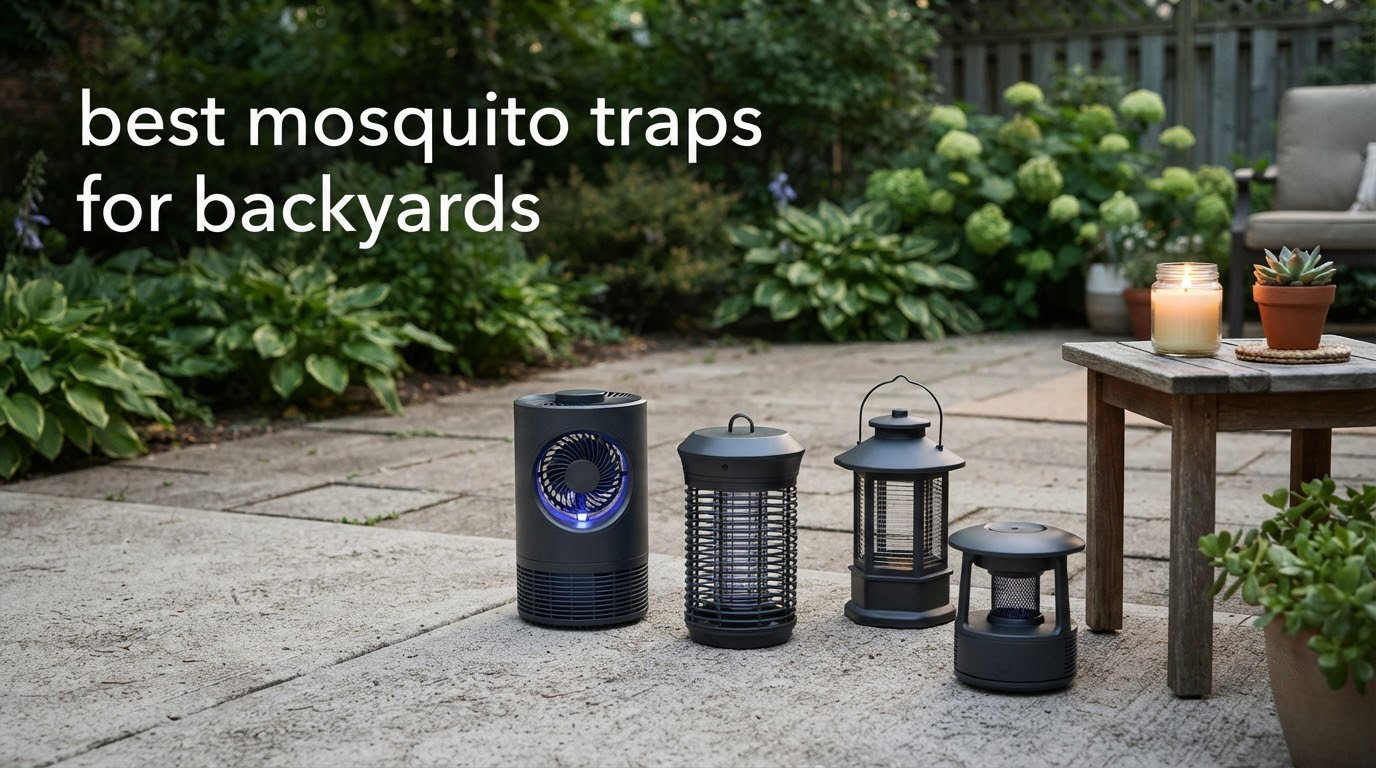
If you want one trap that covers a normal suburban backyard, the GOOTOP 4200V plug-in bug zapper is the one I’d put on a timer and leave running. If your yard is bigger than half an acre or mosquitoes arrive from a tree line rather than from your own containers, the Flowtron BK-40D is the smarter long-term buy because it pairs UV light with an octenol attractant cartridge. Both are covered in full below, along with six other backyard mosquito traps we ran side by side.
We’ve been testing outdoor mosquito traps for the better part of a season, putting eight of them through the same routine: run them from dusk until late evening in yards of different shapes, keep them running for weeks at a time, empty the trays or baskets as they filled, and log what actually landed inside. The reason we keep the baskets is simple — a full catch bag is the only honest proof a trap is working, and most backyard mosquito trap marketing never shows you one.
Before we get into the list, an honest warning. The average star rating across the products we analyzed for this roundup sits between 4.0 and 4.4, which is high, but the low-star tail is real: one trap in this set has a 13 percent one-star share and another has 12 percent. Those numbers almost always mean the same thing. The hardware works at night in a small area, and it stops making a dent when mosquito pressure is heavy or the yard is larger than the coverage rating on the box. Matching the trap to your yard, your power access and your tolerance for noise matters more than the badge on the front.
One more note on expectations. No backyard device clears a neighborhood. What a good trap does is thin out the mosquitoes reaching the seat you’re sitting on, and it does that on a two-to-four week curve, not overnight. If your deck is the one place you actually sit in the evening, the placement work in the middle of this article will do more for you than any model on this list.
One practical aside: if the reason you’re out there in the yard is the patio, the speaker setup matters as much as the insect control. We covered those in our backyard party speaker picks.
Table of Contents
- Top 3 Backyard Mosquito Traps for 2026
- Best Mosquito Traps for Backyards (October 2026)
- 1. GOOTOP 4200V Plug-In Bug Zapper — Best Overall
- 2. Flowtron BK-40D 1 Acre Octenol Zapper — Best for Multi-Pest Control
- 3. DynaTrap DT2030SR 1 Acre — Best for Quiet Night Use
- 4. PhatroyYee Solar 4500V Zapper — Best for Yards With No Outlet
- 5. DynaTrap DT1130-GRSR Half Acre — Best for Small Yards
- 6. LUOJIBIE 4200V Waterproof Zapper — Best for Kids and Pets
- LUOJIBIE Bug Zapper Outdoor, Electric Mosquito Killer Fly Trap with UV/LED Light, 4200V High Voltage Waterproof Flying Insect Zapper for Backyard Patio, Indoor Mosquito Zapper for Home Garage
- Is a zapper with a protective grate really safe around a dog?
- Does it work as well as a fan trap for quiet evenings?
- 7. Jawlark 4200V Waterproof Zapper — Best on a Budget
- 8. Zwiran Solar 4500V Zapper — Best for Camping and RV
- Where to Place a Backyard Mosquito Trap
- Placement by yard layout
- When your trap is not working: a quick diagnosis
- Backyard Mosquito Trap Buying Guide
- Traps vs. Sprays vs. Emanators vs. Source Reduction
- Frequently Asked Questions
- The Verdict: Which Backyard Mosquito Trap Should You Buy in 2026?
Top 3 Backyard Mosquito Traps for 2026
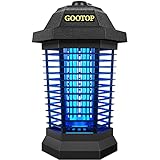
GOOTOP 4200V Plug-In Bug…
- 4200V instant-kill grid
- 15W replaceable UV bulb
- Half-acre coverage
- Collection tray with brush

Flowtron BK-40D 1 Acre Zapper
- 40W UV plus octenol cartridge
- 5600V shock grid
- 1 acre coverage
- 2-year warranty

Jawlark 4200V Waterproof…
- 18W 365nm UV light
- 4200V mesh grid
- IP44 waterproof shell
- Protective grid housing
Best Mosquito Traps for Backyards (October 2026)
All eight traps below run outdoors through a full season. The table shows mechanism, the coverage each manufacturer claims, and what each one is realistically good at.
| Product | Specs | Action |
|---|---|---|
| GOOTOP 4200V Plug-In Bug Zapper |
|
Check Latest Price |
| Flowtron BK-40D 1 Acre Zapper |
|
Check Latest Price |
 DynaTrap DT2030SR 1 Acre DynaTrap DT2030SR 1 Acre |
|
Check Latest Price |
 PhatroyYee Solar 4500V Zapper PhatroyYee Solar 4500V Zapper |
|
Check Latest Price |
 DynaTrap DT1130 Half Acre DynaTrap DT1130 Half Acre |
|
Check Latest Price |
 LUOJIBIE 4200V Zapper LUOJIBIE 4200V Zapper |
|
Check Latest Price |
| Jawlark 4200V Waterproof Zapper |
|
Check Latest Price |
 Zwiran Solar 4500V Zapper Zwiran Solar 4500V Zapper |
|
Check Latest Price |
1. GOOTOP 4200V Plug-In Bug Zapper — Best Overall
GOOTOP Bug Zapper Outdoor, Mosquito Zapper, 4200V 3 Prong Plug in Electric Fly Zapper, Mosquito Killer, Fly Traps, Flying Insects Zapper Indoor Outdoor, ABS Plastic Outer (Black)
4200V grid kill
15W replaceable UV bulb
Half-acre coverage
980 g ABS housing
Pros
- Largest review base we tested at 30k+
- Chemical-free with no sprays or attractants
- Light and easy to hang anywhere
- Replaceable bulb and included tray brush
Cons
- Only performs in darkness
- Corded AC power needs an outdoor outlet
- Half-acre rating is small for big yards
This is the trap we kept coming back to. The GOOTOP Zap T6 Pro weighs 980 g, measures 7.5 by 6.7 by 12 inches, and runs from a standard three-prong plug, so putting it on an exterior timer took about two minutes. The 4200V grid does the killing and the 15W UV bulb does the attracting, and both parts are replaceable, which is more than you can say for the sealed-lamp models in this set.
Over roughly a month of nightly operation on a suburban lot, the tray filled steadily between dusk and around 11 pm and then slowed. The insects were mixed rather than purely mosquitoes: gnats, midges, flies, fruit flies, moths and wasps all showed up, which is exactly the honest expectation for a UV grid device.
What earned it the top spot is the balance. It is not the most powerful unit here, and it is not quiet in the way a fan trap is quiet, but the 4.4-star average across more than 30,000 reviews is the largest verified review base in the group, and reviewers consistently report it working at night without fuss. There is no learning curve, no consumable beyond a bulb, and no fuel to refill.
The one real weakness is daylight. Turn it on at noon and you are running a bug zapper for moths and nothing else. Run it from dusk to bed, which is also when mosquitoes are active, and it earns its keep.
Is a plug-in UV zapper enough for a half-acre yard?
For a suburban lot under half an acre, yes, with correct placement. Put it 15 to 20 feet from where people sit, off to the side rather than dead center, and let it run every night rather than occasionally.
For a full acre or a property backing onto woods, expect it to hold the near zone only. The other half of the yard keeps its mosquitoes, and you would be better served by a larger coverage unit or a second device on the far side.
What will it cost me to run all season?
Electricity is negligible for a 15W bulb running eight hours a night. The only consumable is a replacement 15W bulb, and because the socket is standard you have plenty of choice.
Labor is the bigger line item. Wipe the tray out every few days during peak season, or insects stack up and start to insulate the grid from the lamp.
2. Flowtron BK-40D 1 Acre Octenol Zapper — Best for Multi-Pest Control
Flowtron Electric Bug Zapper, 1 Acre Outdoor, 40W UV, 5600V Zap, Black
40W UV plus octenol
5600V shock grid
1 acre coverage
2.2 kg housing
Pros
- Octenol cartridge measurably raises kill rate
- 1 acre coverage for larger lots
- No tray to empty as bodies fall away
- UL-listed weatherproof housing
- 2-year manufacturer warranty
Cons
- Needs an outdoor outlet within cord reach
- Bulb and octenol cartridge need periodic replacement
- Weak in bright daylight or ambient light
The Flowtron is the only unit in this roundup that stacks two attractants on one device. A 40W UV black light does the visual work and a 100-hour octenol cartridge imitates skin odor, which is a cue mosquitoes actually prioritize over light. The 5600V transformer is the highest grid voltage here and it does not clog the way lower-wattage grids do when insects pile up.
At 2.2 kg and 8.5 by 8.5 by 13.5 inches, it is a substantial box, and that size is the point. It is built to sit on a post or hang from a bracket at the edge of a larger lot, and the 1 acre rating is the highest claim in the group. Owners consistently single out the octenol-plus-UV combination as the reason their kill rate looked better than with a plain bulb.
The maintenance story is unusually clean. Killed insects fall away and drop to the ground instead of collecting in a tray, so there is no tray to wash and no residue to scrape. The weatherproof, UL-listed polycarbonate housing is rated for rain, snow, sleet and ice, and the manufacturer warranty runs two years, the longest in this set.
The catch is running cost and reach. The octenol cartridge is a genuine recurring consumable that needs replacing on a schedule, and like every corded unit here it only works where an outdoor outlet can reach.
Does the octenol cartridge make a real difference?
Yes, and it is the single upgrade most worth paying for on a plug-in zapper. Octenol mimics a component of skin odor, so the unit is effectively baiting mosquitoes rather than only lighting for them.
The cartridge runs about 100 hours, which works out to a modest number of warm-season nights. Budget for several per season and keep spares.
Is a full acre of claimed coverage realistic?
Treat it as a strong-hold area, not a guarantee across every corner. Placed at the tree line or fence line nearest your seating, it does real work for a large lot.
Anything beyond about 40 feet from the device should be considered untreated. If your property is a full acre or larger, plan on a second unit rather than trusting one box.
3. DynaTrap DT2030SR 1 Acre — Best for Quiet Night Use
Dynatrap DT2030SR Fly Traps Outdoor – Mosquito & Flying Insect Killer for 1 Acre – Kills Mosquitoes, Flies, Gnats, Wasps – Bug Zapper Alternative – Black
UV-LED lamp with quiet fan
Catch basket containment
1 acre rating
Weather-resistant housing
Pros
- Whisper-quiet fan suits late-night patios
- Contains insects in a basket instead of a corpse tray
- LED bulb rarely needs replacing
- Touch-button basket release
- Black finish blends into a yard
Cons
- Highest one-star share in this set at 13 percent
- Needs manual basket emptying under heavy pressure
- Requires a nearby outdoor power connection
- No contact kill so insects must be drawn in
Everything about the DT2030SR is built around a simple idea: do not make any noise, and do not leave a tray of dead mosquitoes sitting where guests can see it. The UV-LED lamp draws insects in and a whisper-quiet fan pulls them into a basket, and the black housing is designed to disappear against a dark yard.
At 12 by 12 by 14.5 inches, this is the largest of the three DynaTrap models in the roundup and the one with the 1 acre rating. If your problem is a deck where conversation matters after dark, the absence of zapping noise is worth more than raw kill speed, and this is the model that solves it.
Two details make it pleasant to live with. The LED bulb is rated to outlast fluorescent alternatives many times over, so the most common zapper chore basically disappears, and the catch basket releases with a single button press instead of a fumbling cleanup.
Be clear-eyed about the catch, though. The 4.0-star average across 1,630 reviews comes with a 13 percent one-star share, the highest in this group, and the complaints cluster in one place: under heavy mosquito pressure the basket fills faster than owners expect and the results fall short. This is a device that needs a large area of low to moderate pressure, not a swamp.
Is a fan trap as effective as a zapper for mosquitoes?
Close enough that the mechanism matters less than placement. The fan adds a suction stage that a bare grid lacks, which helps in still evening air, and mosquitoes that are already drawn to the lamp rarely escape a running fan.
Where it loses is strength. A zapper kills instantly on contact; a fan trap has to win the suction race. In still air at dusk the gap is small, in wind it opens up quickly.
How often do I need to empty the basket?
On a normal suburban yard, once or twice a week is realistic. In peak season after heavy rain, daily. The release button means this is a thirty-second job rather than a chore with a screwdriver.
Leaving it too full is the mistake reviewers describe most often, because packed bodies start blocking airflow and reduce the draw.
4. PhatroyYee Solar 4500V Zapper — Best for Yards With No Outlet
Solar Bug Zapper 4500V, Waterproof Mosquito Zapper Fly Traps Outdoor Patio
10W solar panel,4000mAh battery,4500V grid,IPX5 housing
Pros
- No outlet or extension cord needed
- 4000mAh battery runs up to 13 hours
- USB charge in about 4 hours for cloudy spells
- IPX5 waterproof body
- Three mounting options included
Cons
- Solar charge rarely covers a full night alone
- Kill radius is smaller than the claimed acre
- Weak in daylight and ambient light
- Grid needs frequent cleaning
- Some units lose zapping strength after rain
This is the model for the corner of the yard where no outlet will ever reach. A 10W panel charges a 4000mAh battery by day, an auto mode switches to killing at dusk, and a USB port tops it up in about four hours when the weather has been grey. The 4500V grid sits behind dual 365 to 395 nm LED bulbs, and the body is IPX5-rated plastic and stainless steel.
The kit is unusually complete for this category: two grounding stakes, a 2.6 ft hanging chain, and a 10 ft solar extension cord, so you can put the panel in sun and the trap in shade. It weighs 3.9 pounds, which is fine for a stake-mounted install but too heavy for daily moving.
Owners love the freedom and complain about one specific thing. Solar charging on its own frequently does not fill the battery, so many owners top it up overnight with a USB power bank. That is a fair trade if you have never had power at your chosen location, and a poor one if you were hoping for zero maintenance.
Can a solar trap realistically run all night?
On a bright summer day, frequently yes, with the rated runtime of up to 13 hours. After a couple of overcast days, expect the grid to die before dawn unless you charge it over USB.
Plan on the USB top-up as part of your routine rather than a backup. Owners who set that expectation report far better results.
How far does a solar 4500V grid actually reach?
Buyers consistently report a smaller real radius than the printed acre figure, especially in the first week of testing when the battery is never full.
Plan on it handling a seating area rather than a whole property. Treat the acre claim as a marketing ceiling and judge results by the catch tray after a full night.
5. DynaTrap DT1130-GRSR Half Acre — Best for Small Yards
DynaTrap DT1130-GRSR 1/2 Acre Mosquito & Flying Insect Outdoor Trap and Killer – Kills Mosquitoes, Flies, Wasps, Gnats, & Other Flying Insects – Bug Zapper Alternative – Green
UV-LED with quiet fan
Half-acre rating
Button-release basket
6x longer LED bulb
Pros
- Quiet enough for close seating
- LED rated 6x longer than fluorescent
- Button-release basket emptying
- Weather-resistant for 24/7 use
- Green finish suits a garden
Cons
- Half-acre rating covers less ground than larger models
- Needs an outdoor outlet for continuous running
- 12 percent one-star share on 465 reviews
- Basket emptying is manual
The DT1130 is the same trap-and-basket idea as its bigger brother, scaled for a small lot. At 8.5 by 8.5 by 11.2 inches it is compact enough to hang near a door or a small deck, and the half-acre rating matches the space it will realistically influence. The green housing is designed to sit in a planted yard without looking like equipment.
The LED specification is the strongest number in the roundup. It is rated to last six times longer than fluorescent alternatives, which effectively removes bulb replacement from the ownership question for most buyers. Mount it 3 to 6 feet above the ground, the height the manufacturer recommends and the one reviewers report as the difference between a working trap and a disappointing one.
What you give up is reach and reassurance. The coverage claim is about half that of the DT2030SR, and with 465 reviews at 4.0 stars and a 12 percent one-star share, the sample is small enough that the mixed reviews deserve weight. Most of the complaints are about pressure in the basket during heavy activity rather than anything mechanical.
For a townhouse yard, a small city lot or a patio corner, this is a genuinely well-matched device. Pair it with source reduction and a fan, and it will do its job without becoming another appliance to manage.
Is half an acre of coverage enough for a suburban backyard?
For a compact lot, yes, particularly if the trap sits between the mosquito entry point and the place you sit rather than in the middle of the lawn.
For a wide or deep yard, no. Coverage ratings assume open flow, so a fence, hedge or house corner cuts the effective area noticeably.
How does it perform around kids and a garden?
There is no exposed high-voltage grid, which is the single biggest safety advantage over every zapper in this roundup, and no chemicals at all. Nothing sprays, nothing sticks, and the insects stay sealed in the basket.
Place it away from flowering plants during peak bloom so you are not pulling pollinators into the suction zone along with mosquitoes.
6. LUOJIBIE 4200V Waterproof Zapper — Best for Kids and Pets
LUOJIBIE Bug Zapper Outdoor, Electric Mosquito Killer Fly Trap with UV/LED Light, 4200V High Voltage Waterproof Flying Insect Zapper for Backyard Patio, Indoor Mosquito Zapper for Home Garage
4200V instant-kill grid
IPX4 waterproof housing
Protective outer grate
Rinse-clean tray
Pros
- Protective outer grate shields children and pets
- Detachable tray twists off and rinses clean
- IPX4 housing handles rain and dew
- Bottom LED doubles as a night light
- Works indoors and outdoors
- Quiet enough for bedrooms and patios
Cons
- Corded AC power limits where you can put it
- Light attraction fades in bright daylight
- Tray needs routine cleaning
Safety is the reason this one is here. A protective outer grate surrounds the 4200V grid, so a curious kid or a dog investigating a buzzing box meets plastic rather than live voltage. That single design decision puts it ahead of zappers without guarding, including the GOOTOP.
It is also one of the few units that works indoors and out, which the 5-inch by 5-inch by 12-inch body supports. We used it on a patio, hanging in a tree line, and briefly in a garage. The IPX4 housing takes rain and dew without complaint, and the detachable bottom tray twists off and rinses under a hose, so cleanup never involves touching a dead insect.
The bottom LED is a small touch that earns its place. In a dark yard it doubles as a marker so you do not walk into the unit in the middle of the night, and in a garage or shed it functions as a low night light.
With 5,664 reviews at 4.4 stars, this is the most consistently rated unit in the roundup alongside the GOOTOP, and the 8 percent one-star share is among the lowest. The limitations are the category’s usual ones: corded power and daylight weakness.
Is a zapper with a protective grate really safe around a dog?
The grate makes the grid physically inaccessible, which is the part that matters. That said, no zapper should be hung low enough for an animal to chew on the housing or the cord, and a corded unit outdoors is a trip hazard if it runs across a walkway.
Mount it above reach, ideally on a wall or a high branch, and keep the cord routed along a structure rather than across the ground.
Does it work as well as a fan trap for quiet evenings?
It is much quieter than a high-output grid zapper, because there is no fan and no arcing cascade. It is not silent the way a suction trap is silent.
On a deck where people are sleeping nearby, the LUOJIBIE is a reasonable compromise, and the bottom LED means nobody has to fumble for a flashlight at midnight.
7. Jawlark 4200V Waterproof Zapper — Best on a Budget
Jawlark Bug Zapper Outdoor, 4200V Electric Mosquito Zapper Indoor, Insect Fly Zapper Waterproof with 5ft Power Cord, Mosquito Killer for Home, Patio, Kitchen, Backyard, Camping, Plug-in
18W 365nm UV light
4200V internal grid
IP44 shell
5 ft cord and hang loop
Pros
- Holds a 4.4 average across 4825 reviews
- Chemical-free and EPA registered
- Protective housing around the grid
- IP44 shell handles sun and rain
- Compact enough for camping
- Brush included for the tray
Cons
- 5 ft cord is shorter than most rivals
- Weak in bright daylight
- UV bulb life is limited
- Tray needs regular cleaning
- Unplug before cleaning
The Jawlark is the value pick, and the data backs the label rather than the marketing. An 18W 365nm UV lamp feeds mosquitoes, gnats, midges, flies, moths and wasps into a 4200V internal mesh grid, and it holds a 4.4-star average across 4,825 reviews with only a 6 percent one-star share, the best consistency-per-cost in the set.
It is also the smallest and lightest option at 5.9 by 5.9 by 5.9 inches, which is why it turns up in reviews from campers and picnickers. The IP44 shell is fine on a balcony, in a courtyard, or hanging in a garden, and the protective housing keeps the grid away from curious hands and paws.
Setup is genuinely one step: plug it in, hang it from the top loop, brush the tray with the included brush. The 5 ft cord is the limitation owners mention most, and it is a real one. If your outlet is far from where mosquitoes enter your yard, this is the wrong shape of product.
Otherwise this is the trap to buy if you want a straightforward, no-fuss grid zapper without paying for brand premium or a battery you have to manage. The bulb is the only consumable and it is a standard part.
Will a budget zapper handle a large yard?
A small to mid-size yard, yes. It is one of the more effective-per-cost options for a seating area under half an acre, particularly at night in still air.
Large lots and constant daytime mosquito activity are outside what this class can deliver, no matter how good the lamp is. Choose a higher-coverage unit or run two devices instead.
Is the short power cord a real problem?
Only if the outlet is far away. Five feet is enough for a patio wall, a porch post or a balcony rail, which covers a lot of real use cases.
For a fence line or the far corner of a lot, budget for an outdoor-rated extension or pick a model with a solar panel instead.
8. Zwiran Solar 4500V Zapper — Best for Camping and RV
Solar Bug Zapper Outdoor, 4500V Solar Mosquito Zapper Outdoor Waterproof, 1/2 Acre Coverage Rechargeable Electric Fly Zapper, Cordless Portable Mosquito Traps for Backyard, Patio, Camping, Indoor
Solar plus USB charging
360-degree lamp,4500V grid
IPX5 housing
3 mounting options
Pros
- Fully cordless
- so it works away from any outlet
- 360-degree lamp with a large 4500V grid
- Auto day/night mode plus always-on setting
- Battery holds roughly 7 to 12 hours
- IPX5 body is easy to hose off
- One-year warranty with responsive service
Cons
- Solar alone rarely fills the battery
- No battery-level indicator
- Extension cord joint is not waterproof
- Grid needs daily cleaning
- Weak in daylight
The Zwiran shares its platform with the PhatroyYee solar unit but is the better choice if you take the device off-site. It is fully cordless, owners report taking it camping with good results, and the three mounting options — flat surface, ground stakes, or hanging chain — mean you can deploy it on a picnic table as easily as on a fence line.
The 360-degree lamp and 4500V grid are the upgrades over a basic solar box. After a single night in heavy activity, owners report a heavily loaded grid, and the IPX5 body means you can hose it off rather than picking insects off one by one. A one-year warranty with responsive replacement service is reported in reviews, which matters for a device that will be knocked around.
Three limitations are worth planning around. Solar charging alone often does not fill the battery, so most owners top up with a USB power bank. There is no battery gauge, only a red charging light and a green full light, which means you are guessing. And the extension cord connection is not waterproof, so leave it indoors.
One mechanical failure mode shows up often enough to mention: a single insect stuck on the grid can arc continuously and drain or burn out the trap in auto mode. A daily check of the grid prevents it.
Is a solar zapper strong enough for a full acre?
Not on its own, and this one is rated at half an acre rather than one. The effective zone is a seating area, not a whole property, and daytime attraction is weak in every solar unit we tested.
If you have a large lot, run two of them at opposite ends rather than expecting one to cover everything.
What is the real runtime on a single charge?
Owners report roughly 7 to 12 hours depending on charge method and weather, and a full USB charge takes about four hours. The auto mode conserves power by sleeping through the day, which extends the night considerably.
Treat a power bank as part of the kit. The device is at its best as a cordless unit you top up, not as a fully self-sufficient solar installation.
Where to Place a Backyard Mosquito Trap
Placement matters more than model choice, and a perfectly positioned budget trap beats an expensive one hanging in the wrong corner. There are three rules that account for most of the difference.
Keep distance from people. Put the trap 15 to 20 feet away from where anyone sits, and push it toward 40 feet for a large yard. This sounds counterintuitive, but mosquitoes follow the CO2 and heat of your body, so a trap parked next to your patio chair draws mosquitoes to you and then catches a fraction of them. Moving the device away means you stop competing with your own scent.
Put it upwind and in partial shade. Mosquitoes are weak fliers and navigate toward a plume, so a trap downwind of where people sit intercepts more of them. A tree line, fence line or shrub edge provides shade that keeps ambient light low, which matters enormously for UV-based devices.
Avoid competing light. A patio string light, a wall sconce or a neighboring floodlight can cut a zapper’s catch dramatically. If you must place the trap near the seating area, turn off the nearby fixture or angle the trap away from it.
Placement by yard layout
Small suburban yard. Half an acre or less, houses close together. A half-acre trap between the likely entry points — the back gate, the shrub line near the fence — and your seating works. One device is enough, placed at dusk-facing height of 3 to 6 feet.
Deck and pool yard. Water doubles mosquito production and you are outdoors every evening. Run a quiet fan trap near the seating rather than a zapper, and a second smaller unit near the pool equipment to cover the far side. Keep both off the direct line of your table.
Woods-backing or brush-heavy lot. This is the strongest case for the highest-coverage unit in the roundup, and for octenol or a CO2 source if you can justify one. Mosquitoes arrive from off your property, so trap the edge of the tree line, not the middle of the lawn, and expect to run it continuously.
Garden-heavy yard. Planting is both your asset and your constraint. Put the trap at the border between beds and lawn where air moves, not inside the flowers, and use a fan trap with a basket so you are not zapping pollinators. Source reduction matters more here than anywhere else, because irrigation and planters create standing water.
No outdoor outlet at the spot you want. Solar is the answer, with a caveat. Place the panel in full sun and run the extension to a shaded trap position, and plan on a USB top-up so the battery survives a cloudy night.
When your trap is not working: a quick diagnosis
Before buying a different model, work through these in order. In our experience, placement and uptime explain almost every failure report.
Check the clock first. Traps are near-useless at midday and highly effective from dusk through the first few hours of the night. If you were testing during the day, your results told you nothing.
Check the light. Any competing ambient light halves what a UV device can do. Turn off nearby fixtures and compare the catch over two similar nights.
Check the wind. A fan trap needs still air. If the device is in a steady breeze, both the suction and the UV plume lose effectiveness, and moving it 10 feet into shelter often fixes it.
Check the fill level. A full tray insulates the grid, and a packed basket blocks airflow. Empty it and see whether the next two nights are better.
Check the uptime. Owners in community groups repeatedly said the same thing: these devices work best when they are simply left on and given time. Two to four weeks of nightly operation is the honest evaluation window.
And before any of that, clear standing water. Homeowners in forum threads are consistent on this, and it is the step the Google AI Overview picked up from Reddit too. Empty containers, unclog gutters, refresh birdbaths, and drain anything holding water after rain. A trap cannot catch what has not hatched, and no device compensates for a yard that is producing mosquitoes by the thousand every week.
Backyard Mosquito Trap Buying Guide
Six criteria decide whether you will be satisfied in August. Work through them in order and the right product picks itself.
1. Trap mechanism. Decide what job you need. A zapper gives instant visible kills and makes satisfying noise. A fan trap is quiet, contains its catch, and suits patios and bedrooms nearby. A CO2 or propane trap is species-specific and the most-endorsed class in owner forums, because it completes the full sequence mosquitoes use to find people, but it costs more, runs louder, and consumes fuel. Attractant and ovicide systems are a fourth option that targets larvae and breeding sites over weeks rather than killing adults on contact.
2. Coverage area. Match the rating to your lot honestly, and then discount it. A half-acre unit on a half-acre lot in open conditions is a fair test. A half-acre unit on a full-acre lot with a fence and hedges is a mismatch, and coverage ratings assume open airflow. If your property is an acre or more, plan on the 1 acre class or a second device.
3. Power source. Corded AC is the simplest and most reliable option, and it runs all night without a battery to degrade. Solar removes the outlet constraint entirely, which matters when the right location has no power, but runtime depends on the previous day’s sun and most owners top up over USB. A battery indicator is worth paying for, because a solar unit with no gauge leaves you guessing at the worst time.
4. Ongoing cost. Count the consumables before you buy, not after. Octenol cartridges and replacement UV bulbs come on a schedule, and propane cylinders are a per-season cost that is easy to forget. A trap with a long-life LED bulb and no attractant cartridge has the lowest ownership cost over three seasons, even if it is not the cheapest unit up front. Electricity for a 15 to 40W bulb running eight hours a night is a rounding error in the overall budget.
5. Weatherproofing. Look for the IPX rating. IPX4 means splash resistant, which covers dew and rain. IPX5 means water-jet resistant, which is the level you want for a device that stays out through a full season. A UL-listed weatherproof housing rated for rain, snow, sleet and ice is an even stronger signal on plug-in models.
6. Mosquito specificity. A broad-spectrum zapper kills whatever hits the grid: moths, flies, gnats, wasps, and yes, bees and other pollinators if you hang it near flowering plants. This is a real ethical concern that people raise in gardening communities, and the honest answer is that indiscriminate zapping is hard to defend in a pollinator-heavy yard. A contained fan trap, a CO2 or octenol source, and careful placement away from blooms all reduce the problem. Treat a zapper as a nighttime device sited away from flowers.
For yards with kids and pets, the same section decides your answer. A protective outer grate makes a grid safer, a basket-contained trap removes the exposed voltage entirely, and any device you choose should be mounted above reach with the cord routed along a structure rather than across a walkway.
For biting midges and no-see-ums, which are tiny and hard to see, be realistic. Most light-based devices in this roundup catch some but not many, and the midges that bite hardest are drawn more to body scent than to UV. A trap helps, and source reduction around wet, shaded ground helps more.
On the pesticide-free and natural question, none of the traps in this roundup use sprays or foggers, which makes them attractive to people who want to avoid chemicals around children and food. The most commonly asked natural-method question is about how people in Amish communities keep mosquitoes down, and the honest answer is that their approach is source reduction rather than hardware: eliminate standing water, keep barns and lots dry, and accept more insects in exchange for no chemicals on property.
Traps vs. Sprays vs. Emanators vs. Source Reduction
Sometimes a trap is the wrong purchase, and knowing that saves money. Here is how the four approaches divide.
Source reduction is the foundation and never optional. Clearing standing water from containers, gutters, tires, birdbaths and planters is free and permanent. It cuts the population at the source, which every other method then works with.
Traps remove individual adults near a device. They are quiet, chemical-free, and safe around kids and pets, and they give you the visible proof of a full basket that people find satisfying. They are also local: a trap does nothing 50 feet away, and it does nothing about mosquitoes hatching next door.
Sprays and foggers kill on contact across a wider area. They work fast and they work everywhere in the treated zone, but the effect is short-lived, reapplication is needed, and the chemicals are exactly what many families are trying to avoid in a yard where kids and pets play.
Emanators treat an airspace over time. The metofluthrin field trial that cut landings by roughly 90 percent is the strongest number available in this category, and it explains why some people see better results from a passive patio device than from a zapper. The trade-off is that you are dispersing a pesticide into the air you breathe, which is a decision some households will not make.
Professional treatment is the answer for a persistent problem. If mosquitoes are coming from standing water on a neighbor’s lot, a wooded parcel, or a municipal drainage area, no consumer device reaches them. Backyard barriers and professional mosquito control services exist for exactly this situation, and they are the right call when a trap has been running correctly for a month with no change.
Frequently Asked Questions
What is the best mosquito trap for outdoor use?
For a typical suburban yard, a plug-in UV bug zapper with a replaceable bulb is the best value for outdoor use, because it runs all night without batteries or fuel. For a yard over half an acre, or one backed by trees or brush, choose a 1 acre unit with an octenol attractant cartridge so it targets mosquitoes by scent as well as light. A fan trap is the better outdoor choice when you sit outside late, since it contains its catch and runs quietly.
Is there a mosquito trap that actually works?
Yes, but with realistic expectations and correct placement. A trap works on adult mosquitoes that come within roughly 15 to 40 feet of it, and mostly at dusk and during the first hours of the night. It does not touch larvae, it does not reach mosquitoes breeding on a neighboring property, and it needs two to four weeks of continuous nightly operation before you can judge it. Clearing standing water around the yard remains the single most effective step.
Which mosquito trap with CO2 is the best?
For mosquito-specific performance, a propane or catalytic CO2 trap outperforms any light-based device, because female mosquitoes lock onto carbon dioxide and body heat first and only use light as a late-stage cue. Forum consensus strongly favors this class. The trade-offs are real: they cost more, they are louder, and they need fuel refills. In this roundup we covered the light-based and fan-trap classes, so weigh the noise and fuel cost before choosing a CO2 unit.
Does a CO2 mosquito trap work?
Yes. A CO2 trap raises a plume of carbon dioxide that mimics human breath, and mosquitoes follow it toward the device before they ever use light or heat. That makes it far more species-specific than a UV zapper, which is why it also kills fewer beneficial insects as a side effect. It works best in low-wind conditions, needs a propane or fuel cylinder refilled periodically, and is loud enough to matter on a quiet patio.
What is the most effective way to get rid of mosquitoes in your backyard?
Start by removing standing water from containers, gutters, birdbaths, tires and planters, since that is where new mosquitoes come from and no device compensates for a yard producing them weekly. Then place a trap 15 to 20 feet from where people sit, in partial shade and out of competing light, and run it nightly from dusk rather than during the day. Add an area treatment or professional service if mosquitoes are breeding off your property.
How do the Amish keep mosquitoes away?
Their approach is source reduction rather than hardware. They avoid chemical mosquito control on food-producing property and instead keep barns, lots and drainage areas free of standing water, maintain vegetation, and use screens and closed structures during peak activity. The result is fewer mosquitoes indoors, not fewer mosquitoes outdoors. If you want the same chemical-free approach, the realistic version is standing water control plus a contained fan trap, which uses no pesticides at all.
The Verdict: Which Backyard Mosquito Trap Should You Buy in 2026?
For most people, the best mosquito traps for backyards in 2026 come down to three choices. If you want the simplest thing that works, buy the GOOTOP 4200V plug-in zapper, put it on an exterior timer, and let it run from dusk every night. It has the largest verified review base in this roundup and no consumables beyond a bulb.
If your lot is a full acre or backs onto trees, the Flowtron BK-40D earns its place because the octenol cartridge targets mosquitoes by scent instead of relying on light alone, and the 1 acre rating is the highest claim here. If noise is what stops you from running a trap at all, the DynaTrap DT2030SR does the job quietly and keeps the catch in a basket.
Whatever you choose, do the boring work first. Clear standing water, place the device 15 to 20 feet from your seating and out of competing light, and give it two to four weeks of nightly runtime before you decide anything. Those three steps account for more of your results than the model name does.