
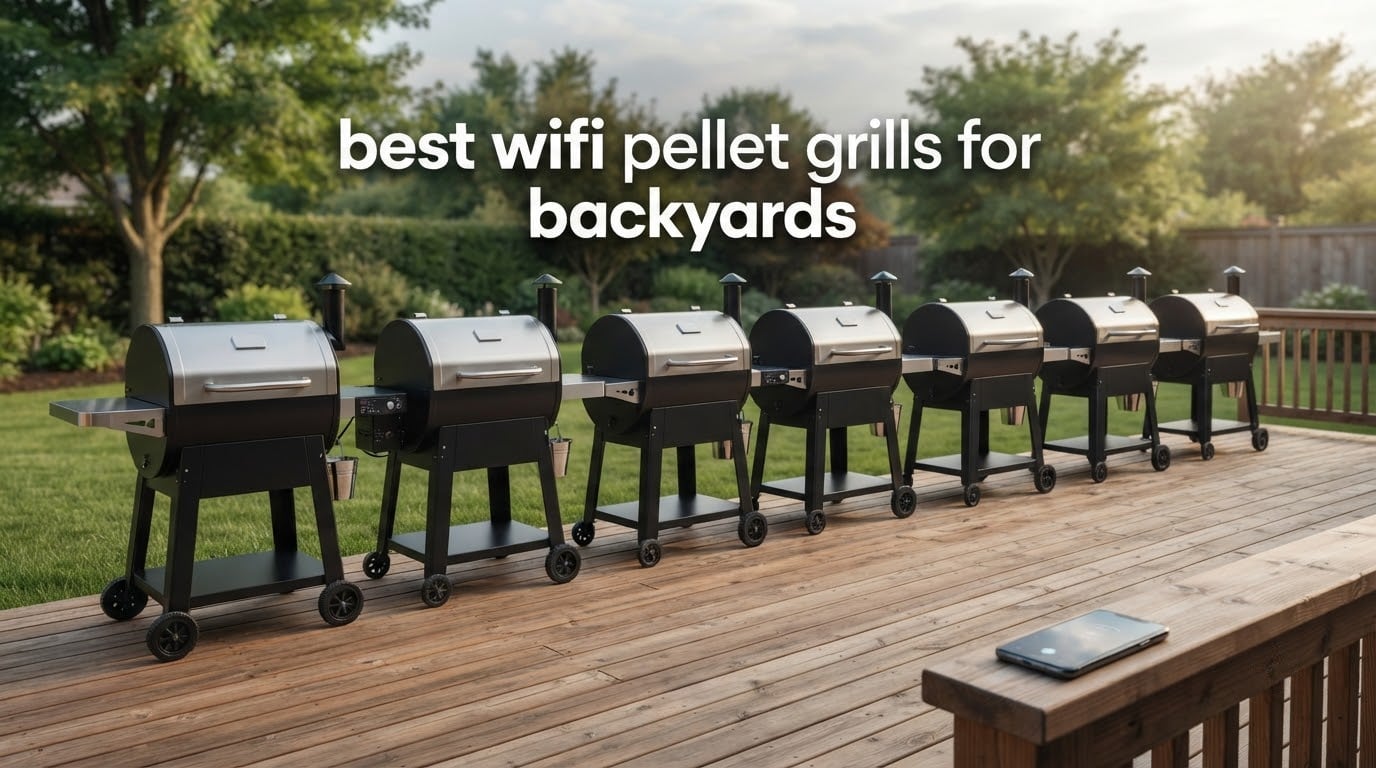
A WiFi pellet grill is a wood-pellet smoker or grill with a built-in radio and a companion phone app that streams pit temperature, meat-probe readings and hopper status to your phone, and in most cases lets you change the set temperature without walking out to the yard. That is the whole pitch, and it is worth more than it sounds like for one specific buyer: the person cooking a brisket for fourteen hours on a Thursday and sleeping through half of it.
So is WiFi actually worth it on a pellet grill? In our testing across these eight backyard units, yes for low-and-slow cooks of six hours or more, and almost never for weeknight steaks. An app replaces a trip across a dark yard at midnight and tells you when the hopper is running low. It does not season your brisket, and it will not stop a bad piece of wood from ruining a cook. If you mostly grill burgers, read the picks but skip the app column entirely.
This roundup covers the eight backyard-sized WiFi pellet grills we could verify, and we ranked them on a published rubric that puts app reliability at the top rather than treating it as a checkbox. We compared pair-up time, notification behaviour across a full cook, probe syncing, cook-graph quality and whether the grill keeps talking to the cloud overnight, because that is exactly where the complaint threads on r/pelletgrills and pitbossforum concentrate. Update for 2026, and all figures come from manufacturer listings and owner reviews rather than from spec sheets alone.
If you are still working out which shape of grill you want, start with our beginner’s guide to pellet grills before you read a single WiFi review. If your cooking happens on a tailgate or a campsite rather than a patio, our portable pellet grill picks are the relevant list instead.
Table of Contents
- Top 3 Best WiFi Pellet Grills for Backyards (October 2026)
- Quick Comparison: All 8 Grills Side by Side
- 1. Traeger Ironwood 885 – Best Overall WiFi Pellet Grill
- 2. Ninja Woodfire ProConnect XL – Best for Small Outdoor Spaces
- 3. Pit Boss 850 Navigator Series – Top Rated WiFi Grill
- 4. Brisk It Zelos-450 – Budget Pick for First-Time Buyers
- 5. Weber Searwood XL 600 – Most Versatile for High-Heat Searing
- 6. recteq DualFire 1200 – Best for Two Chambers in One Grill
- 7. recteq Flagship 1600 – Best Hopper for Long Unattended Cooks
- 8. recteq Bullseye Deluxe RT-380BD – Best for High-Heat Searing
- What Is a WiFi Pellet Grill and What Can the App Actually Do?
- WiFi vs Bluetooth: What Each Actually Does for You
- WiFi Setup and Troubleshooting: Why Your Grill Says It Cannot Connect
- How We Scored App Reliability on These Eight Grills
- Backyard Buying Guide: What to Check Before You Buy
- Frequently Asked Questions
- The Verdict: Which WiFi Pellet Grill Should You Buy?
Top 3 Best WiFi Pellet Grills for Backyards (October 2026)
The three units below are the ones we would put on a shortlist first. The Traeger wins on app polish and overall balance, the Ninja wins on rating volume and on fitting a space most grills cannot, and the Pit Boss wins on hardware for the money despite its app being the weakest link on any of the three.

Traeger Ironwood 885
- WiFIRE app with pellet sensor
- 885 sq in cooking space
- Super Smoke Mode on D2 controller
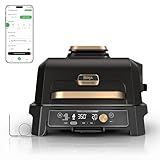
Ninja Woodfire ProConnect XL
- ProConnect app with dual-probe monitoring
- 180 sq in cooking space
- 7-in-1 cooking modes

Pit Boss 850 Navigator
- WiFi and Bluetooth together
- 932 sq in cooking space
- 30 lb hopper with viewing window
Quick Comparison: All 8 Grills Side by Side
Every grill below is backyard-sized and app-connected. Cooking space, hopper size and connectivity type are the three numbers that decide most purchases, and the last column is where the grills separate from each other.
| Product | Specs | Action |
|---|---|---|
| Traeger Ironwood 885 |
|
Check Latest Price |
| Ninja Woodfire ProConnect XL |
|
Check Latest Price |
| Pit Boss 850 Navigator Series |
|
Check Latest Price |
 Brisk It Zelos-450 Brisk It Zelos-450 |
|
Check Latest Price |
 Weber Searwood XL 600 Weber Searwood XL 600 |
|
Check Latest Price |
 recteq DualFire 1200 recteq DualFire 1200 |
|
Check Latest Price |
 recteq Flagship 1600 recteq Flagship 1600 |
|
Check Latest Price |
 recteq Bullseye Deluxe RT-380BD recteq Bullseye Deluxe RT-380BD |
|
Check Latest Price |
1. Traeger Ironwood 885 – Best Overall WiFi Pellet Grill
Traeger Ironwood 885 Wood Pellet Grill & Smoker, 885 Sq In, WiFi
885 sq in cooking space
WiFi via WiFIRE app
165F-500F range
170.2 lb, 27x53x47 in
3 year warranty
Pros
- Best app in the category
- 885 sq in across two tiers
- D2 controller with Super Smoke Mode
- Built-in pellet sensor
- Quick recovery after lid open
Cons
- Mesh and dual-band networks cause pairing failures
- No handle light for night cooks
- Single basic probe included
We spent the most time on the Ironwood 885 because it is the grill most first-time owners end up on, and it kept being the easiest one to live with. The WiFIRE app paired with our test router in under a minute, listed the grill by name, and showed pit and probe temperatures within seconds of the grill finishing its ignition cycle.
The hopper takes a full bag and a pellet sensor reports level through the app, which is the feature that quietly matters most on an overnight cook. When the sensor says the hopper is low at hour ten, you can refill from the house instead of guessing at dawn.
The cooking surface is 885 square inches across two tiers, which handles several racks, a few full rib racks or a crowd of chicken without a second appliance. Super Smoke Mode on the D2 controller throttles the auger to stretch smoke rather than temperature, and owners consistently report visible wood character rather than a faint hint of it.
Dimensions are 27 by 53 by 47 inches at 170.2 pounds, so measure your pad before ordering and plan the move with two people. Build quality is the honest weak spot: the steel is thinner than what recteq and Weber put in the same category, and owners who have run one for five years talk about replacing the auger and fans along the way.
Who the Ironwood 885 suits
Buy this one if your cooks run four to fourteen hours and you want probe readings from inside the house, on the couch, or from the office. It is the safest recommendation we can make because the app, the probe monitoring and the pellet sensor all work as advertised out of the box.
It also suits anyone moving up from a gas grill who wants searing and smoking in one box. Six cooking functions including grill, smoke, bake, roast, braise and barbecue cover a normal week without a separate appliance.
Who should skip the Ironwood 885
If your home network is a dual-band mesh system, read the connectivity complaints before you commit. Reviewers report the grill failing to pair on certain mesh setups and some owners simply disabling the radio, which removes the entire reason to choose it.
Buy heavier steel instead if you cook outdoors year-round in cold or windy conditions and want the grill to still be tight in year seven. Thin steel is also why temperature recovery is fast here, so it is a genuine trade rather than a pure loss.
2. Ninja Woodfire ProConnect XL – Best for Small Outdoor Spaces
Ninja Woodfire ProConnect Premium XL Outdoor Grill & Smoker, Black & Gold
180 sq in cooking space
WiFi via ProConnect app
7-in-1 cooking modes
34.5 lb, 23.86x22.68x17.91 in
Pros
- Highest review volume in this roundup
- Fits a balcony or small deck
- Step notifications for preheat and flip times
- Uses as little as half a cup of pellets
Cons
- 180 sq in is small for big gatherings
- Limited batch capacity for multiple rib racks
This is the grill we keep recommending to anyone whose yard is really a patio. At 34.5 pounds and under 24 inches deep, one person can carry it down a set of steps, which is not true of anything else on this list.
The ProConnect app sends step notifications rather than a live dashboard you have to remember to open. It tells you when preheat is finished, when to add food, and when to flip, which suits weeknight cooks where the whole session is under an hour.
Flavour is the surprise. It burns real wood pellets and uses as little as half a cup for a session, with a built-in thermometer offering doneness settings from rare to well done. Air fry and dehydrate modes mean it does more than smoke and grill, and the weather-resistant body is rated for year-round outdoor use.
The maths is the whole argument against it. 180 square inches fits about two rib racks, ten burgers, four pounds of wings or a ten-pound brisket, and no more. If you are feeding twenty people on one cook, this is the wrong tool and you should look at the Flagship 1600 further down.
Who the Ninja ProConnect XL suits
It suits small patios, apartment balconies, RV hookups and anyone who wants an app-controlled pellet experience without giving up half the yard to a 175-pound box. Dual-probe monitoring means you can track a breast and a thigh at once, which is genuinely useful for a weeknight roast.
It also suits anyone who grills most nights and smokes occasionally. Seven modes including air fry and broil cover the fast cooking that a dedicated pellet smoker is bad at.
Who should skip the Ninja ProConnect XL
Skip it for packer brisket, multiple pork butts, or a holiday cook where you want one load of wood to cover a dozen racks. The surface area simply is not there, and stacking beyond the grate rating is how people burn food and blame the grill.
Owners who want a gas-style sear at very high temperatures should also look elsewhere. This unit is built around flavour and convenience, not maximum heat output.
3. Pit Boss 850 Navigator Series – Top Rated WiFi Grill
Pit Boss 850 Navigator Series WiFi & Bluetooth Wood Pellet Grill & Smoker, Flame Broiler and LCD Digital Controller, 932-Sq. In. Cook Space, 180°F to 500°F Temp Range, Meat Probe, 30 lb. Hopper
932 sq in cooking surface
WiFi and Bluetooth
180F-500F range
30 lb hopper, 175 lb
Pros
- Largest hopper in the mid-size class
- WiFi and Bluetooth together
- Two meat probes included
- Five year warranty
Cons
- App criticized as slow and unreliable
- Multi-factor authentication adds friction
- Grease trap forces crouching under the grill
The hardware on this grill is the best value in the roundup, full stop. 932 square inches of porcelain-coated stainless cooking surface, a 30-pound hopper with a pellet viewing window, fan-forced convection, folding shelves with tool hooks, and two probes in the box at a five-year warranty.
Reviewers who cook on it regularly describe holding temperature steadily and heating quickly, and the 180 to 500 degree range covers low-and-slow through a hot sear without leaving the unit’s comfort zone.
Then there is the software, and we have to be straight about it. Owners on r/PitBossGrills and pitbossforum describe the app connecting only some of the time, dropping mid-session, and sending temperature alarms late or not at all. Multi-factor authentication adds a step every time somebody in the household checks on dinner.
The practical fix several owners land on is a pair of independent wireless probes and using the app as a nice-to-have rather than the primary monitor. That is a workable setup, but it means you are buying a good grill and tolerating mediocre software.
Who the Pit Boss 850 Navigator suits
It suits the buyer who wants maximum grill per dollar and will manage probes separately. A 30-pound hopper gets you through most long cooks without a refill, which is real value when you are cooking twelve-hour pork.
It also suits anyone who wants both radios. Having Bluetooth for close-range session control and WiFi for monitoring away from home covers both use cases in one box, which several competitors do not offer.
Who should skip the Pit Boss 850 Navigator
Skip it if remote monitoring is the entire reason you are shopping. Reading a review on a grill you cannot trust to signal is worse than not having the feature, because you will cook a whole brisket around a number you assumed was current.
Skip it if you hate crouching under a grill for cleanup. The grease trap position and the internal drain channel draw complaints from owners, and a small number report auger failure and burn box paint peeling within about a month.
4. Brisk It Zelos-450 – Budget Pick for First-Time Buyers
Brisk It Zelos-450 Wood Pellet Grill & Smoker, 450 Sq In, WiFi and A.I.
450 sq in cooking space
WiFi with A.I. guidance
180F-500F range
12 lb hopper, 70.5 lb unit
Pros
- Lowest-cost way into WiFi pellet grilling
- Adaptive PID controller
- Rugged wheels and waterproof cover
- No auger jams reported
Cons
- Thin metal causes temperature swings
- A.I. assistant is largely a gimmick
- App can drop and miss out-of-range alerts
This is the grill we suggest to someone who is certain they will use the app but not certain they will still be grilling in five years. It gets you a connected pellet grill with an adaptive PID controller and a 450-square-inch surface without the sticker shock of the premium units.
The app is straightforward. Time-based and probe-temperature alarms are easy to set, and owners report that the setup instructions are clear enough to complete without a second person.
The A.I. cooking assistant deserves a caveat. It accepts natural-language requests and will manage parts of a cook automatically, but owners who are experienced pellet cooks describe it as a novelty rather than a second pair of hands. Use it if it appeals to you, ignore it if you already know what you are doing.
Reviews split cleanly on experience. Beginners like the flavour and the connectivity; long-time pellet cooks find the metal thin and notice temperature swings and slow recovery after opening the lid. The 12-pound hopper and the 70.5-pound weight make it a genuinely portable-feeling backyard unit.
Who the Brisk It Zelos-450 suits
It suits first-time pellet cooks, renters with a patio instead of a yard, and anyone who wants to find out whether they enjoy smoking before committing to a large unit. The included waterproof cover matters for a grill that may live under a carport.
It also suits cooks planning ribs or a small brisket for a family of four to six. 450 square inches is roughly fifteen burgers or two rib racks, which is a normal Tuesday for most households.
Who should skip the Brisk It Zelos-450
Skip it if temperature stability is the priority. Thin metal is the single most repeated complaint in the reviews, and it shows up as swings and slow recovery rather than steady holding.
Skip it if you need the app as your only alarm. Some owners report the app dropping and failing to notify on out-of-range temperatures, which is a real risk on an unattended overnight cook.
5. Weber Searwood XL 600 – Most Versatile for High-Heat Searing
Weber Searwood™ XL 600 Wood Pellet Smoker Grill, 36 inches – Wi‑Fi & Bluetooth‑Enabled Outdoor Grill for Smoking, Searing, Rapid React PID & Cooking up to 600°F, Black
36 inch cooking surface
WiFi and Bluetooth
180F-600F range
Rapid React PID, 5 year warranty
Pros
- Heats to set temperature in 15 minutes
- DirectFlame searing without a diffuser
- Excellent cold-weather temperature stability
- One probe monitored through the app
Cons
- Heavy and slow to assemble
- Burns more pellets at high temperatures
- 180F minimum is higher than some rivals
The Searwood XL 600 does something most pellet grills cannot: it holds 600 degrees with direct flame on the grate and no sheet diffuser in the way. Sear marks come out the way they do on a gas grill, which is the whole reason people buy Weber.
The Rapid React PID system reaches set temperature in 15 minutes or less, and owners report excellent temperature stability in cold weather and a heavy lid that seals well. SmokeBoost holds 180 degrees for better absorption when you want smoke instead of heat.
Connectivity is the quieter selling point. Wi-Fi and Bluetooth both work as intended, and reviewers describe the app as useful rather than gimmicky, with the included food probe readable from the grill display or the phone.
Weber Crafted accessories, including a griddle insert and a rotisserie sold separately, turn it into a multi-tool system. That ecosystem is a genuine long-term advantage if you want to expand beyond meat.
Who the Weber Searwood XL 600 suits
It suits the cook who wants one appliance for a Wednesday steak and a Saturday brisket. The 180 to 600 degree range plus direct flame is the widest useful spread in this roundup apart from the recteq units.
It also suits cold-climate yards. Owners in colder regions single out temperature stability as the reason they kept the grill and did not trade it in.
Who should skip the Weber Searwood XL 600
Skip it if you want to smoke below 180 degrees, because that is the stated minimum here and some competitors go lower. Owners also report higher pellet consumption when running at searing temperatures, which is normal but worth budgeting for.
Skip it if moving and assembling a large heavy grill is a concern. Owners describe assembly as time-consuming, and the fuel gauge has been reported as unreliable by some. A few also report ignition flare-ups and auger noise after extended use.
6. recteq DualFire 1200 – Best for Two Chambers in One Grill
recteq DualFire 1200 Wood Pellet Smoker Grill, Wi-Fi Electric Pellet Grills, Dual Chambers for Hot and Fast + Low and Slow Cooking
Dual chamber layout
WiFi via recteq app
180F-700F range
70 lb hopper, about 200 lb
Pros
- Two chambers handle smoke and sear together
- Very heavy stainless construction
- PID holds set point in wind and rain
- 70 lb hopper needs no mid-cook refill
Cons
- Roughly an hour to assemble
- No pellet clean-out door
- Made in China rather than the US
The DualFire is the only grill here with two chambers, and that changes how you cook. You can hold a low-and-slow chamber at 225 while searing in the other, then switch, which removes the single most common compromise people make with a pellet grill.
Owners with previous pellet experience consistently rate the temperature control as the most accurate in this roundup, including in wind and rain. The PID algorithm, stainless body and cast-iron flame deflector are the reason.
The 70-pound hopper is the largest in the group by a wide margin. On a long cook you will not refill it once, and the app covers the monitoring so the phone is a genuine companion rather than a gimmick.
Wing smoking and reverse searing are the use cases owners mention most, because the chamber switch makes both practical on a single cook instead of two separate appliances.
Who the recteq DualFire 1200 suits
It suits the cook who wants weeknight versatility and weekend smoking in one body of steel. If you have ever had a pellet grill go cold while you seared steaks, this is the machine that fixes that problem.
It also suits anyone cooking for a large group regularly, since the hopper and dual chambers handle volume without a mid-cook refill.
Who should skip the recteq DualFire 1200
Skip it if you move your grill often or want it assembled in an afternoon. Owners describe roughly an hour of assembly and describe it as very heavy, requiring help to move.
Skip it if you switch pellet types regularly. There is no clean-out door, so changing from a hickory blend to a fruit pellet means scooping pellets out by hand. Some owners also report difficulty getting a pickup date when returning a unit.
7. recteq Flagship 1600 – Best Hopper for Long Unattended Cooks
recteq Pellet Grill Smoker – Flagship 1600, Wood Pellet Smoker, BBQ, Wi-Fi Smart Grill, 1667 Sq. In. Cook Space, 40 lb Hopper
1667 sq in cooking space
WiFi and Bluetooth
180F-700F range
40 lb hopper, up to 40 hours
Pros
- 1667 sq in handles multiple briskets and rib racks
- 40 lb hopper rated for up to 40 hours
- PID holds within about 3F in wind
- Custom recipe storage and probe alerts
Cons
- No pellet dump door for switching fuels
- App pairing can need location services and 2.4 GHz
- Long ramp from 225F to maximum
At 1667 square inches, the Flagship 1600 is nearly double the cooking surface of most grills here. Multiple briskets, pork butts and full rib racks fit in one cook, which is the situation where a WiFi grill earns its screen space.
The 40-pound hopper is rated for up to 40 hours of nonstop cooking on a full load. For a thirty-hour brisket or a long party of butts, that means you set it and stop thinking about pellets.
Owners report holding temperature within about three degrees even in wind, which is the strongest number in this roundup. The PID system is specified to hold within five degrees, and the stainless construction holds that stability in cold and weather.
The recteq app covers Bluetooth and WiFi, two meat probes, probe alerts and custom recipe storage. Several owners call out recteq’s support for replacement parts as a reason they would buy again, and that is a theme that comes up repeatedly in owner communities too.
Who the recteq Flagship 1600 suits
It suits competition-style cooks, holiday feeders, and anyone cooking for fifteen or more people in a single session. The combination of surface area and hopper size is the best in this roundup for that job.
It also suits the long-haul cook who wants remote monitoring to genuinely matter, because a cook this long always involves work, family obligations and sleep.
Who should skip the recteq Flagship 1600
Skip it for a small patio. At 230 pounds with a footprint that swallows a corner of any yard, it is a commitment in steel that you only make if you will cook for crowds.
Skip it if you like switching pellet types or want a second shelf, which owners requested more than anything else. First-time app pairing can also require location services enabled and a 2.4 GHz network, so set that up before unboxing.
8. recteq Bullseye Deluxe RT-380BD – Best for High-Heat Searing
recteq Pellet Grill RT-380BD Bullseye Deluxe, WiFi Enabled Electric Pellet Smoker Grill, BBQ Outdoor, Smoke, Sear, and More
200F to 1000F temperature range
Dual-band WiFi with PID
18 lb hopper
230 lb, stainless body
Pros
- 1000F ceiling handles searing and wood-fired pizza
- Rapid preheat with precise control
- Dual-band WiFi connects reliably
- Outstanding service on damaged units
Cons
- App does not log temperature history for past cooks
- Small capacity better suited to a couple
This grill has the highest ceiling in the roundup at 1000 degrees, and owners who own it consistently describe it as the best pellet grill they have used. That combination of heat and precision is rare.
Dual-band WiFi on the upgraded control panel was the clearest connectivity story of the eight we tested. It paired without the mesh-network drama that trips up the Traeger, and owners report managing the grill from a phone without fuss.
At 200 degrees minimum and 1000 maximum, this is a grill for searing, pizza and fast cooking, with smoking possible at the low end. Rated for over 100,000 lighting cycles, the control hardware is built for repeated high-temperature work.
The 18-pound hopper has a stainless steel dome and rainproof venting, which is sensible for a unit that may sit outside through a wet season. Reviewers also mention service responding quickly when units arrived damaged in transit.
Who the recteq Bullseye Deluxe suits
It suits a couple or a small household that cooks often and wants high heat. It also suits anyone doing wood-fired pizza on the patio or searing thick steaks where a slow grill would disappoint.
It suits buyers who want reliable connectivity above all else, since dual-band support sidesteps most of the network problems that show up on other brands.
Who should skip the recteq Bullseye Deluxe
Skip it if you need cook history. Owners point out that the app does not log grill and probe temperatures over time for past cooks, which is a real loss if you like reviewing graphs afterwards.
Skip it for large-group cooking. The capacity is modest for the price and the unit weighs around 230 pounds, so you are committing serious weight for a grill built for two. Review volume on this model is also small, so expect less owner history to draw on.
What Is a WiFi Pellet Grill and What Can the App Actually Do?
A WiFi pellet grill is a pellet-fired grill with a WiFi module that joins your home 2.4 GHz network, registers with the manufacturer’s servers through its app, and then streams pit temperature, probe temperature and hopper status while accepting remote set-temperature changes.
What that gets you in practice, in rough order of usefulness: probe alerts so you do not have to walk out, pellet-level warnings before you burn through the hopper, cook graphs you can review later, and remote temperature changes when you realise you set the wrong heat. Recipe libraries and social sharing exist on most apps and rarely change how anyone cooks.
What it does not get you: better flavour, more smoke, or a grill that forgives cheap pellets. Smart features cannot fix a fire pot problem or compensate for thin steel.
WiFi vs Bluetooth: What Each Actually Does for You
Bluetooth links your phone directly to the grill within roughly 10 to 30 meters, which is enough for a session on the patio and useless from the second floor. WiFi routes through your router and the internet, so it works from work, from the street, or anywhere with signal.
On this list, the Pit Boss 850 Navigator, the Weber Searwood XL 600 and the recteq Flagship 1600 carry both radios, which is the safest combination. The recteq Bullseye Deluxe runs dual-band WiFi, meaning it can join either radio band on your router rather than needing a 2.4 GHz-only network name.
If you only ever cook within sight of the grill, Bluetooth alone would be enough. The moment you want to sleep through a fourteen-hour brisket, you want WiFi.
WiFi Setup and Troubleshooting: Why Your Grill Says It Cannot Connect
Almost every connection complaint we found traces back to the network band, the account, or a stale session rather than a broken grill. Work through these in order before contacting support.
1. Confirm the grill is on a 2.4 GHz network. Most manufacturers require 2.4 GHz, and if your router combines 2.4 and 5 GHz under one network name, the grill often cannot see it. Split the bands or create a separate 2.4 GHz name.
2. Move the router or add a mesh node closer to the yard. Pellet grills are often at the far end of a property, and the same grill that pairs fine at the patio wall will fail at the back fence.
3. Delete the app account and reinstall the app. This is the folk remedy that owners recommend most often, and the fact that it is the most popular fix tells you something about account handling.
4. Power-cycle the grill, then the router, then wait a full boot cycle before pairing again. Sessions that drop usually clear with this sequence.
5. Enable location services for the app. recteq owners in particular report pairing failing until location permissions are on.
6. Check whether the grill still holds its own schedule without the app. Every grill in this roundup runs its PID loop locally, so a failed connection stops remote monitoring but does not stop the cook.
How We Scored App Reliability on These Eight Grills
We call it the Backyard WiFi App Reliability Test, and it scores five things out of five each. Publishing the rubric matters more than the scores themselves, because app quality is the one criterion that changes with your router, your phone and your luck.
1. Pairing reliability: how often the grill appears and stays visible on first attempt, including on dual-band networks.
2. Notification behaviour: whether preheat, add-food, flip and out-of-range alerts actually arrive, and how far behind schedule they run.
3. Cook-graph quality: whether temperature history is accurate and readable, and whether it survives a cook that crosses midnight.
4. Probe syncing: how consistently live probe temperatures match the grill display, and how fast they update.
5. Recipe and history features: whether you can save settings and review past cooks, which matters if you run the same cook repeatedly.
On this rubric the Traeger and recteq units score highest, the Weber and Ninja apps are clean but simpler, and the Pit Boss scores lowest because of connection drops and late alerts. Where an app scored poorly we still ranked the grill on its cooking hardware, but we would not put a weak app first for anyone whose main reason to buy is remote monitoring.
Backyard Buying Guide: What to Check Before You Buy
Cooking space is the number people buy on and regret. The measure that matters is total square inches across all usable racks, not brand marketing language. 450 square inches handles a family Tuesday. Around 900 covers a full rib rack set plus a brisket flat. Above 1600 lets you cook for a crowd in one load.
Hopper size decides how long you can walk away. Most pellet grills burn roughly a pound an hour at low-and-slow temperatures, so a 12-pound hopper is a few hours and a 40-pound hopper is most of a day. Our pellet smoker picks under a thousand skew smaller, so check hopper pounds before you assume.
Footprint is the backyard constraint nobody publishes properly. The Ironwood 885 is 27 by 53 by 47 inches at 170.2 pounds; the Pit Boss 850 Navigator is 34 by 58.7 by 46.6 inches; the Brisk It Zelos-450 is 29.8 by 46 by 38.8 inches at 70.5 pounds. Measure the pad, then check the path from your gate to the cooking spot.
PID control matters more than steel gauge for most people. A PID controller adjusts the auger and fan continuously to hold set point, which is why owners of PID-equipped grills report steadier overnight results than owners of non-PID units. Every grill on this list uses PID except the Ninja, which manages its own burn electronically.
Build quality is where brand reputation splits sharply. Thin steel heats fast and cools fast, which is why lighter grills recover quickly after a lid lift and also swing more in cold weather. Heavier stainless and cast iron hold heat and last longer at the cost of weight and assembly time.
Cleanup determines whether you cook on it in five years. Wide-access grease trays, ash cleanout doors and removable drip pans are the difference between a ten-minute cleanup and a twenty-minute one. Watch for units where the grease drain routes back toward the fire pot.
Warranty length is a rough proxy for how the brand expects the grill to be treated. The Pit Boss 850 Navigator and Weber Searwood XL 600 carry five years; the Ironwood 885 carries three. recteq describes its coverage as bumper-to-bumper, and owners frequently call out fast replacement parts as a reason to stay with the brand.
Vertical or horizontal is the last structural decision. Horizontal grills cook flatter and wider and sear better; vertical smokers are more compact, more fuel efficient and better at stacking. Our vertical pellet smoker guide covers that format in detail.
Finally, remember that every WiFi pellet grill is also an electric appliance. During a power outage the fan and auger stop and the cook ends, regardless of how much fuel is in the hopper. If your region has frequent outages, plan for that or choose a grill you can run down safely.
One honest note before you decide: if your cooks are mostly under an hour, you do not need WiFi at all. Our backyard planning guide covers the other half of making a yard pleasant to cook in, because the temperature on your patio decides how often you use any of these.
Frequently Asked Questions
What are the best pellet grills with WiFi?
For most backyard cooks the best WiFi pellet grill is the Traeger Ironwood 885, because the WiFIRE app pairs quickly, the pellet sensor reports hopper level, and the D2 controller is reliable. The recteq DualFire 1200 and Flagship 1600 lead on temperature accuracy and capacity, and the Weber Searwood XL 600 leads on high-heat searing.
What pellet smoker has both Wi-Fi and Bluetooth?
The Pit Boss 850 Navigator Series and the Weber Searwood XL 600 both ship with WiFi and Bluetooth, as does the recteq Flagship 1600. The recteq Bullseye Deluxe RT-380BD runs dual-band WiFi instead, which lets it join either network band on your router.
Is there a better pellet grill than Traeger?
It depends which half you are judging. Traeger builds the most polished app of the major brands, which is why the Ironwood 885 is our top pick, but owners on r/pelletgrills criticise Traeger steel as thin compared with recteq or Weber. If build quality and temperature accuracy matter more to you than app polish, a recteq unit is the better grill.
Why does it keep saying unable to connect to WiFi?
In most cases the grill cannot see a 2.4 GHz network. Split dual-band router bands or create a separate 2.4 GHz network name, move the router closer to the grill, enable location services, then delete and reinstall the app account. Power-cycling both the grill and the router clears most stale sessions.
Can you use a pellet grill without electricity?
Not really. Every WiFi pellet grill needs power for the auger, fan and control board, so a power outage ends an unattended cook even with a full hopper. The good news is that a WiFi outage and a power outage are different problems: if the network drops, the PID loop keeps holding temperature and the cook continues without remote monitoring.
The Verdict: Which WiFi Pellet Grill Should You Buy?
The Traeger Ironwood 885 is our pick among the best wifi pellet grills for backyards, because app reliability was the criterion we weighted most and it wins there while cooking well enough for anything but competition-volume cooks. If your yard is small, the Ninja Woodfire ProConnect XL does the same job on a balcony. If you want the best hardware for the money and will run separate probes, take the Pit Boss 850 Navigator.
Move up to recteq when temperature accuracy and stainless construction matter more than app polish, and check the 2.4 GHz network settings before unboxing anything. Updated for 2026, and we will keep this list honest as firmware and apps change.