
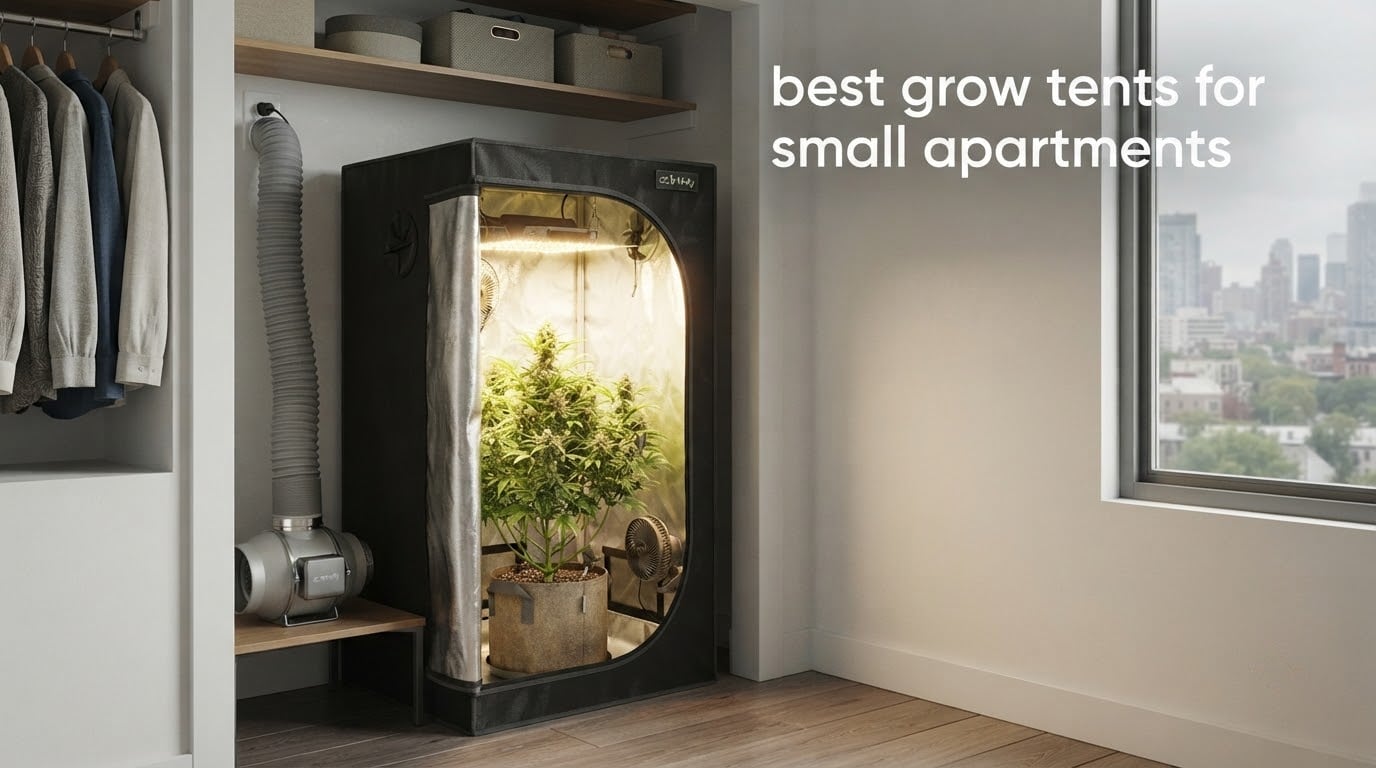
A grow tent is the one piece of equipment that makes indoor growing possible in a place you do not own. It contains the light so your hallway and your street-facing windows stay dark at 11pm, it holds odour and dust inside a defined box, and it gives your fan a sealed path to pull air through. Without one, a bright grow light in a rented flat announces itself to every neighbour who walks past the bedroom door.
That is why the best grow tents for small apartments are not simply the smallest tents. They are the tents whose footprint clears your closet door, whose external height leaves room for ducting, and whose seams and zippers actually seal. Get those three right and everything else is an ordinary buying decision.
How we picked: this ranking is built on published specifications plus the patterns in tens of thousands of owner reviews, not on a season of hands-on trials. Where we estimate something, such as usable grow height after your gear goes in, we tell you how we calculated it. I would rather you check a measurement yourself than trust a number we cannot stand behind.
Before the picks, here is the filter we applied to every tent in this guide. Score a candidate against all five and the list gets very short very fast:
Footprint versus closet depth. A standard bedroom closet is often 24 inches deep. A 24 x 24 tent fits with almost no clearance left for a door swing, so a 24 x 30 tent needs a corner or a walk-in closet instead.
External height plus ducting clearance. Add at least 6 inches above the tent for an inline fan and ducting bend, and 12 inches if you plan to hang a carbon filter up there.
Usable grow height after equipment. The number on the box is not the number you grow in. Subtract the lamp, the hangers and any reservoir and you lose roughly 28 inches of a rated height.
Light-spill risk. Seams, zipper baffles and port flaps decide this, not the denier number printed on the fabric.
Noise and vibration risk. The tent is rarely the problem. The pump, the fan and how they are mounted are.
If you want the short version before reading further: the compact apartment audio guides we publish deal with the same underlying problem we face here, which is fitting loud, hot equipment into a small room without disturbing the building. A grow tent solves the light half of that. For the sound half, keep reading.
Table of Contents
- Top 3 Best Grow Tents for Small Apartments (October 2026)
- Best Grow Tents for Small Apartments at a Glance in 2026
- AC Infinity CLOUDLAB 422: The Best Small Grow Tent Overall
- VIVOSUN S224 2×2: Best Value for a Closet Grow
- CoolGrows 2×2: Best for Airflow in a Warm Flat
- Spider Farmer 2.3×2.3: Best Frame Strength in a Compact Footprint
- Gorilla 2×2.5: Best Maximum Headroom, and the One to Skip in a Closet
- MARS HYDRO 2x2x3: Best for Low Ceilings and Shallow Spaces
- zazzy 2×2 Grow Tent: Best Budget Starter Tent
- VIVOSUN P224 PRO 2×2: Best Heavy-Duty Upgrade in a 2×2
- VIVOSUN Smart Grow Tent Kit 2×2: Best All-In-One Kit
- MELONFARM 24x16x24: Best for Countertops and Seed Starting
- What to Check Before You Buy a Grow Tent for an Apartment
- No-Drill Exhaust, Noise Control and Heat in a Small Apartment
- Frequently Asked Questions
- Bottom Line: Which Grow Tent to Buy in 2026
Top 3 Best Grow Tents for Small Apartments (October 2026)
Our three names carry the most weight in this guide. The AC Infinity CLOUDLAB 422 is the best overall build, the VIVOSUN S224 is the best value at its size, and the zazzy 2×2 is the lowest-cost tent we would hand to a beginner without hesitating.

AC Infinity CLOUDLAB 422
- 2000D canvas
- 1 in steel poles
- 150 lb hang weight
- 4 in and 6 in duct ports


Best Grow Tents for Small Apartments at a Glance in 2026
All ten tents below are 2×2-class or smaller, with two exceptions: the Spider Farmer sits at 2.3 x 2.3 feet and the Gorilla at 2 x 2.5 feet. Both are marked with their real footprint so you can measure before you commit.
| Product | Specs | Action |
|---|---|---|
| AC Infinity CLOUDLAB 422 |
|
Check Latest Price |
| VIVOSUN S224 2×2 |
|
Check Latest Price |
 CoolGrows 2×2 Grow Tent CoolGrows 2×2 Grow Tent |
|
Check Latest Price |
 Spider Farmer 2.3×2.3 Grow Tent Spider Farmer 2.3×2.3 Grow Tent |
|
Check Latest Price |
 Gorilla 2×2.5 Grow Tent Gorilla 2×2.5 Grow Tent |
|
Check Latest Price |
 MARS HYDRO 2x2x3 Advanced MARS HYDRO 2x2x3 Advanced |
|
Check Latest Price |
| zazzy 2×2 Grow Tent |
|
Check Latest Price |
 VIVOSUN P224 PRO 2×2 VIVOSUN P224 PRO 2×2 |
|
Check Latest Price |
 VIVOSUN Smart Grow Tent Kit 2×2 VIVOSUN Smart Grow Tent Kit 2×2 |
|
Check Latest Price |
 MELONFARM 24x16x24 Tent MELONFARM 24x16x24 Tent |
|
Check Latest Price |
AC Infinity CLOUDLAB 422: The Best Small Grow Tent Overall
AC Infinity CLOUDLAB 422, Advance Grow Tent 2×2, Thickest Poles & Mylar
2000D canvas
1 in steel poles
16 cu ft
150 lb hang weight
Pros
- Highest rated tent here
- 2000D canvas and 1 in poles hold heavy gear without flex
- SBS zippers with front flaps seal tightly
- controller mounting plate
- 4 in and 6 in duct ports
Cons
- Pricier than the entry-level mylar tents
- 2x2 floor holds about one 5 gallon plant
- heaviest unit at 9.1 kg
This is the tent I end up recommending to people whose real constraint is that they cannot drill, cannot run new cable, and cannot have a visible glow under a door at midnight. At 24 x 24 x 48 inches it drops into a standard 24-inch closet, and the 1-inch steel poles are thick enough that an inline fan and a lamp do not bow the bars.
Owners describe the light sealing as near-total, and that lines up with what I can see in the spec sheet: SBS zippers rather than commodity zips, front zipper flaps, and a lightproof controller mounting plate with a dedicated cable passthrough. The lab-tested mylar lining carries the highest reflectivity figure in this roundup, which matters a lot when your only real source is a single lamp in a closet.
The catch is weight and what you pay for it. At 9.1 kg it is the heaviest tent here, and moving it into a tight closet with a door that opens inward is a two-person job. The floor area is genuinely a single-plant footprint, so anyone planning four plants should look at the taller options further down instead.
On a 48-inch rated height, expect roughly 20 inches of usable grow space once the lamp, hangers and any reservoir are hanging. That is enough for basil, chives, lettuce and a compact ornamental, and it is tight for anything you intend to train upward.
Check the closet before you buy this one
A 24 x 24 tent in a 24-inch closet leaves about half an inch of depth slack, which is not enough for a hinged closet door opening inward to clear the tent face. In a sliding-door closet it works fine, and in a walk-in closet the extra space makes it the most comfortable setup in this guide.
Measure the ceiling height above the closet rod too. If the interior ceiling sits under 60 inches you need another 6 inches for the fan and a bend in the ducting, and that 60-inch number is the most common reason this tent disappoints people.
Why it beats the cheaper 2×2 tents
The difference is concentrated in two places: pole diameter and zipper grade. On cheaper tents, the seams are single-stitched and the zips are thin, so light finds the pinholes under a strong lamp. Double flaps and SBS zips close those paths.
If your apartment risk is light spill visible from a hallway, this is the pick. If your risk is budget, the next tent down does the job for less and most owners never notice the difference in daily use.
VIVOSUN S224 2×2: Best Value for a Closet Grow
VIVOSUN S224 2×2 Grow Tent 24″x24″x48″ High Reflective Small Mylar Tent
24 x 24 x 48 in
1680D-style canvas
100 lb bars
16 cu ft
Pros
- Highest reviewed tent in this roundup
- black-lined zippers contain light well
- tool-free assembly with metal top bars
- removable floor tray
Cons
- 2 ft width caps the canopy at a couple of small plants
- zipper-edge stitching can crimp when the door opens
- heavier fabric is stiff to pull on in tight rooms
With more than 33000 reviews at a 4.5 average, the S224 has more owner history behind it than any other tent here, and that is genuinely useful information. When tens of thousands of people describe the same behaviour, you can plan around it. They consistently report strong light blocking, fast tool-free assembly and a floor tray that slides out for cleaning.
Reddit growers treat Vivosun as the reference mid-range tent for a reason. One commenter in the r/microgrowery community puts it plainly: the tents are good, the bundled fans are not. That distinction matters if you are buying a standalone tent, and it matters a great deal if you buy the kit version further down.
The physical limits are the honest part of the story. A 2-foot width gives you room for a couple of small plants and not much else, and the extra weight of that canvas makes it awkward to dress in a closet where you are kneeling rather than standing. Owners also report light bleed at seams under a heavy lamp load, so patch any that shows up.
Usable grow height works out to roughly 20 inches, same as the CLOUDLAB, because both share the 48-inch rated height. The reflective mylar interior and the black-lined zips are doing the heavy lifting for light containment here.
Who should buy the S224
Buy this if your first grow is culinary herbs, leafy greens or ornamentals and you want one order that arrives complete enough to start. The floor tray and the observation window are the two features you will use every single week, and both are here.
Skip it if you plan to run a carbon filter heavy enough to matter for odour, or if you want more than one plant. At 100 pounds of hang weight the frame has less headroom than the CLOUDLAB or the Gorilla.
Where it loses to the CLOUDLAB
The gap is construction, not function. Metal top bars and black-lined zippers are a tier below SBS zippers with front flaps, and the single-stitched seams are the first place light escapes when a lamp is close to the fabric.
Also consider the P224 PRO in the same brand later on. It steps up to 2000D canvas and 22mm poles, which removes most of the reasons the S224 is a compromise.
CoolGrows 2×2: Best for Airflow in a Warm Flat
CoolGrows Grow Tent, 2×2 Feet Mylar Hydroponic Grow Tent with Obeservation Window and Floor Tray for Indoor Gardening Plant Growing (24″x 24″x 48″)
24 x 24 x 48 in
600D double-stitched
95 percent reflective
16 cu ft
Pros
- Numerous vent and ducting ports with drawstring covers
- 95 percent reflective lining
- PVC-free PEVA materials
- removable waterproof floor tray
Cons
- Zipper flap catches unless you hold it clear
- fabric frays at cut edges
- small 2x2 base runs warm
Heat is the quiet failure mode of small tents, and the CoolGrows is the pick if your flat gets warm. Reviewers repeatedly note that this 2×2 runs hot and that the port count is the reason it copes, with numerous vent and ducting ports fitted with drawstring covers and two crossbars plus a high top opening for filter mounting.
There is a second reason to like it in a rental: the materials are PVC-free PEVA, which matters more than most buyers realise. PVC off-gasses, and the same reviewers who praise reflectivity also praise the fact that this tent is built for apartment, condo and rented-space growing rather than a greenhouse.
Owners describe it as the best value tent in its class more often than not. The one handling tip that appears repeatedly is to run a finger ahead of the zipper so the light-blocking flap does not curl into the teeth, and to light the 2×2 footprint conservatively because heat rises fast in 16 cubic feet.
The frame is plain metal with no reinforced corners and no tool bag, so treat the 600D fabric as the weakest long-term point. Expect some fraying along cut edges at the door and windows over years of folding.
What to check before this one goes in a closet
Drawstring port covers are not light-tight. If your corridor is dark and your closet door is the only gap, plan on the patch-and-test routine in the buying guide rather than trusting the covers to seal.
Also confirm your closet rod is high enough that the tent can sit under it, or that you are willing to move the rod. Nobody mentions that step and everybody hits it.
Where the extra ports pay off
Extra ports let you run an intake low and an exhaust high, which is the whole point of a tent airflow design. In a small volume that vertical separation is worth more than a bigger fan, and port count is a bigger factor in a small volume than pole grade or denier.
If you also need a filter, pair it with a clip fan rather than a rigid-mounted inline fan, and check the frame’s flex under the load before you hang anything heavy.
Spider Farmer 2.3×2.3: Best Frame Strength in a Compact Footprint
Spider Farmer 2.3×2.3 Grow Tent, 28″x28″x63″ Indoor Plant Growing 2026 New
28 x 28 x 63 in
1680D Oxford
120 lb support
4 sq ft
Pros
- Thick hardened steel poles rated to 120 lb
- SBS zippers with flap and dual stitching
- 63 in height gives real vertical room
- cable pass-through and controller hooks
Cons
- 28 inch footprint is wider than a true 2x2
- observation window and ports are small for the chamber
- sits above the entry-level mylar tents
The Spider Farmer solves the problem that makes a 48-inch tent feel cramped. At 63 inches tall it yields roughly 35 inches of usable grow height once the lamp and hanging gear go in, which is the difference between a shelf of herbs and a plant you can actually train.
Build-wise it is a serious frame for a compact tent: 3x-thicker hardened steel poles with reinforced adapters supporting 120 pounds, 1680D waterproof Oxford canvas, and a diamond reflective mylar interior. The light sealing gets the SBS zipper plus flap plus dual stitching treatment, and owners describe it as near-complete.
The compromise is footprint. At 28 x 28 inches it is 4 inches wider and 4 inches deeper than a true 2×2, which pushes it out of a shallow 24-inch closet and into a corner or a walk-in closet. The 11.8-inch observation window and the duct ports also look small once you are inside a 28-inch-wide chamber.
Controller hooks and a dedicated cable pass-through keep the wiring tidy, which matters in a closet where a loose power strip on the floor is both a trip hazard and a spill risk.
Is 63 inches too tall for a rented room
Only if you forget the ducting. You need roughly 6 inches of clearance above the tent for an inline fan and a bend, so plan on about 70 inches of total interior height. Most standard ceilings clear that; a low-ceiling basement flat may not.
The payoff is close to the tallest usable grow space you can get in a compact footprint without going to a fixed 76-inch frame, which is the trade you are really making against the 2×2 units.
How it compares to the Gorilla for headroom
The Gorilla is 13 inches taller than this and rated for 300 pounds rather than 120, but its floor is 30 by 24 inches and it is far heavier to move. If your space is a corner with open floor, take the extra height; if it is a closet, this is the more manageable box.
Forum growers describe Spider Farmer as a decent middle option between the entry mylar tents and the heavy premium frames, which is exactly how it reads on the spec sheet.
Gorilla 2×2.5: Best Maximum Headroom, and the One to Skip in a Closet
Gorilla Grow Tent 2×2.5 Fixed Height Indoor Grow Tent, 6’6″ Tall, 1680D Canvas, 300lb Hang Capacity, All-Steel Frame for Hydroponics, Soil Grows, Carbon Filters, Inline Fans, Home Cultivators
30 x 24 x 76 in
1680D canvas
300 lb hang weight
30 cu ft
Pros
- Tallest tent here at 6 ft 6 in
- 19mm all-steel frame rated to 300 lb
- 1680D threaded canvas with reinforced stitching
- EZ View windows
Cons
- Fixed 76 in height will not clear every ceiling
- 30 x 24 in floor is larger than a true 2x2
- among the pricier standalone tents here
- heaviest frame to move
Nothing else in this roundup comes close on headroom. A 76-inch fixed height gives roughly 48 inches of usable grow space after a lamp, hangers and a carbon filter go in, and the 19mm all-steel frame is rated to hold 300 pounds of hanging equipment without the hollow-crossbar bowing that growers complain about constantly with lighter frames.
That frame rating is the reason to consider it at all. If you ever hang a filter and an inline fan up there, the 300-pound figure means you are not guessing. The 1680D threaded canvas is also substantially heavier than the other 2×2-class tents here, and the reinforced stitching and industrial-strength zippers show in the details.
Now the part that matters more in an apartment than in a grow room. The floor is 30 by 24 inches, so this is not a 24-inch closet tent, it is a corner tent. The height is fixed, which means no extension kit and no lowering, and at 76 inches plus fan clearance you need a room that can take it.
Owners consistently describe the vertical space as the reason to buy and the box size as the reason to hesitate. For herbs in a kitchen corner, that is a mismatch. For a tall plant in a room with an open corner, it is the most capable tent on this list.
Who should skip this tent
Skip it if your space is a bedroom closet. A 30-inch depth will not clear a standard 24-inch closet, and the fixed height rules out the low-shelf workaround that saves smaller tents. This is the tent people buy and then have to move because the room was smaller than the product page implied.
Also skip it if you will ever need to carry it up a stairwell. The all-steel frame is one of the heaviest things here to manoeuvre in a tight room.
How to make it fit an apartment corner
Treat the 30 by 24 inch footprint as a real piece of furniture. Clear the corner, keep the front door swing arc free, and leave a path to the closet or the window so you can service the tent without pulling it across the floor.
EZ View inspection windows let you check plants without breaking the photoperiod, which is more useful in a shared apartment than in a dedicated grow room where you can just open the door.
MARS HYDRO 2x2x3: Best for Low Ceilings and Shallow Spaces
MARS HYDRO 2x2x3 Advanced Grow Tent, 24″x24″x36″ Indoor Plant Growing
24 x 24 x 36 in
1680D canvas
12 cu ft
detachable tray
Pros
- Zipper flap plus heavy-duty zips give very little light bleed
- steel frame holds a 100W light and inline fan with no sag
- detachable floor tray with velcro corners
- tool-free pop-snap build
Cons
- Only 36 in tall
- no filtered active intake
- side exhaust ports sit low
- some minor corner pinholes
At 36 inches this is the shortest full-size tent in the roundup, and that is the entire point. If your ceiling is low, an over-door storage cube or a shallow hall cupboard, a 48-inch tent simply will not go in and this one will.
Despite the compact height the 1680D double-stitched Oxford canvas with dense diamond mylar is serious fabric, and there is a shade cloth layer between the zipper and the canvas specifically to block pinholes. One detailed review reported temperature holding near 80F with a 100W light, which is a useful data point for a 12 cubic foot chamber.
The honest limitation is that at 36 inches you have almost no vertical budget. Expect roughly 8 to 10 inches of usable grow height once a lamp and hangers go in, which is a propagation and micro-green space rather than a flowering space.
There is no active intake with filter support, only intake flaps, and the side exhaust ports sit low, which wastes the upper tent space. A few owners also report minor pinholes at the corners that the flap system does not fully close.
What fits in a 36-inch tent
Cuttings, seedlings, micro-greens, a single-rooted herb pot and a countertop tomato under a clip light all work. Anything you plan to top or run a SCROG net on does not, because there is no vertical room to lace into.
Detachable floor tray and double-layer viewing window are both genuinely useful for a propagation setup, and the pop-button corner adapters mean you can collapse the whole thing flat in under a minute between rounds.
When to choose this over a 48-inch tent
Choose it when the alternative is not buying one at all. People routinely stretch for a taller tent and end up in a spot with light spilling out of the sides because the fabric is bunched against a wall.
Choose a 48-inch tent when you have the height and want real growing space. The extra 12 inches of rated height is worth roughly 12 inches of usable height, which is the difference between a seedling tray and a plant with a stem.
zazzy 2×2 Grow Tent: Best Budget Starter Tent
zazzy 2’x2′ Grow Tent 24″x24″x36″ Hydroponic Mylar Growing Tent
24 x 24 x 36 in
600D canvas
110 lb frame
95 percent mylar
Pros
- Reflective mylar and double zippers hold light well with vents closed
- all-steel frame survives repeated assembly
- floor tray and tool bag included
- plenty of vent and cord ports
Cons
- Pinhole leaks around observation windows
- plastic frame joints and sliding crossbars
- mylar thinner than premium tents
- only 36 in tall
This is the lowest-cost tent in the 2×2 class on this list, and I would still put it in front of a first-time grower without hesitation. Owners repeatedly compare results to tents costing several times more and report identical yields with no leaks when the vents are closed.
The 95 percent reflective mylar lining and double-stitched 600D canvas do the containment work, and the all-steel poles rated to 110 pounds survive the repeated assembly and disassembly that moving flats always involve. Patented anti-rust reinforced adjustable connectors are a small detail that pays off in a humid closet.
Two weaknesses show up repeatedly. There are pinhole light leaks around the observation window panels, which matters if your closet faces a lit hallway, and the frame joints are plastic with top crossbars that can slide once covered. That is also why growers warn against inferring a safe hang load from steel poles alone.
At 36 inches tall, the same low-ceiling logic as the MARS HYDRO applies, and the mylar is slightly thinner than the premium-brand tents here.
Is this tent too small to be worth it
Not if your plants are herbs, greens or ornamentals. A 24 by 24 by 36 box on a shelf with a 20W to 40W light will keep a basil plant alive for months, and the whole setup stays light and easy to move.
It is too small for a flowering canopy. Be honest with yourself about plant count before you build a light and filter setup around it.
How to fix the window pinholes
Growers on Overgrow patch intake and exhaust leaks with cut-to-size carbon filter material, and the same offcut works on observation window pinholes. Lay it over the seam from the inside, then run the dark-room test described below before you keep the tent.
The sliding crossbars are the other fix worth making immediately: brace them with a short length of pole or a bar clamp so a hanging filter cannot walk them sideways.
VIVOSUN P224 PRO 2×2: Best Heavy-Duty Upgrade in a 2×2
VIVOSUN P224 PRO Grow Tent 2×2 Small Indoor Grow Tents 24″x24″x 48″
24 x 24 x 48 in
2000D Oxford
22mm poles
16 cu ft
Pros
- 2000D canvas and 22mm poles feel far sturdier than expected
- heavy-duty zips stitching and removable door
- high CFM support poles stop side flex
- clear lettered instructions
Cons
- Vents are small and few so humidity control needs a fan
- windows and zips still admit a little light
- some boxes have arrived missing support poles
The P224 PRO is the in-between step that the S224 leaves open. Same 24 x 24 x 48 footprint, but 2000D Oxford canvas on 22mm steel poles with load capacity quoted up to 400 pounds depending on model, and a removable door with a hook-and-loop side attachment instead of a fixed one.
Owners of the PRO line describe assembling the 2×2 alone in about 20 minutes in a closet, which matters if you are doing this in a space where you cannot easily get help. The package includes three hanging bars, four CFM-supporting poles that double as a scrog shelf, and a floor tray.
The weakness is ventilation. Owners report that the air vents are small and few, so humidity control basically requires an always-on fan, and that the viewing windows and heavy-duty zippers still admit a little light. Cable management slots for smart controllers and an external tool pocket are the small features that make a closet setup tidy.
There is also a quality-control note worth making: some orders have arrived with missing support poles. Check the bag against the parts list before you start.
When this beats the standard Vivosun
Buy the PRO when you intend to hang a real light, a fan and possibly a filter. The 22mm poles and the side-support poles exist to stop the frame flexing under that load, and the removable door means you can work on the tent without unloading the top bars.
Stay with the standard S224 if you are running a small light and nothing else, because the extra canvas and pole mass buy you very little in that scenario.
Is the 400 lb rating real
Treat it as a range, not a figure. The manufacturer quotes 150 to 400 pounds depending on model, so match the specific listing you are buying. Either way, spread the load across all the hanging bars rather than concentrating it on one.
The high CFM support poles are the part that changes day-to-day stability, since they brace the side walls that would otherwise bow inward when a filter is hung at the top.
VIVOSUN Smart Grow Tent Kit 2×2: Best All-In-One Kit
VIVOSUN Smart Grow Tent Kit 2×2, 1-Plant WiFi-Integrated Grow Kit System
Tent, 100W LED, 195 CFM fan and carbon filter
app controller
16 cu ft
Pros
- Everything needed in one box
- app control of light and fan with temp and humidity sensors
- heavy duty tent material with a strong zipper
- good value against buying pieces separately
Cons
- Controller has no humidifier or heater integration and limited trigger logic
- light will not dim below 25 percent
- bundled light fans blow warm air downward
- sensor readings only approximate
If your question is whether an all-in-one grow tent system exists, this is the direct answer. The box contains a 24 x 24 x 48 tent in 600D Oxford with high-reflective mylar, a 100W full-spectrum LED, a 4-inch AeroZesh G4 inline fan rated at 195 CFM with an EC motor and PWM speed control, a carbon filter with prefilter, ducting, clamps, vent covers, a trellis net, five-gallon grow bags, pruning shears, twist ties and hangers.
The GrowHub E42A+ app controller with temperature and humidity sensors is the reason to buy it as a set rather than piecemeal. Owners consistently call the all-in-one value hard to beat and praise the app-based setup.
It is also the heaviest package in this roundup at 38.5 pounds, so plan how it gets into a closet. The recurring gap buyers report is climate-control granularity: the controller has no integrated humidifier or heater, limited automation trigger options, and the light will not dim below 25 percent, which stays bright for shade-loving plants.
Two more honest notes: the bundled light fans push warm air downward rather than drawing it up, and the sensors are approximately accurate rather than precise. Growers consistently rate bundled fans as the weakest part of any kit, so swap it if you care about noise.
Who should buy the kit instead of pieces
Buy the kit if this is your first setup, if you want one delivery instead of five, and if you would rather spend your time learning plants than learning ducting. The trellis net and the grow bags in the box are the details that make a first grow go smoothly.
Buy pieces instead if you already have a fan and a filter you trust, or if you want a specific light spectrum. A kit is a convenience purchase, and you pay part of the convenience in flexibility.
How it compares to the bare tents
Against a standalone tent you get the 100W light, the 195 CFM fan, the carbon filter and the controller in a single delivery, and most buyers find that undercuts buying the same pieces separately. The trade is 600D canvas rather than 1680D or 2000D, and a light that will not dim low.
Against the Spider Farmer or the Gorilla you give up frame mass and hang rating. If your plan is herbs and greens, that is a good trade. If your plan involves heavy hanging equipment, it is not.
MELONFARM 24x16x24: Best for Countertops and Seed Starting
Pros
- Smallest and lightest footprint here at 1.43 kg
- material is sturdy for the size
- two transparent observation windows
- tool-free install and holds humidity
Cons
- Fabric and zips a step below Vivosun quality
- light leak around view and vent ports
- poorly illustrated instructions and missing poles reported
- internal dimensions run small
At 24 x 16 x 24 inches and 4 cubic feet, this is the smallest tent here by a wide margin, and it is the only one sized for a countertop rather than a closet. It is designed around an AeroGarden-style tower, and at 1.43 kg you can carry it between rooms one-handed.
It also sits at the top of the Amazon Grow Tents category ranking with more than 2500 reviews. For seed starting and micro-greens, most people do not need a 16 cubic foot box. The 600D double-stitched canvas with reflective waterproof lining holds humidity well, and two transparent windows let you watch seedlings without opening the door.
This is the lowest-rated tent in the roundup at 4.3, and the reasons are consistent. Fabric and zippers are a step below Vivosun quality with reports of snagging, some light leaks around the velcroed viewing and vent ports, and instructions that are poorly illustrated. Some boxes have also arrived with missing poles.
Check the internal dimensions rather than trusting the listed ones, because several owners report the usable space running smaller than advertised. At 24 inches tall there is no room for anything above seedling stage.
What to grow in a 4 cubic foot tent
Seedlings, cuttings, micro-greens, a single-rooted herb pot and a small salad bowl under a 20W to 40W light. That is the honest list, and for those crops the footprint is the feature rather than a compromise.
It also works as a hardening-off chamber or a quarantine box before plants move to a bigger tent or a windowsill, which is a use almost nobody thinks of at purchase time.
When to spend more instead
Move up the moment you want a plant with a real stem. Every 2×2 in this guide has roughly one and a half times the floor area of this tent and four times the volume, and the jump from 4 to 16 cubic feet is the jump from propagation to growing.
It collapses flat enough to slide into a drawer between seasons, which is worth something in a flat where storage space is the scarcest resource of all.
What to Check Before You Buy a Grow Tent for an Apartment
Measure first, and measure four things. The width and depth of your closet floor with the door open at its widest, the interior ceiling height, the clearance above the closet rod, and the distance from the nearest window. Everything else in this guide depends on those numbers.
Then subtract the equipment. Our rule of thumb, which matches what experienced apartment growers report, is that usable grow height lands about 28 inches below the rated height. That puts a 48-inch tent at roughly 20 inches of real growing space, a 55-inch tent at 27 to 30 inches, and the 76-inch Gorilla at around 48 inches.
Canvas denier: what it tells you and what it does not
Denier is thread weight, not a light-proofing rating. 600D Oxford is thin and light and fine for propagation tents, 1680D is the workhorse middle, and 2000D is what the AC Infinity CLOUDLAB 422 and the VIVOSUN P224 PRO use. Heavier canvas resists tears and feels substantial, but two tents with the same denier can seal very differently.
What actually determines light-proofing is seam construction, zipper grade and flap coverage. A double-stitched seam with an SBS zipper and a front flap beats a single-stitched seam with a commodity zip every time, and the MARS HYDRO goes further with a shade cloth layer between the zipper and the canvas specifically to block pinholes.
Ports, hang weight and the wattage that matches
Duct ports move air. Cord ports run cable. Running a power cable through a duct port is the most common reason a well-built tent leaks, so use the lightproof controller mounting plate or cable passthrough the tent provides, and seal the duct port with its flap and drawstring.
On hang weight, do not infer a safe load from the presence of steel poles. Published ratings in this roundup run from 100 pounds on the VIVOSUN S224 to 300 pounds on the Gorilla, and hollow cross-bars that bow under a carbon filter are a recurring complaint in the forums. Spread the load across every bar you have.
Match light to floor area rather than to the room. Roughly 100W to 150W covers a 2×2 and 200W to 300W covers a 2×4. Overpowering a 16 cubic foot box is the fastest way to cook a small tent, and the CoolGrows and MARS HYDRO reviews both warn about it.
The three-step dark-room light-leak test
Do this inside your return window, not weeks later. Assemble the tent in the dark, put your light in its normal position, close everything, then wait the length of a photoperiod and look from the hallway with your own eyes.
Next, run your hand along every seam, zipper and port flap while the light is on. Pinholes you cannot see in daylight become obvious against a lit interior, and this is where the 600D tents with window pinholes give themselves away.
Finally, patch anything you find from the inside with offcut filter material before you reassemble. Growers on Overgrow use exactly this material on intake and exhaust leaks, and it works the same way on a window seam.
No-Drill Exhaust, Noise Control and Heat in a Small Apartment
Renters cannot drill, so plan the exhaust path before you buy the fan. The four-step method below needs no tools and no wall damage, and it is the technique apartment growers describe on GrowDiaries and Overgrow.
First, lift the closet door off its hinges. It takes minutes with a screwdriver and it turns a sealed closet into a vented one.
Second, hang two overlapping tarps or blackout curtains inside the door frame, overlapping enough that light cannot pass the seam. Third, cut a hole in one tarp for a 4-inch duct and run the exhaust hose through it to a window, or simply into the room where the air is already moving. Fourth, leave the bottom of the tent open to the room for passive intake so air completes a full path rather than short-circuiting.
Match fan size to volume. A 4-inch inline fan moving 100 to 200 CFM handles a 2×2 or 2×3 comfortably, and the kit further up includes a 195 CFM fan as a working reference point. One full air exchange per minute is the working target for a tent in a warm room.
Keep the noise out of the building, not just the tent
Canvas thickness is not a sound rating. The pump, the fan, the mounting method and the room surfaces dominate, and a heavy 2000D tent with a fan clamped rigidly to the frame can be noisier than a 600D one with the same fan hung on bungee cords.
Bungee-suspend the inline fan from the top bars rather than clamping it rigidly to a pole. Foam-pad the air pump and never set an unshielded pump directly on a hard floor inside the tent, because the vibration travels through the frame and into the floorboards. This is the same principle behind our soundproof curtain guide for NYC apartments, where soft surfaces rather than thicker equipment do the work.
Low-frequency hum is a different problem from fan whine, and if the thump is what travels downstairs, the apartment subwoofer guide covers how structure-borne vibration behaves through building floors. The short version: isolate the source, do not try to out-volume it.
Heat, leases and the practical limits
Above roughly 80F inside the tent, growth stalls and a portable air conditioner becomes a real cost. Small tents are less forgiving than large ones because air volume is low, which is exactly why the port-rich tents earn their place in a warm flat. Aim to keep reservoir water between 65F and 75F if you are running hydroponics.
Two practical cautions. Read your lease and ask your landlord before you set up, because odour and electrical load are the two things that actually generate complaints. And keep the smoke detector clear and your exit route unobstructed, since a tent in a hallway closet can narrow an escape path.
Frequently Asked Questions
Can a 2×2 grow tent fit in a standard apartment closet?
Yes, a 24 x 24 inch tent fits most standard 24 inch deep closets, but clearance is tight. A hinged closet door opening inward will hit the tent face, so a sliding door or walk-in closet is better. Leave at least 6 inches above the tent for an inline fan and ducting, and avoid a 30 inch deep tent such as the Gorilla 2×2.5 in a shallow closet.
What is better, AC Infinity or Vivosun?
AC Infinity is better for build quality: 2000D canvas, 1 inch steel poles, SBS zippers with front flaps and a lightproof controller mount. Vivosun is better for value at the same size tier, with the S224 holding a 4.5 rating across tens of thousands of reviews. Buy AC Infinity if light spill is your main worry, Vivosun if budget is.
Is there an all-in-one grow tent system available?
Yes. The VIVOSUN Smart Grow Tent Kit 2×2 includes the tent, a 100W full-spectrum LED, a 4 inch inline fan rated at 195 CFM, a carbon filter with ducting, and an app controller with temperature and humidity sensors. Kits like this usually leave a 600D canvas as the weakest component, and the bundled fan is the part most growers replace.
How hot is too hot inside a grow tent?
Consistently above 80F, growth slows and a portable air conditioner becomes necessary. Small tents are less forgiving because the air volume is low, so a 12 to 16 cubic foot box swings temperature faster than a 2×4. More and better-placed duct ports help more than a bigger fan, and powering a 2×2 above 150W makes it worse.
How do you ventilate a grow tent in an apartment without drilling?
Lift the closet door off its hinges, hang two overlapping blackout tarps inside the door frame, cut a hole in one tarp for a 4 inch duct, and run the exhaust hose through it to a window or into the moving air in the room. Leave the bottom of the tent open for passive intake so air completes a full path.
Bottom Line: Which Grow Tent to Buy in 2026
Pick the AC Infinity CLOUDLAB 422 if light spill is what frightens you most and build quality is what you will notice every day. Pick the VIVOSUN S224 if you want the same footprint for less and you are growing herbs or greens rather than running heavy hanging equipment.
If your ceiling is low, take the MARS HYDRO 2x2x3 or the zazzy 2×2 and stop trying to force a 48-inch box into a space that will not take it. If heat is your problem, take the CoolGrows for its port count. If you want one delivery and no decisions, take the VIVOSUN Smart Grow Tent Kit.
Whichever you choose, measure the closet, run the dark-room test inside the return window, and bungee-suspend the fan before you worry about anything else. That is the best grow tents for small apartments advice that actually changes the outcome this year.