
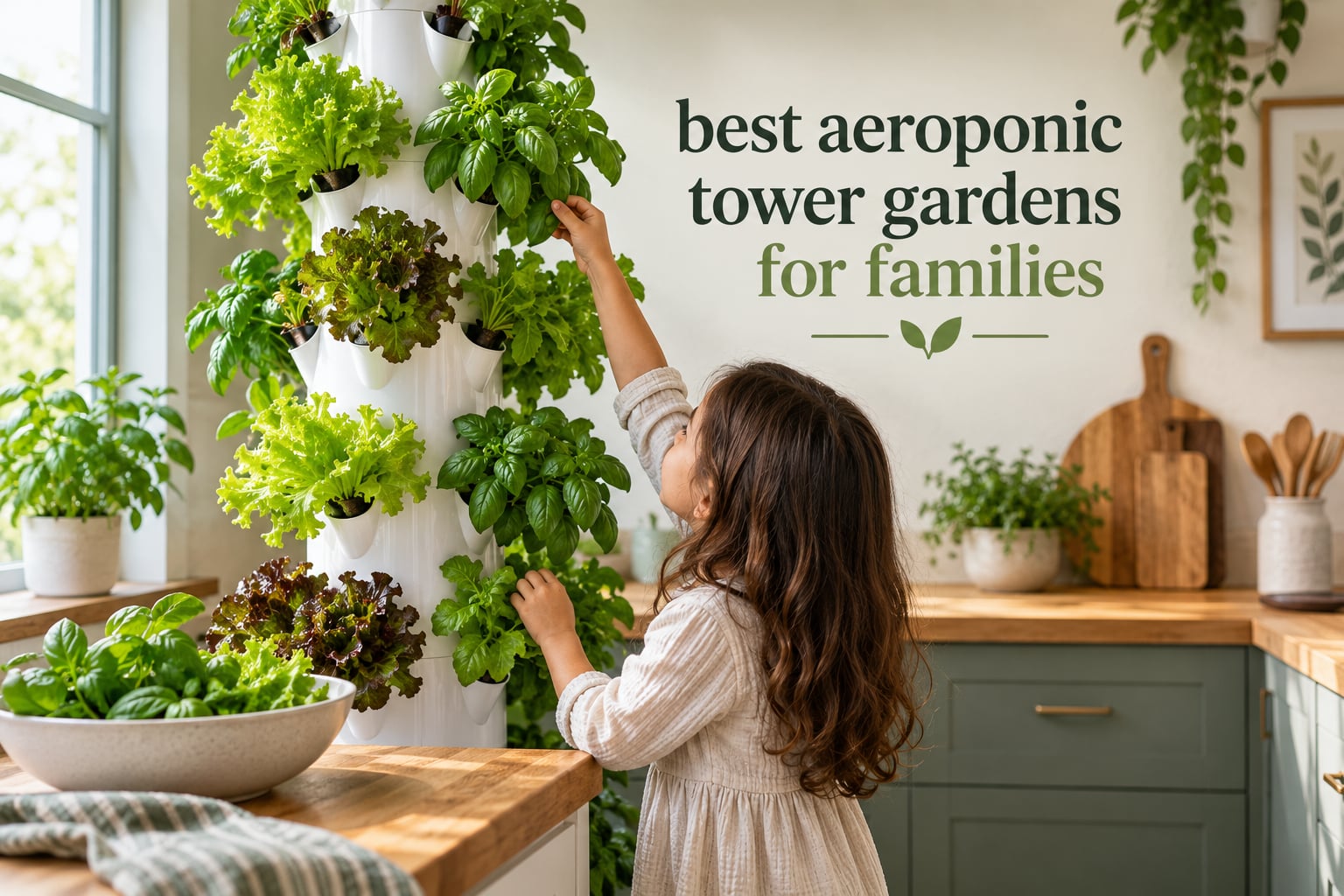
Somewhere in most family homes there is a quiet corner of the kitchen floor where a bag of salad greens gets opened and picked at, not by anyone choosing to, but because a child is hungry at six in the evening. An aeroponic tower garden is a machine for ending that moment. It stands about shoulder-high, holds roots in a sealed chamber, and mists them with nutrient water on a timer while a built-in light does the work of the sun. Ten weeks after assembly you cut your own lettuce at the table.
That idea has sold a lot of hardware in the last few years, and the marketing has been louder than the evidence. Nearly every listing calls itself “aeroponic,” most never explain what that means, and none of them tell you what a tower actually produces for a household of four. So we took eight of the best-selling vertical hydroponic and aeroponic towers on the market, read the owner reviews rather than the marketing copy, and ranked them on the four questions that actually decide a family purchase: is it safe with a toddler in the room, is the pump noise going to drive everyone mad, how much food does it hand you, and what does it cost to keep running every year.
This roundup covers the best aeroponic tower gardens for families in 2026, from countertop units to floor-standing towers with room for thirty plants. We look at what each one can grow, how often you touch it, and where it will make a family miserable rather than happy. One thing worth saying up front: none of these systems replaces a vegetable garden. A good tower replaces your salad bag and your herb drawer, and it does it with a Saturday morning of assembly and ten minutes a week after that.
Table of Contents
- Top 3 Best Aeroponic Tower Gardens for Families (October 2026)
- All 8 Systems Compared at a Glance in 2026
- 1. AeroGarden Bounty – the Best Overall Aeroponic Tower Garden for Families
- 2. ALTO GARDEN GX – the Best All-In-One Indoor Aeroponic Tower
- 3. Lettuce Grow Farmstand – the Best Low-Effort Tower for Busy Families
- 4. Gardyn Home 4 – the Best Metal-Frame Tower for Small Floor Spaces
- 5. AOONEG 42-Pod Tower – the Most Plant Sites for the Money
- 6. SJZX 5-Layer Tower – the Best Tower for Indoor and Outdoor Use
- 7. LYCereal 6-Tier Tower – the Best Fit for a Small Kitchen
- 8. JPWDDWYT 35-Plant Tower – the Budget-Friendly Starting Point
- Are Aeroponic Towers Worth It for a Family?
- What Are the Disadvantages of Using an Aeroponic Tower?
- How to Choose an Aeroponic Tower Garden for Your Household
- Safety, Noise and Placement in a Family Home
- Frequently Asked Questions
- The Bottom Line: Which Aeroponic Tower Garden Should Your Family Buy?
Top 3 Best Aeroponic Tower Gardens for Families (October 2026)
If you want the answer in one line, the AeroGarden Bounty is the tower the largest number of families have actually lived with, the ALTO GARDEN GX is the most complete indoor package, and the Lettuce Grow Farmstand demands the least attention of the three. Here is why, with the detail behind each pick in the full reviews below.

ALTO GARDEN GX Tower
- 24 net pots
- six layers
- 10-gallon wheeled reservoir
- Lights and nutrients included

Lettuce Grow Farmstand
- 24 plants on three levels
- 95% less water
- Expandable
- 15 minutes of weekly care
All 8 Systems Compared at a Glance in 2026
Plant sites are the number a manufacturer advertises, not the number of plants you will actually harvest. A 35-site tower with crowded sites gives you a good handful of small heads, while a 24-site tower with wide-spaced net pots gives you proper full-sized plants. Read the plant site count as capacity, then read our notes on spacing.
| Product | Specs | Action |
|---|---|---|
| AeroGarden Bounty |
|
Check Latest Price |
| ALTO GARDEN GX Tower |
|
Check Latest Price |
| Lettuce Grow Farmstand |
|
Check Latest Price |
 Gardyn Home 4 Gardyn Home 4 |
|
Check Latest Price |
 AOONEG 42-Pod Tower AOONEG 42-Pod Tower |
|
Check Latest Price |
 SJZX 5-Layer Tower SJZX 5-Layer Tower |
|
Check Latest Price |
 LYCereal 6-Tier Tower LYCereal 6-Tier Tower |
|
Check Latest Price |
 JPWDDWYT 35-Plant Tower JPWDDWYT 35-Plant Tower |
|
Check Latest Price |
1. AeroGarden Bounty – the Best Overall Aeroponic Tower Garden for Families
AeroGarden Bounty, Black
9 plants to 24 inches
40W dimmable LED
Water level panel
Wi-Fi and Alexa
Pros
- Grows 9 plants up to 24 inches tall on a countertop
- 40W LED with automatic on and off scheduling
- Control panel shows water level and nutrient reminders
- Quiet pump plus a vacation mode for travel
- Soil-free with pre-seeded non-GMO pods in the box
Cons
- Must be lifted by the top section to refill the water bucket
- Light is bright enough to disturb light sleepers
- A few shipments arrived without the plastic seed pod domes
The AeroGarden Bounty is the one we keep coming back to, and the reason is simple: at 1,804 owner reviews it is the only tower here where we can look at a long, well-populated record of how it behaves after six months in a real kitchen rather than after six weeks on a countertop. Owners describe fast assembly, strong germination and steady harvests of lettuce and herbs across many months of use, with replacement pods shipped when a seed fails.
It is also the smallest serious option. Nine plants at up to 24 inches tall will not feed a family of five on greens alone, but for a household of two, or for a family of four that eats salad three or four times a week, it is a steady drip rather than a flood. The pods are pre-seeded and non-GMO, which removes the single most fiddly part of indoor growing for anyone who has never propagated a seed.
The control panel is where this design earns its keep in a family home. A three-step water level indicator and a nutrient reminder mean a fifteen-year-old can top it up without reading a manual, which removes the most common reason a tower gets abandoned in month two. Wi-Fi and Alexa control let you check it from another room, and the vacation mode keeps the cycle running while the family is away.
The 40W LED is dimmable and scheduled, so you can dial it back for a bedroom or a room where people sleep. That dimmer matters more than the wattage figure: the most common complaint is that the light is bright enough to be a problem at night, and a dimmer solves it without unplugging anything. The pump is quiet in normal operation, which makes this the least intrusive tower to run in a kitchen next to a busy breakfast hour.
Who this tower suits
This suits a first-time grower, a two-person household, or any family who wants a reliable countertop project with almost no decision-making. If your children are old enough to be interested and too young to be trusted with the water, the sealed pod design and the visible water indicator do most of the work for you. It is the lowest-risk way to find out whether your family actually wants to grow food.
Where it will let you down
Nine sites is the ceiling. A family of four eating salad daily will strip it in a week and wait three weeks for the next harvest, and there is no version of this unit that scales. Refilling means lifting the top section to reach the bucket, which is genuinely awkward with a full reservoir, and the light is still too bright for a bedroom no matter how far down you dim it.
2. ALTO GARDEN GX – the Best All-In-One Indoor Aeroponic Tower
ALTO GARDEN GX Hydroponic Tower | Vertical Planter Tower | Hydroponics Growing System Kit | Food Grade with 24 Net Pots (with LED Grow Lights)
24 net pots, six layers
10-gallon reservoir on casters
Lights and nutrients in the box
No subscription
Pros
- Everything needed to start is in the box
- 24 wide-spaced net pots across six layers
- 10-gallon wheeled reservoir with water gauge
- Adjustable LED lights with a built-in timer
- No app or monthly subscription required
Cons
- Move it by the base only
- the filled reservoir is heavy
- Assembly video quality is poor and online guidance is weak
- One buyer reported the tower falling apart shortly after assembly
The ALTO GARDEN GX is the best package on this list, and for a specific family reason: nothing else arrives ready to grow. The box includes 30 rockwool cubes, A and B nutrients, a digital pH test pen, a four-head germination light on a clamp, a water gauge, and broad-spectrum LED lights with a built-in timer. A family that has never grown anything indoors does not have to make a second shopping trip before the first seedling appears.
Twenty-four wide-spaced net pots across six layers is a genuine family configuration rather than a headline number. The spacing is the point: plants have room to size up, which means fewer of the small, crowded lettuces you get from a 30-site tower where everything touches. The tower walls are 2mm thick with 360-degree construction, so there is no seam for the tower to leak at, and the reservoir sits on casters so you can roll the whole thing rather than carry it.
The absence of a subscription is worth a second look for family budgeting. Plenty of connected growing systems gate their best features behind a monthly membership, and this one runs fully on its own hardware. Owners with nearly two years of continuous use report healthy greens through winter indoors, and customer service here resolves missing parts and faulty LEDs quickly, including shipping replacements at no charge.
The design also names its method honestly, describing aeroponic and hydroponic delivery side by side rather than borrowing a better-sounding word. Claims of faster harvests and greater yields than soil depend on crop, temperature, light, nutrient strength and spacing, so treat them as a starting expectation rather than a promise. Our read is that most families will see a first harvest of greens inside three weeks of transplanting.
Who this tower suits
This suits a family of four or five who wants a real indoor crop and wants everything to work without an app, a membership, or a second set of purchases. The germination light in the box is a genuinely family-relevant touch, because it lets you start seeds on a windowsill without adding another lamp. It also handles herbs at the top and greens below without the crowding you get on smaller towers.
Where it will let you down
It is a floor-standing unit at 20 by 20 inches and 66 inches tall, so it needs a real corner, not a counter. The filled reservoir is genuinely heavy, and the manufacturer is clear that you move it by the base only. Assembly guidance is the weak point, so budget an evening rather than an hour, and check the wall structure if you have very young children in the house.
3. Lettuce Grow Farmstand – the Best Low-Effort Tower for Busy Families
Lettuce Grow Farmstand Hydroponic Growing System, 24-Plant Indoor/Outdoor Vertical Garden, BPA-Free Food Grade, Made in USA
24 plants on three levels
95% less water than soil
Grow Rings sold separately
Pros
- Highest satisfaction rating among the systems we reviewed
- About 15 minutes of maintenance each week
- First harvest roughly two weeks after transplanting
- Taste and freshness of home-picked greens praised repeatedly
- Expands with additional levels when the family grows
Cons
- Indoor use requires buying supplemental lighting separately
- Purchasing through this listing leaves the unit unregistered with the app
- Pump can clog and needs cleaning every few weeks
- No seedlings included in this variant
The Lettuce Grow Farmstand carries the highest satisfaction rating of anything we reviewed, at 4.8 across its reviews, and owners consistently describe about fifteen minutes of care a week. For a household where two adults work full time and someone else has to run the watering, that maintenance figure is the whole argument. The automated water distribution sends water evenly to all 24 plants across three levels, so nothing gets left behind at the bottom.
First harvests arrive roughly two weeks after transplanting, which is fast enough to keep a child interested through the first cycle. Owners also single out taste, which matters for the picky-eater problem: greens picked minutes earlier from a tower simply taste different from a bag that has been in a fridge for a week. This is a soil-free, mess-free system, so there is no dirt on the floor and no weeding, which is exactly what a family with small children needs.
Two design facts matter for a household. First, the Farmstand uses 95% less water than traditional gardening and recirculates what it draws, so the ongoing water cost is close to nothing. Second, it expands with additional levels, so a family of two who starts small can add a tier later rather than buying a second system. The frame is floor standing and BPA-free food grade, and it moves between indoors and outdoors as the seasons change.
Read the variant carefully before buying. This listing is the outdoor configuration with no seedlings, and the lighting rings for indoor use are a separate purchase. If your plan is an indoor kitchen tower, you need to budget for lighting as a second item, and you need seedlings or plugs from somewhere else. Bought through this listing, the unit also does not register with the app, so the reminders and growing tips are not available.
Who this tower suits
This suits a family that eats salad every day and wants the smallest possible commitment in minutes per week. The 24 sites on three levels is a comfortable supply for two to four people, the expansion path handles a growing household, and the soil-free operation means no spilled dirt and no bugs. Buyers also note that the company donates one Farmstand for every ten sold, which is a reasonable thing to know if that matters to your household.
Where it will let you down
Indoor lighting is not included, and that changes the maths. Without a proper light source, a Farmstand in a dim kitchen is a very expensive seed tray. The pump can clog and wants a clean every few weeks, and a clogged pump is the failure that most often ends a family’s growing habit, so put the cleaning on the calendar rather than waiting for it.
4. Gardyn Home 4 – the Best Metal-Frame Tower for Small Floor Spaces
Gardyn Home 4 Vertical Hydroponics Growing System Kit – 30 Plants
30 large plants in 2 sq ft
Four levels, alloy steel frame
30 yCubes included
Kelby AI coach
Pros
- Grows 30 large plants in roughly 2 square feet
- Metal frame feels far more durable than plastic towers
- Thirty free yCubes of non-GMO seeds in rockwool included
- Redesigned columns are easier to clean
- Real-time water measurement with sunrise and sunset light modes
Cons
- Premium price against plastic tower kits
- AI plant coach trial and bonus cubes are tied to the company's own seed program
- One-star feedback is a meaningful share of the ratings
- Listing detail on complaints was limited
The Gardyn Home 4 answers the footprint question better than anything else here. Thirty large plants in roughly two square feet of floor space is the tightest capacity-to-area ratio on the list, and it does it with an alloy steel and aluminum frame rather than plastic. If you have a small flat and a genuine shortage of floor area, that structural difference is the reason to look here first.
The box includes 30 yCubes of non-GMO seeds in rockwool, so you can start on day one rather than sourcing seedlings. Real-time water measurement removes the guessing game that trips up most beginners, and the redesigned columns are easier to get a hand and a cloth into, which matters when the person cleaning it is a child being asked to help. Sunrise and sunset lighting modes are a small touch that makes the thing look considered rather than industrial.
Here is where a family should read the small print. The AI plant coach runs on a trial with a set of bonus cubes attached, which is a soft funnel toward buying that company’s seed refills rather than your own. The app-based guidance is genuinely useful, but the ongoing cost of a family’s greens is not just the tower, and seed refills are the line item that grows fastest. The system is indoor-focused by design, and the brand is explicit that it uses 95% less water than conventional growing.
Ratings cluster strongly at five stars with a heavier one-star tail than we would like to see, and the listing detail we could retrieve did not spell out what those one-star reviews complain about. We would treat this as a tower worth trying in a home where the metal build and the footprint genuinely solve a problem, rather than a safe first purchase for a cautious family.
Who this tower suits
This suits a family in a small home who wants maximum plants from minimum floor area and who will keep the refill habit going. Metal construction survives being moved and bumped in a way plastic towers do not, and thirty included seed cubes mean a satisfying first week. The two-square-foot footprint is the single best number on this list for an apartment with a corner to spare.
Where it will let you down
It is the most expensive tower in the group and the one where the app matters most to the experience. Budget for seed refills on top of the purchase, and understand that the assistant features are part of a company’s own ecosystem rather than an open standard. If your family wants a set-it-and-forget-it weekend project with no phone involvement, this is the wrong one.
5. AOONEG 42-Pod Tower – the Most Plant Sites for the Money
Hydroponics Growing System,AOONEG 42Pods Indoor Herb Garden with LED Grow Light,Hydroponics Growing System Kit with Automatic Timer,Pump System,Adjustable Height,No Seed
42 planting baskets
23L tank, about 20 days of water
Six 30W lights
Low-water pump protection
Pros
- Three tiers with 42 planting baskets
- 23L food-grade PP5 tank lasting about 20 days
- Six 30W LED lights on extendable mounts
- Quiet pump with an adjustable flow rate
- Supports herbs
- greens
- cherry tomatoes and peppers
Cons
- Small included pump reported failing within weeks with no replacement sold
- Grow lights slide down the mounts and need repeated adjustment
- Supplied pump setting causes overflow unless run lower
- Clear fittings let light in and encourage algae
Forty-two planting baskets is more than any other tower here, and for a family of five or six that eats greens daily it is the most food per unit of floor space on the list. The 23L tank is the other headline: at roughly 20 days of water it is the longest refill interval of any system in this roundup, which for a family that forgets small chores is worth more than another ten plant sites.
The lights are the real strength. Six 30W LED grow lights sit on movable PVC mounts with extendable height, which is a better lighting arrangement than a fixed single column. Reviewers report the light is bright enough to carry cherry tomatoes and dwarf peas through to actual fruit, not just leafy growth, and the three-tier layout spreads that light across a tall crop column rather than concentrating it at the top.
The pump is the weak link, and we want to be direct about it. Several buyers report the small included pump failing within weeks, and replacement pumps are not sold for this unit, which turns a repairable fault into a write-off. The default pump setting also causes overflow until you turn it down, and the instructions do not clearly mark which reservoir belongs to which tier, so the first assembly is a trial-and-error session rather than a smooth build.
Algae is the other ongoing nuisance, caused by clear fittings that let light reach the reservoir. With forty-two sites there is more water surface exposed and more light entry points than on a small tower, so covering those fittings is a weekly task rather than an occasional one. The components are modular enough that refilling is straightforward once you know which tier goes where.
Who this tower suits
This suits a large family or a family that wants to grow enough to share, and a household where someone genuinely enjoys the ten-minute weekly reset. The 20-day refill interval and the high site count mean a family can eat fresh greens most days without a shop run. It also suits anyone who wants fruiting crops indoors, because the six adjustable lights are the best lighting package in this roundup.
Where it will let you down
Do not buy this as a first tower. The pump is the part most likely to fail and the part hardest to replace, and the build is confusing enough that a beginner will spend the first week troubleshooting rather than harvesting. Forty-two crowded sites also produce smaller plants than the count suggests, so manage expectations about what a site is worth.
6. SJZX 5-Layer Tower – the Best Tower for Indoor and Outdoor Use
SJZX Hydroponics Growing System Kit, 5-Layer Hydroponic Tower, 30 Planting Holes, Space-Saving Vertical Gardening System, Suitable for Both Indoor and Outdoor use Germination Kits
30 planting holes, five layers
12L tank with level gauge
Smart socket for remote watering
Pros
- Rated for both indoor and outdoor placement
- Sturdy tower that survives being bumped and moved
- Smart socket sets watering run time from a phone
- Detailed instructions and simple assembly
- Useful teaching tool for first-time growers
Cons
- No low-water auto shutoff on the pump
- Water level can sit too low for seedlings to reach
- Tower wells appear to restrict root growth
- Outdoor use needs a separate grow light for good results
The SJZX tower is the one to buy if your family wants to follow the seasons rather than fight them. It is rated for indoor and outdoor placement, and it is built from BPA-free food grade plastic with a base that seats tightly into the bucket lid so it stays stable outside. Buyers describe it as solidly packed and able to survive being moved around, which is exactly the handling profile a family garden on a deck needs.
Five layers with thirty planting holes and a 12L tank with an integrated water level gauge make it a sensible middle-sized system, and the smart socket is a genuinely nice family feature: you set the watering run time from a phone and can trigger the pump remotely. For a household where the grown-up who understands the machine is not in the house, being able to start a cycle remotely is worth more than another ten planting holes.
There are real limits. The pump has no low-water automatic shutoff, so if the reservoir runs down the pump keeps running, and several reviewers flag that as a service-life risk. Water level can also sit too low for seedlings to actually reach it, which stalls growth after sprouting and is confusing the first time it happens. The tower wells appear to restrict root growth, which caps the size of what comes out of each site.
Owners also report inconsistent germination, with one buyer seeing roughly half the seeds sprout and some turn mildewy, and third-party long net cups can drop through the planting holes unless you seat them at an angle. If you plan to use it outdoors, buy a grow light separately, because sun alone rarely produces the result the listing implies.
Who this tower suits
This suits a family with a deck, balcony or patio who wants one system that works in summer and comes inside for winter. It is also the one several buyers describe as a good learning tool for children, because thirty sites make it easy to run a variety experiment and see which crops thrive and which do not.
Where it will let you down
The unguarded pump is a real concern in a home with curious children, since a running pump with a low reservoir is the failure you least want. Root restriction and inconsistent germination also mean you should buy more seedlings than you think you need. And it is a tower for people who already have a light sorted for outdoor growing.
7. LYCereal 6-Tier Tower – the Best Fit for a Small Kitchen
LYCereal Hydroponics Growing System, 30-Plant Indoor Hydroponic Tower with Pump System, Plants Germination Kit, Smart Aeroponic Herb Garden, Vertical Hydroponic System for Gardening Lover (No Seed)
30 plants in under 1 sq ft
10L tank with level gauge
Partly pre-assembled
Pros
- Fits in less than 1 square foot of floor space
- Arrives largely pre-assembled so setup is quick
- Sturdy plastic that stays stable when top-heavy
- Good germination for lettuce
- cilantro and herbs
- Responsive customer support
Cons
- No grow light included
- No plant fertilizer or nutrients included
- Plastic material is not identified as food grade
- Planted baskets need a grow light to be productive indoors
The LYCereal 6-tier tower solves a problem most lists ignore: floor area. At 9.84 by 9.84 inches it takes up less than one square foot, so it fits in a corner of a small kitchen or beside a fridge where a 20-inch round tower would not. Thirty plant sites in that footprint is the second-tightest packing on this list, and it is the one to consider if your family is in a flat with no room to spare.
It also arrives largely pre-assembled, which matters for a Saturday-morning project with children competing for your attention. The 10L tank carries a water level gauge on the front so nobody has to lift a cover to check, and the timer-controlled pump has an adjustable run duration rather than a fixed program. Owners report steady growth across lettuce, cilantro and herbs, and the sound of circulating water gets singled out as oddly pleasant.
Here is the catch that decides this tower’s place on the list: it ships with no grow light and no nutrients. Both are sold separately, which means the purchase is not the whole cost and the first thing you do after assembly is order a lamp. The plastic is not identified as food grade, and a reviewer questioned that directly, which is a fair thing for a family growing edible crops to ask about.
The tower is plastic and stays stable even when top-heavy, which is a genuine plus in a house where a corner gets bumped. Six tiers at 33.86 inches tall is a reasonable height for an adult to reach every level without a step stool, though a younger child will need help with the top tier. It is listed for indoor use, so if your plan is a balcony you will want one of the dual-rated models instead.
Who this tower suits
This suits a family in a small home who already has a grow light, or who wants to try tower growing for the first time on a low commitment. Quick assembly and a small footprint make it a good first system, and 64 growth sponges and a shower cap lid are included so you can start immediately. It is also a good choice for a child who wants their own smaller station.
Where it will let you down
Without a light, this tower is a very tall seed tray. The missing nutrients mean a second purchase before your first harvest, and unlisted material grade is not what you want when the whole appeal is food you grew yourself. At this size it is also not the tower you buy to cut down a family’s weekly shop.
8. JPWDDWYT 35-Plant Tower – the Budget-Friendly Starting Point
JPWDDWYT Hydroponics Tower Indoor Growing System Vertical Garden Planter Indoor Smart Garden Kit with Pump and Movable Water Tank Vegetable Plant Gift for Gardening Lover (35-Plants)
35 planting sites
18L movable water tank
Timed top-down watering
Indoor and outdoor use
Pros
- Lowest entry cost of the towers we reviewed
- Automatic timed top-down watering cycle
- Movable water tank and portable design
- Works indoors and outdoors
- Compact enough for a kitchen or living room
Cons
- Only an instruction manual is listed in the box contents
- Bulky in practice relative to the 35-plant claim
- No written customer reviews or photos available for this listing
- Heavier one-star share of ratings than the group average
The JPWDDWYT tower is the cheapest way we found to get thirty-five planting sites into a family home, and the automatic top-down watering cycle is the feature that makes it viable at that level. Thirty-five sites and a timed cycle sounds like a lot of management, but the machine runs itself, and the movable water tank means refilling does not mean dismantling the tower.
It works indoors and outdoors, and the soilless setup cuts water waste compared with potted plants in a way a family can see on a meter. The 18L reservoir is larger than the two smaller towers here, which stretches the refill interval. For a household that wants volume without a large purchase, the arithmetic on paper is the most attractive on this list.
What holds it back is evidence and box contents. The listing lists only an instruction manual as included, so plan on sourcing net cups, growing medium, nutrients and seed yourself before anything germinates. The dimensions are also smaller than the 35-plant claim suggests, which tells you the real density once everything is planted is high. No written customer reviews or customer photos were retrievable for this listing, so our assessment rests on the rating and the feature list alone.
The one-star share of ratings is heavier than the group average, and with no review text to explain it we would not call the failure modes unknown so much as undocumented. If your family is curious but not committed, this is a reasonable place to find out whether a tower fits into your routine before spending on a better-made one.
Who this tower suits
This suits a family on a budget that wants a large plant-site count and mostly intends to grow greens and herbs, which is what this class of tower is genuinely good at. The automatic cycle means the machine keeps working through a busy week, and the portable design lets a family move it between the kitchen and a balcony as the light changes.
Where it will let you down
You will be sourcing most of the consumables yourself, and with the lowest documentation on the list, troubleshooting is guesswork. High site density on a small footprint means crowding, so expect to thin. It is a reasonable experiment and a weak long-term family workhorse.
Are Aeroponic Towers Worth It for a Family?
Yes for a household that eats salad greens and herbs most days and has two to four square feet of floor to spare, no for everyone else. A tower reliably replaces a share of your greens and herb spending, not your whole food budget, and the trade is a steady weekly harvest against one assembly session and about ten minutes of attention a week. The purchase price is only part of the cost: seed refills, nutrients and electricity come every year, so treat the tower as a five-year commitment rather than a one-time buy.
The break-even question for a family of four is whether it replaces two bagged salads a week for long enough to matter. If your household is already buying that much fresh produce, a tower earns its keep within the first year. If not, you are buying a very good hobby that happens to feed you, and that is still a perfectly good reason to buy one.
Match the tower to your household size
Two people who eat salad a few times a week will be well served by a nine-site countertop unit. A family of four eating greens daily is the sweet spot for a 24-site tower, because it produces a steady supply without crowding. A household of six, or a family that wants to share surplus, wants 30 sites or more and should plan on thinning seedlings so the remaining plants size up.
What none of these towers replaces is root vegetables, corn, or full-size tomatoes and squash. Plan to keep your summer garden or patio pots for those, and use the tower for the salad drawer, the herb shelf, and the strawberry bowl.
What Are the Disadvantages of Using an Aeroponic Tower?
The honest list runs longer than the marketing does. Main ones: the purchase and the ongoing consumables; a shared reservoir that forces one nutrient profile across every level; a pump that runs constantly and a small water reservoir that needs refilling; light burn on anything taller than about ten inches under fixed arms; algae in clear fittings; and electricity draw every day.
Three of those deserve a further note for families. First, a single reservoir means you cannot run tomatoes and lettuce on the same tower without compromise. Second, fixed, non-tilting light arms burn the tops of taller plants, which is a common and avoidable disappointment. Third, pump noise on low water is genuinely disruptive in a home, and several systems shut the pump off automatically while others keep running.
Then there is the learning curve, which is real but shallow. Families who fail usually fail for one of three reasons: nobody owns the refill, the light is wrong, or the site density is too high and everything is stunted. Fix any one of those and the same tower works for years.
How to Choose an Aeroponic Tower Garden for Your Household
Start with the floor space and the ceiling height, because that rules systems out faster than any other factor. Round 20-inch towers need a real corner; the 66-inch ALTO GARDEN GX needs vertical clearance as well as floor area; a countertop unit needs a 24-by-6 inch stretch of counter and nothing more. Then count how many people eat greens most days and pick a site count in the same range, not twice the range.
Next, settle the lighting question honestly. Two of the towers here ship with no light at all, one needs a separate indoor light ring, and the rest include adjustable LEDs. A tower without light is a seed tray, and no amount of enthusiasm changes that. If you already own a grow lamp, you can start cheaper; if not, factor the lamp into the total.
Then look at the reservoir and the refill interval, because that is the actual chore. A 23L tank lasted roughly 20 days in one owner’s hands, which is the longest interval in this roundup, while a 10L tank will ask for a top-up far more often. Buy a tower with a water level gauge and a visible indicator on the control panel, because the families who keep going are the ones who never have to lift a cover to check.
Watch for near-identical hardware under different names. A lot of the cheap vertical towers on the market are the same moulded plastic with a different logo and a different seed packet, and the photos across listings are interchangeable. Look for a brand that publishes the number of net pots, the tank volume, the wattage of the lights, and the included accessories, because a seller who hides those is hiding the differences that matter.
Finally, cost out three years before you buy. The tower is the smallest line. Seed refills or seedlings, nutrient solution, and electricity every single day add up, and if the system needs a separate lamp or a paid membership for its smart features, add those too. A family that budgets the whole number is far less likely to feel the purchase was a mistake in month four.
Safety, Noise and Placement in a Family Home
Every tower puts water and electricity within a metre of the floor, so placement is a family decision before it is a design decision. Put it on a hard, level floor rather than carpet, keep it clear of play areas and walkways, and put a mat under it in a kitchen where water will be splashed. Keep the power cord out of reach and route it so nobody trips, and never pull a tower out of its spot by the cord.
Two safety details separate the models. An automatic low-water shutoff means the pump stops when the reservoir runs dry; several towers here, including the five-layer model, do not have one and keep running. A pump running dry is the failure nobody wants next to a curious child, so if your household has a five-year-old, favour a system with a float indicator and an automatic cut-off rather than one without.
On noise, the normal operating sound is a low hum from the pump and a faint trickle, and most owners describe it as unobtrusive. What is disruptive is the alarm state: some units change pitch or cut out when water is low, and that is the sound that wakes people up. Before you buy, note which systems have an audible low-water alert, because a bedroom or a room adjacent to a child’s room makes that detail decisive.
Light is the other family consideration. A 40W dimmable LED can be turned down for evening use, and a fixed non-tilting arm cannot be adjusted at all, so tall crops either stretch or burn. Put the tower where the light reaches every tier evenly rather than in a half-lit corner, and pick a dimmer or a timer over a bright one if anyone in the house is light-sensitive.
On cleaning, a weekly wipe of the reservoir rim and the fittings is enough for most of these systems, and a monthly reservoir reset keeps algae from taking hold in clear connectors. Algae is not dangerous, but it competes for nutrients and smells, and it is far easier to prevent than to remove. Give the job a name and an owner in the household, and the system will still be running a year later.
Frequently Asked Questions
Which aeroponic garden system is the best?
For a family, the AeroGarden Bounty is the best overall because it has the longest record of real household use and the simplest refill routine. A family wanting maximum capacity indoors should look at the ALTO GARDEN GX, and a family wanting the least weekly effort should look at the Lettuce Grow Farmstand.
What plants grow well in aeroponic towers?
Leafy greens and herbs are the reliable crops: lettuce, kale, basil, mint, cilantro, parsley and dill. Compact fruiting crops such as cherry tomatoes, dwarf peppers and strawberries can also fruit indoors if they get the upper tiers, strong light and generous spacing. Deep-rooted vegetables and full-size tomatoes do not do well on a tower.
Are aeroponic towers worth it?
They are worth it for a household that eats salad greens and herbs most days and has two to four square feet to spare. A tower reliably replaces part of your produce spending, not all of it, and you still pay for seed refills, nutrients and electricity every year. Treat it as a five-year commitment rather than a one-time purchase.
What are the disadvantages of using an aeroponic tower?
The main drawbacks are the purchase and ongoing consumable costs, a shared reservoir that forces one nutrient profile across every level, a pump that runs constantly, the need to refill a small reservoir, light burn on tall plants under fixed arms, algae in clear fittings, and daily electricity use. A steep early learning curve puts many families off as well.
Can kids help use an aeroponic tower safely?
Yes, with supervision. Children can help fill net cups, place seeds, check the water level indicator, and harvest. Adults should handle the reservoir refills, the pump, and the power cord, and should keep the unit on a hard floor clear of walkways. Choosing a model with an automatic low-water shutoff matters in a house with young children.
The Bottom Line: Which Aeroponic Tower Garden Should Your Family Buy?
The best aeroponic tower garden for families in 2026 is the AeroGarden Bounty, because it is the only tower here with a deep, well-populated history of families using it for months at a time, and because the visible water indicator and dimmable light solve the two problems that most often end a household’s growing habit. If you need more food from one machine, the ALTO GARDEN GX gives you 24 well-spaced sites with lights and nutrients in the box and no subscription attached. If you need the least effort, the Lettuce Grow Farmstand asks for about fifteen minutes a week and expands when your family does.
Whichever you choose, give one person in the household ownership of the refill and the clean, put the tower on a hard floor with clear space around it, and start with greens and herbs rather than trying tomatoes. That combination does more for a family’s odds with a tower than any specification on the box.