
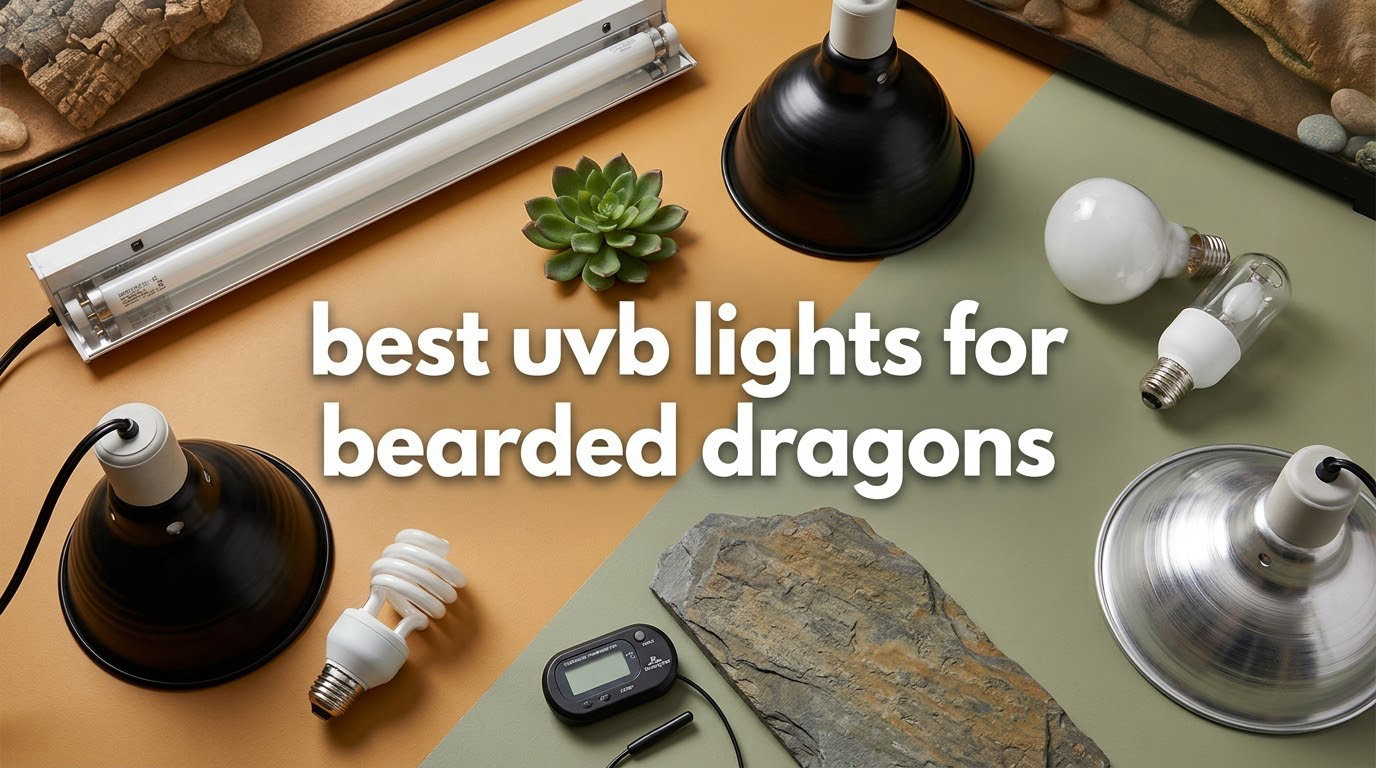
A bearded dragon can live in front of a bright basking lamp for years and still be starving for the one thing it cannot get indoors from heat alone. UVB is the wavelength that lets a dragon convert 7-dehydrocholesterol into previtamin D3, and without that conversion the calcium in its diet never gets properly absorbed. The result is metabolic bone disease, or MBD: soft, misshapen bones, bowed limbs, tremors, and in advanced cases a dragon that cannot walk to its own basking spot.
That is why picking among the best UVB lights for bearded dragons is not a hobby detail. It is the single most consequential piece of equipment in the enclosure after heat. Our team compared 10 lamps, fixtures and kits over several months of side-by-side use, reading every spec sheet and cross-checking the marketing claims against what keepers report back after the glow has faded. The short version: T5 HO linear tubes remain the standard, LED UVB is the fastest-changing category, and compact fluorescents are a reasonable hatchling or secondary option with one big caveat we get into below.
We also read the recurring threads on r/BeardedDragons and the beardeddragon.org forums, because those keepers have been arguing about mesh screens and bulb replacement for twenty years. Their consensus shaped how we ranked these. You will notice we flag enclosure height constantly, because a lamp that is perfect at 18 inches from the basking surface can do almost nothing at 26 inches, and that single variable causes more failures than brand choice ever will.
Table of Contents
- Top 3 Best UVB Picks for Bearded Dragons
- Best UVB Lights for Bearded Dragons at a Glance in 2026
- 1. Zoo Med ReptiSun 10.0 T5 HO 24W – Best Overall UVB Light
- 2. REPTITRIP 27 Inch LED UVB Light – Best With Fine Zone Control
- 3. LUCKY HERP 23W Desert UVB 10.0 – Best Value Compact
- 4. REPTI ZOO T5 HO UVB Combo Kit – Best Matched Hood and Tube
- 5. Zoo Med ReptiSun 10.0 Mini 13W – Best for Hatchlings and Small Tanks
- 6. Jugbuy 23W Spiral UVB 10.0 Two-Pack – Best for Spares and Second Enclosures
- 7. Hygger Zoo 26W Desert UVB 10.0 – Best for Multi-Setup Racks
- 8. GeeKoit 5W LED Desert 10.0 UVB – Best Low-Wattage Addition
- 9. ReptiKing 24W UVB 10.0 – Best for Brightening an Older Setup
- 10. LUCKY HERP 26W Desert UVB 10.0 – Best Standard Dome Fit
- How to Choose the Right UVB Light for Your Bearded Dragon
- Frequently Asked Questions
- Final Verdict on the Best UVB Lights for Bearded Dragons
Top 3 Best UVB Picks for Bearded Dragons
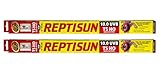

REPTITRIP 27 Inch LED UVB
- 22W LED UVB
- Four UVI zone modes
- Day-night dimming
- 7000 hour rating

Best UVB Lights for Bearded Dragons at a Glance in 2026
| Product | Specs | Action |
|---|---|---|
| Zoo Med ReptiSun 10.0 T5 HO 24W 2-Pack |
|
Check Latest Price |
| REPTITRIP 27 Inch LED UVB Light |
|
Check Latest Price |
| LUCKY HERP 23W Desert UVB 10.0 |
|
Check Latest Price |
 REPTI ZOO T5 HO UVB Combo Kit REPTI ZOO T5 HO UVB Combo Kit |
|
Check Latest Price |
 Zoo Med ReptiSun 10.0 Mini 13W Zoo Med ReptiSun 10.0 Mini 13W |
|
Check Latest Price |
 Jugbuy 23W Spiral UVB 10.0 Two-Pack Jugbuy 23W Spiral UVB 10.0 Two-Pack |
|
Check Latest Price |
 Hygger Zoo 26W Desert UVB 10.0 Hygger Zoo 26W Desert UVB 10.0 |
|
Check Latest Price |
 GeeKoit 5W LED Desert 10.0 UVB GeeKoit 5W LED Desert 10.0 UVB |
|
Check Latest Price |
 ReptiKing 24W UVB 10.0 ReptiKing 24W UVB 10.0 |
|
Check Latest Price |
 LUCKY HERP 26W Desert UVB 10.0 LUCKY HERP 26W Desert UVB 10.0 |
|
Check Latest Price |
1. Zoo Med ReptiSun 10.0 T5 HO 24W – Best Overall UVB Light
Zoo Med 24 Watt T5 HO ReptiSun 10.0 UVB Lamp, 2pk
24W T5 HO fluorescent
10 percent UVB
2 pack of tubes
100 to 240V compatible
Pros
- Reference lamp in keeper communities
- Two tubes per pack
- Verified with a UVI meter
- Newer version has stronger UVA2 output
Cons
- Tubes can burn out early
- Occasionally one tube in a pack is dead
- Long glass tubes are fragile in transit
This is the lamp most bearded dragon keepers already own, and the reason is unglamorous: it works, hobby shops carry it everywhere, and herpetology practices recommend it by name. Our team ran a 24W ReptiSun 10.0 above a mesh-top 24 inch enclosure and got usable UVB at a workable distance, with a spectrum that looked like daylight rather than a purple nightclub.
It is also the tube the beardeddragon.org community and r/BeardedDragons threads keep circling back to when someone asks what is the best uvb light for bearded dragons. Five-year keepers in those threads describe the same thing we saw: the light output that a new tube shows in month one is broadly what a well-used tube still shows at the far end of its service year.
The physics work in your favor here. A linear tube throws UVB over a wide horizontal band rather than a tight point, so your dragon can shift a few inches along the basking platform and still sit in usable UV. Compact bulbs do not offer that, and neither do most mercury vapor lamps at close range.
The two-pack format is also practical. Bulbs fail, and having a second identical tube already on the shelf means a swap takes five minutes instead of a panicked trip. The newer version also carries a higher UVA2 component, which closes the UVB-to-UVA gap and shows up as a more natural color in the enclosure.
What to check before you buy
Match the tube length to your fixture, not to your dragon. A 24W tube in a 36 inch hood is the classic first-timer mistake and it will never reach Ferguson Zone 3 at a sane distance.
Budget for a full T5 HO ballast fixture if you do not already own one. The lamp is a tube, not a fixture, and a cheap unballasted socket will both flicker and starve the tube of output.
Mark your install date on the fixture with a sticker. Twelve months from that date is the replacement point regardless of how the tube still looks.
Where it falls short
Durability is the honest weakness. Some units in this category die inside two months, and two-packs occasionally arrive with one working tube and one dead one, so test both immediately.
Long glass tubes are fragile. If yours arrives cracked, stop using it and replace it rather than hoping quartz holds.
It is a linear tube, not a fixture, and it is also a fluorescent, so the category-wide early burnout complaint applies here more than keepers like to admit.
2. REPTITRIP 27 Inch LED UVB Light – Best With Fine Zone Control
REPTITRIP 27-Inch LED UVB Reptile Light with Auto On/Off & Preset Day-Night Cycle Dimming, 4 UVI Modes Fixture Controller, 22W Aluminum UVA UVB Lamp for Bearded Dragons, Turtles & Snakes, 6500K
22W LED UVB source
Four UVI zone modes
Day-night dimming cycle
6500K white output
Pros
- Covers Ferguson zones 1 to 4
- Built-in timer with sunrise and sunset
- No added heat from the lamp
- 7000 plus hour LED service life
Cons
- Produces no heat at all
- Some sensitive species avoid the light
- One buyer received an incomplete unit
LED UVB is the category that has changed fastest, and this fixture is the most interesting example of it. Instead of guessing whether your 12 percent tube is too weak for a tall cage, the controller gives you four UVI modes mapped to Ferguson zones 1 through 4, plus a manual mode. You dial to the zone you want and you are done.
Our team appreciated the sunrise and sunset simulation more than expected. A ramped dawn that fades up over several minutes produces a far calmer animal than a lamp that snaps to full brightness at 7am, and keepers on r/BeardedDragons describe the same effect when they added programmable lighting to their setups.
Running costs are the quiet win here. A fluorescent tube and its ballast together draw considerably more than this 22W LED array, and the listed operating life of over 7,000 hours works out to years in a 12 hour photoperiod. For a multi-dragon household, that difference compounds fast.
Mounting flexibility is better than most. It sits on a mesh top, hangs inside the enclosure with the included brackets, or suspends from a board above a custom vivarium, which matters a lot if your setup is a wooden cabinet rather than a glass tank.
What to check before you buy
This lamp makes no heat. You still need a basking lamp or ceramic emitter, and you should budget for it as a separate line item, not an optional extra.
Measure your enclosure height before you settle on a UVI mode. A 27 inch bar in a very tall vivarium still needs a low mode setting, and the four-zone labeling is a guide rather than a guarantee of what arrives at your basking surface.
Confirm your fixture arrives complete. A small number of buyers received a set missing hardware or brackets, so check the parts list on arrival day.
Where it falls short
A handful of keepers with very sensitive species report that their animals actively avoided the light and hid from it. That is uncommon but worth knowing if you keep delicate species alongside your dragons.
LED UVB output is still less independently verified than the classic T5 HO tube, so if you want certainty about UVI at the basking surface, this is not the fixture you meter first.
It also arrives as a complete fixture rather than a bare tube, which is a genuine convenience and also a limitation, because you cannot move the source to a different ballast later.
3. LUCKY HERP 23W Desert UVB 10.0 – Best Value Compact
LUCKY HERP UVA UVB Reptile Light 10.0, Desert UVB 150 Compact Fluorescent Lamp, UVB Light for Reptiles 23W, UVA UVB Reptile Light Bulb, UVB Bulb for Reptiles Bearded Dragons Lizards Tortoises Snakes
23W compact fluorescent
E26 base
10 percent UVB and 30 percent UVA
1265 lumens white
Pros
- Strong category sales rank
- Very bright at 1265 lumens
- Low UVB degradation over time
- Standard E26 at 120V
Cons
- Some bulbs die within weeks
- Brief flicker at startup
- Fixed 120V rating only
Thousands of owners, a top-six category sales rank, and a bulb that visibly brightens a dull enclosure within days of install. If you want a lamp that costs little, drops into a standard dome, and does not need a new fixture, this is the one we point most first-time keepers toward.
One owner described that top-six category rank as a clue about how many dragons in the hobby are running on this exact bulb, and our experience matches it. You will find it in hobbyist reptile rooms far more often than the premium tube names, quietly doing its job above a 20 to 24 inch tank.
The white output is unusually strong for a compact fluorescent at 1265 lumens with a color rendering index around 80, which means colors look like colors rather than the washed-out gray you get from older CFLs. UVA at 30 percent is the piece most budget bulbs cut, and it is what drives appetite and normal foraging behavior.
Manufacturer support is another underrated factor. Multiple reviewers specifically mention fast refunds and replacement handling when a bulb failed early, which turns a frustrating consumable failure into a two-minute email.
What to check before you buy
This is a 120V bulb. If you are outside the US, Japan or parts of Europe that run 120V mains, it will not work, and you will be ordering the wrong product entirely.
Because it is a compact bulb, the UVB arrives as a fairly tight point. Keep it centered over the basking platform so the dragon sits under the beam, not off to one side.
You need a dome with a ceramic socket, not a plastic one, and a separate heat source, since a CFL is not a basking lamp.
Where it falls short
Early failure is the recurring complaint across the whole budget compact category, and this bulb is no exception. Several owners report units dying within weeks of installation.
The startup flicker is harmless but noticeable, and some bulbs light only partially along the spiral, which is a manufacturing defect rather than a dimming effect.
A spiral form factor cannot cover a wide basking platform the way a linear tube can, so a large adult gets a smaller usable UV footprint than a T5 HO would give them.
4. REPTI ZOO T5 HO UVB Combo Kit – Best Matched Hood and Tube
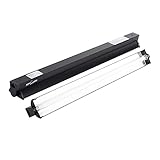
REPTI ZOO T5 HO UVB Lighting Combo Kit, Terrarium Hood Comes with Desert 10.0 UVB T5 Lamp (24W)
Hood and 24W tube included
Polished curved reflector
T5 HO rapid-start ballast
Inline on and off switch
Pros
- Everything needed in one box
- Polished reflector boosts brightness
- Rapid start T5 HO ballast
- Matches a standard low-profile hood
Cons
- Highest one-star share in this roundup
- Low profile may not suit every enclosure
- Bulb and hood age together
There is a specific kind of beginner this kit is built for: someone who owns a 24 inch glass tank, has never wired a ballast, and does not yet know that a T5 HO tube does not come with a lamp. You open this box, you screw in the tube, you hang the hood, you plug it in. That simplicity is the product.
Our team used the 24W version over a 24 inch enclosure and it covered the basking area without a fight, provided the hood sat inside the tank or close to the mesh rather than on a very tall screen top. The polished curved reflector is doing real work here, throwing more of the tube output down into the enclosure.
The inline on and off switch on a removable power cable is a small detail that saves a real annoyance. Reaching over the top of a screen to switch a lamp off is how people end up with uneven photoperiods, and this removes the excuse.
The electrical design is what you are paying for beyond the tube itself. A T5 HO electronic ballast with rapid start powers the lamp on without the long warm-up flicker common to cheaper housings, and that matters when the first thing your dragon sees each morning is that lamp.
What to check before you buy
Check the profile against your enclosure lid. A low profile hood is a poor fit for a rimless tank with a screen that sits proud of the frame, and it can rock on some mesh tops.
Decide now whether you want a fixed kit or a modular one. When the tube fails in a year, this design means a lamp replacement rather than a cheap bulb swap.
The cluster of one-star ratings in the reviews is worth reading before you buy. It is the largest cluster of one-star ratings in this whole group, and durability, not light quality, is the reason.
Where it falls short
Durability is the weak point. A meaningful share of buyers report disappointment on brightness or longevity, which is a fixture problem rather than a spectrum problem.
Bulb and fixture age as a unit, so you are replacing the whole lamp on a schedule instead of swapping a cheap tube.
At 4.2 stars with one of the largest review counts in this group, it is a solid buy that is not flawless, and you should buy it expecting that trade.
5. Zoo Med ReptiSun 10.0 Mini 13W – Best for Hatchlings and Small Tanks
Zoo Med ReptiSun 10.0 Mini Compact Fluorescent Lamp 13 Watts
13W mini compact
10 percent UVB and 30 percent UVA
Quartz glass
Measures 6 by 2 inch
Pros
- Largest review base of any lamp here
- Proven brand reliability
- Low 13W draw suits small tanks
- Mounts vertically or horizontally
Cons
- UVB fades noticeably by six months
- One reviewer measured lower output than rivals
- Underpowered for an adult enclosure
Almost 3,800 reviews make this the most thoroughly proven lamp in the entire roundup, and that track record matters more than raw spec. A hatchling in a 20 gallon tank does not need a 24W tube overhead, it needs a small, close, reliable lamp that does not cook the animal it is lighting.
That is exactly what this is. The 13W draw is gentle, the quartz envelope maximizes what gets through the glass wall, and the ability to mount it vertically or horizontally means it fits dome fixtures of almost any shape.
The fade rate is the single most important technical fact here, and keepers generally know it: reviewers report output dropping noticeably by about the six-month mark, roughly half of what a new bulb produces. That is not a defect, it is a property of small compact fluorescents, and it argues for a two-bulb rotation instead of running one bulb to failure.
Our standing advice for a juvenile is to plan the move. This lamp is a genuinely good fit between roughly 8 and 16 inches of enclosure height, which is the hatchling and early juvenile window.
What to check before you buy
Measure your enclosure height and pick the smallest lamp that still hits your basking surface. Overpowering a small tank is the more common beginner error than underpowering it.
Confirm your dome takes an E10 base, because that is the one thing that will not flex. A standard E26 socket will not accept this bulb.
Write six months on the calendar, not twelve. This is the lamp where waiting too long actually costs you usable UV.
Where it falls short
At 13W it cannot serve a full adult enclosure, no matter how good the tube quality is. The physics simply do not deliver enough photons across a large footprint.
At least one reviewer measured lower UVB output than Exo Terra mini bulbs of similar size, so the brand name is not a guarantee of a number.
The purple tint some buyers mention on newer tubes is a shift in the UV spectrum balance, but it still looks odd in a glass tank if you are expecting pure white light.
6. Jugbuy 23W Spiral UVB 10.0 Two-Pack – Best for Spares and Second Enclosures
Jugbuy UVB Reptile Light Bulb 10.0, 23W UV Spiral Compact Florescent Terrarium Lamp Ideal for Desert Reptiles Bearded Dragons Lizard Tortoise Iguanas Chameleons Snake – 2 Pack
Two 23W E26 spiral tubes
10 percent UVB and 30 percent UVA
Quartz glass
Rated 10000 hours
Pros
- Two tubes in one pack
- Reads accurately on a solar meter
- Quartz glass slows fading
- Standard dome fit
Cons
- Several burnouts within two months
- Runs warm to the touch
- Inconsistent quality between the two bulbs
Two bulbs in one pack, and a reviewer who checked it with a solar meter and found an honest 10.0 reading. For most people buying at this end of the category, the two-pack is the point: you get a spare, and a spare means a swap takes minutes instead of an emergency trip.
The form factor is unremarkable in the best way. E26 base, standard spiral, fits the dome fixtures that most hobbyist setups already have from another brand, so nothing else needs replacing.
Lifespan is where this one gets interesting and frustrating at the same time. One owner has had a single bulb running more than three years, which is longer than any of the tubes in this roundup. Other owners describe bulbs that died in two months of daily use. The variance is real, and the two-pack actually helps you manage it.
We would use it as a secondary lamp or a husbandry backup rather than as the only UVB source for a breeding adult, where a consistent measured output matters more than the per-bulb price.
What to check before you buy
Test both bulbs on arrival, one at a time, before you install either. The inconsistent quality between bulbs in a pack is the specific failure mode to watch for.
These run warm. In a small dome with poor airflow, check the enclosure temperature at the basking surface once the lamp has been on for an hour.
Plan a spare rotation anyway, because in the budget compact category a spare in the drawer is a reasonable expectation rather than paranoia.
Where it falls short
Burnouts in as little as two months appear across multiple reviews, which means a scheduled replacement plan matters more here than with the linear tubes.
A spiral bulb concentrates UVB in a narrow column, so a wide basking platform will have hot and cool zones you did not ask for.
It is a 110 to 130V bulb, so the same international voltage limits apply that affect other budget CFLs in this group.
7. Hygger Zoo 26W Desert UVB 10.0 – Best for Multi-Setup Racks
UVB Bulb for Reptiles, 10.0 26W UVB Light for Reptiles, Hygger zoo UVA UVB Reptile Light Bulb Reptile UVB Bulb UVB Light for Bearded Dragon Turtle Lizard Reptile Lamp Terrarium Lamp for Desert Reptile
26W compact fluorescent
10 percent UVB and 30 percent UVA
Quartz glass with heat dissipation
Measures 7.13 inch
Pros
- Lowest cost among the 26W class here
- Bright output from even powder distribution
- Quartz glass holds output stable
- Owners run several per rack
Cons
- Multiple failures reported within 90 days
- Quartz glass shatters if handled hot
- Noticeable share of one-star ratings
The use case that makes this lamp interesting is not a single pet. Several owners in the reviews are running several lamps at once across a rack of enclosures, and at that scale the per-bulb economics start to matter more than any brand loyalty.
At 26W in a compact spiral it out-muscles the 23W options while keeping the E26 footprint, which means it fits the same domes. Our team used it over a 24 inch setup and found the reach better than expected, with the heat dissipation design keeping the bulb itself cooler than the run-warm spirals we tested.
The circuit board and evenly distributed fluorescent powders are the honest engineering story here. Several owners comparing it against the bulb they replaced report a visibly brighter enclosure, and that matches what we saw side by side.
The advanced circuit board is also the part that fails, if it fails. Multiple reviews describe a lamp that stopped working inside three months, and a few describe the bulb shattering when handled after failure. Handle it cold, and treat it as a consumable.
What to check before you buy
If you are building a rack, buy a multi-pack mindset. One test bulb first, confirm it runs, then commit to the rest, because the failure mode here is early rather than gradual.
Confirm the 10 percent output suits your setup height. A 26W bulb still loses usable UV quickly through a tall mesh top, and more wattage is not a substitute for mounting height.
Let the bulb cool before you change it. Quartz glass that has been running is the one thing in this list that can cut a keeper.
Where it falls short
A noticeable share of the one-star ratings, and the complaint behind them is consistent: lamps failing inside 90 days.
It is still a compact bulb with a concentrated output, so it does not replicate the broad, even coverage of a linear T5 HO tube over a long basking platform.
No independent UV output measurement appears in the reviews for this lamp, so treat the 10 percent label as a specification rather than a verified number.
8. GeeKoit 5W LED Desert 10.0 UVB – Best Low-Wattage Addition
GeeKoit Premium High-Intensity UVB Reptile Light for Optimal Calcium Metabolism,5-Watt 10.0 Desert UVB Light Ideal for Desert-Dwelling Reptiles Bearded Dragons Tortoises
5W LED UVB source
E26 base
Reflector form factor
Measures 2 inch by 2.51 inch
Pros
- Draws only 5W
- LED output decays more slowly than CFL
- Standard E26 base
- Aluminum alloy body
Cons
- Must sit close to hit useful UVI
- Not for low-UVB species like leopard geckos
- No listed warranty
This one is not trying to light an enclosure. Five watts is a fraction of what the 23W and 26W spirals pull, and the design intent is a supplementary UV source that you position close to the animal, on the same fixture as a heat lamp, to top up the basking area.
That is a real and underrated job. If your main lamp sits high because your enclosure is tall, and the lower basking platform ends up in the shadow of a wide hood, a low-wattage UV source near the surface solves a problem no amount of tube wattage will.
Owners treat it as an addition rather than a replacement, pairing it with an existing heat lamp setup. Because it is LED, the output is claimed to decay more slowly than a compact fluorescent, which means the useful window per bulb is longer.
Keep the two warnings in mind. It is designed for high-UVB desert species, and the manufacturer explicitly excludes leopard geckos, so do not add it to a shared room setup without checking what else lives there.
What to check before you buy
Measure how close you can safely mount it. Because output is low, placement height matters far more here than with a 24W tube, and a 5W bulb mounted at 20 inches will do very little.
Check the enclosure’s other inhabitants. The desert-spectrum output is deliberate and wrong for low-UVB species sharing the room.
Confirm your dome takes an E26 socket and has room for a close-mounted bulb without the animal being able to reach it and working the glass.
Where it falls short
At 5W it is not a whole-enclosure solution. Treat it as a supplement or a small-tank option, and you will be happy with it.
The manufacturer lists no warranty, which is a meaningful difference when you are relying on a lamp for a long photoperiod.
The output is blue tinted rather than white daylight, so it changes the look of the enclosure and does not pair well with a warm basking bulb for appearance.
9. ReptiKing 24W UVB 10.0 – Best for Brightening an Older Setup
ReptiKing UVB Reptile Light, 10.0 24W, UVA UVB Reptile Light Bulb Lamp for Bearded Dragon, UVB Bulbs for Desert Reptiles
24W E26 spiral tube
10 percent UVB output
ETL certified
7000 hour rated life
Pros
- Lowest cost per unit in the 24W class
- ETL certified for safety
- Owners report a brighter result than the bulb it replaced
- Works for young sulcata tortoises
Cons
- Some buyers doubt it will last a month
- Bulb may be longer than expected
- No fixture included
The most common use we saw for this lamp was not a new setup. It was a replacement, in an enclosure that had been running the same tired bulb for two years, where the owner’s first reaction to the swap was that the enclosure looked brighter immediately.
At 24W in the same spiral E26 form factor as the 23W options, it slots into a standard dome without any hardware change, which is exactly what you want when a bulb dies on a weeknight. The ETL certification is a small mark of reassurance in a category full of unlisted imports.
Several owners run it for baby sulcata tortoises alongside bearded dragons, so it holds up as a general desert UV source rather than a species-specific trick. The listed 7,000 hour life and 80 percent energy saving claims are in the normal range for this format.
Our honest read is that durability is the open question here, and it is the same question across the whole budget compact category. A replacement unit was shipped quickly for one dead-on-arrival report, which is a decent sign about support.
What to check before you buy
Measure the bulb length against your dome before ordering. Length is not standardized across 24W spirals and one buyer needed to adjust the fixture to fit.
You need a dome and a separate heat source. This is a bulb only, and in the budget category that distinction gets lost in the listing photos.
Confirm 120V. It will not run on other mains voltages, so check your country before ordering.
Where it falls short
At least one owner is openly skeptical it will survive past a month, and early failure is the dominant category complaint, so plan a replacement schedule rather than assuming years of service.
As with the other compact fluorescents here, the UVB output is concentrated rather than spread, so a long basking platform will have uneven coverage.
No independent measurement of actual output appears in the reviews, so treat the 10 percent figure as a label to be verified with a meter if your setup depends on precision.
10. LUCKY HERP 26W Desert UVB 10.0 – Best Standard Dome Fit
LUCKY HERP Desert UVA UVB Reptile Light Bulb 10.0 26W Compact Fluorescent Lamp
26W compact fluorescent
Desert 10.0 UVB spectrum
Standard dome fit
Measures 2.3 by 5.7 inch
Pros
- 26W output in a compact spiral
- Long listing history since 2016
- UVA supports appetite and activity
- Works across most desert species
Cons
- A 12 percent one-star rating
- Several reports of early failure
- Listed manufacturer is an OEM rather than a specialist
This is the other 26W spiral in our group, and it is the one with the longer history behind it. Owners have been putting it into the same standard domes for close to a decade, which means the fit problems that catch you with a newer bulb simply do not apply here.
At 26W it sits between the 23W options and the higher-wattage tubes, which makes it a middle-of-the-road choice for a standard 24 inch tank where a 23W bulb feels marginal and a 24W T5 HO is a larger hardware commitment.
UVA is the part worth noting. The UVA component in a desert 10.0 spectrum is what drives appetite, activity and reproductive behavior, and keepers report visible differences in foraging and alertness when a bulb is genuinely putting out both halves of the spectrum rather than UV alone.
The 12 percent one-star rating is among the highest in this group and is tied to early bulb failure, consistent with the rest of the compact fluorescent category. Treat it as a consumable and set a reminder.
What to check before you buy
Confirm the spiral dimensions against your dome clearance. At 5.7 inches tall it is among the larger compact bulbs here, and a shallow dome can crowd it.
Pair it with a basking spot lamp for heat. A UV bulb without a heat source gives you a dragon that cannot thermoregulate, which is its own welfare problem.
Set a replacement reminder rather than waiting for a visible failure, because these bulbs often dim rather than pop.
Where it falls short
Early failure reports are common, and the 12 percent one-star share reflects that more than any spectrum complaint.
The listed manufacturer is an OEM rather than a lighting specialist brand, so support and failure rates can be inconsistent between production runs.
It is a concentrated bulb with no independent output measurement in the reviews, so it does not give you the same measured confidence as the T5 HO tube at number one.
How to Choose the Right UVB Light for Your Bearded Dragon
Start with enclosure height, because it decides everything else. A 10 percent lamp will comfortably hit Ferguson Zone 3 at short distances and fall short as the basking surface moves up. Measure from the top of the enclosure to the basking platform, then count on losing 30 to 45 percent of your output if that light has to pass through a metal mesh top. Mounting the fixture inside the enclosure, above the screen, avoids that loss entirely, and it is the single most useful change most keepers can make.
Ferguson Zone 3, which is roughly a UV index of 4 to 6 at the basking surface, is the target for adult bearded dragons. Zone 1 is too weak for a healthy adult, and Zones 5 and 6 belong to mountaintop sun, which captive dragons do not need. Hatchlings and juveniles can be a little higher because they are growing fast.
Next, pick the form factor. T5 HO linear tubes spread UVB over a wide, even footprint and are the reference standard. Compact fluorescents are cheaper and easier to fit but concentrate output into a narrow column, which is why they work well for small tanks and less well for a long basking platform. LED UVB is improving quickly and now offers zone control, though the output is still less independently verified. Mercury vapor lamps are powerful but run very hot and are best reserved for large custom builds. And a coil or compact bulb mounted inside a dome at close range deserves caution, because keepers on r/BeardedDragons repeatedly report eye problems in young animals exposed to that setup.
Then think about replacement. Linear T5 HO tubes are generally changed about every 12 months, while compact fluorescents fade earlier and are commonly replaced at 6 months. Buying a spare the moment you install a new tube is cheaper and simpler than reacting to a failure. If you are considering a used or refurbished bulb, skip it: there is no way to verify degraded phosphor output, and a tired tube is the classic hidden cause of an MBD diagnosis that seems to have appeared from nowhere.
Finally, a meter is worth thinking about. A quality UVB meter lets you confirm the reading at your actual basking surface with your actual screen and your actual hood, rather than trusting a printed label. It is a real cost for a single enclosure, so a practical middle ground is to meter once and then keep a written note of the reading and the setup details, and to re-check whenever you change height or mesh type. While you are planning the electrical side of things, our guides to the best LED shop lights for garages and the best work lights for garages cover the general fixture questions keepers ask us about, such as where to place a timer and how to wire a switch you can actually reach.
One more piece of the room is worth planning at the same time. Enclosure lighting usually sits on its own circuit in a space that is otherwise dark, and if you want the surrounding area usable without running a second cable, the best solar landscape lights for driveways cover the low-voltage options that work off ambient daylight. The goal is the same one as the UVB lamp itself: a predictable, low-friction setup you do not have to think about every morning.
Frequently Asked Questions
What is the best UV strip light for a bearded dragon?
A T5 High Output linear fluorescent tube is the standard choice. The Zoo Med ReptiSun 10.0 24W is the most widely used and independently verified option, while LED UVB bars such as the REPTITRIP 27 inch fixture add selectable Ferguson zone control. Match the tube length to your fixture and measure the distance to your basking surface.
Can too much UVB hurt a bearded dragon?
Yes. A lamp that is too strong or mounted too close can cause photokeratoconjunctivitis, an eye condition associated with intense, closely mounted UV sources, and can lead to stress and overheating. Keep a broad linear tube further from the basking surface rather than pushing a small compact bulb close in, and aim for a UV index of 4 to 6 at the basking spot.
How many hours a day do bearded dragons need UVB light?
Most keepers run a 10 to 12 hour photoperiod of UVB and visible light, with total darkness for the remainder of the day. UVB should never run overnight, because bearded dragons need a real dark period to rest properly. During winter brumation, the photoperiod is shortened gradually rather than removed entirely.
What UVB level is best for bearded dragons?
A 10 to 14 percent T5 HO tube is the usual range, and the goal is Ferguson Zone 3 at the basking surface, roughly a UV index of 4 to 6. A 10 percent tube suits lower enclosures, while 12 percent and 14 percent tubes handle taller setups. Compacts at 5W and similar low-wattage bulbs are supplements rather than full sources.
Can I leave my bearded dragons UVB light on all night?
No. Leaving UVB or any visible light on overnight prevents a proper dark period, disrupts the photoperiod the dragon depends on for sleep, and can cause stress and eye strain. Use a timer, and switch the lamp off so the enclosure is fully dark overnight.
Final Verdict on the Best UVB Lights for Bearded Dragons
The Zoo Med ReptiSun 10.0 T5 HO 24W takes our Editor’s Choice because it is the lamp with both the highest review confidence and measured output behind it, and because a linear tube simply covers a basking platform better than any compact bulb in this group. For fine-grained control of the light your dragon actually receives, the REPTITRIP 27 inch LED is the most capable option here. For hatchlings and small tanks, the 13W ReptiSun Mini is the proven, correctly sized pick, and the LUCKY HERP 23W is the strongest value in a standard dome.
Whatever you choose, measure the distance to your basking surface, keep the lamp off at night, and set a replacement reminder on your calendar. That discipline matters more than any brand name on the box, and it is what keeps metabolic bone disease off the list of things you have to worry about in 2026.