
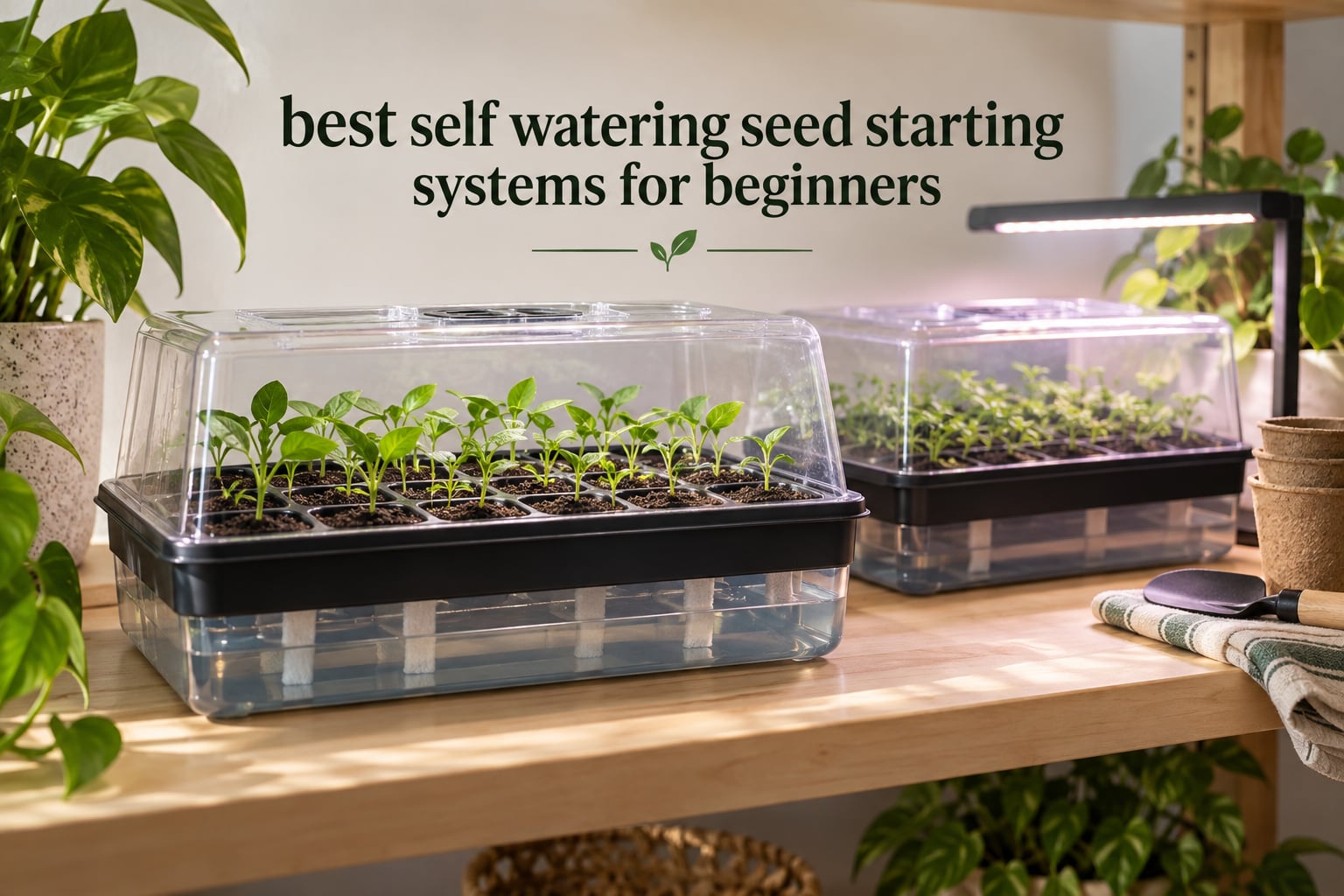
Almost every first-time seed sower loses a tray to the same problem, and it is not the seed. It is the watering. You pour water across the cells, one corner ends up waterlogged, another stays bone dry, and somewhere in between a few seedlings collapse at the base with damping-off. A self-watering seed starting system removes that whole variable by moving water to the roots from underneath instead of from a bottle in your hand.
That is why the best self watering seed starting systems for beginners rank so high with people who have never grown anything before. You fill a reservoir once, a wicking mat carries the moisture up into the cells, and the medium stays evenly damp for days. Our team compared these kits side by side over a full indoor growing cycle, and the difference between a tray that wicks well and one that does not showed up in the seedling counts long before we finished reading the manuals.
This guide covers eight systems spanning small window ledges to two-tray grow stations, with and without grow lights. We evaluated germination consistency, how evenly the wicking mat delivered moisture, how easy the reservoir was to refill and drain, build quality, cleanup between crops, and whether a beginner could set it up without a diagram. For the lighting half of the equation, our grow light guide for seed starting picks up where these trays leave off.
One thing to say up front, because almost nobody does: self-watering solves moisture and nothing else. A veteran grower on a heating-mat setup described seedlings that grew fast in a warm tent and then declined the moment the heat came off. No tray fixes light or temperature. It fixes one very common problem very well.
Table of Contents
- Our Top 3 Best Self Watering Seed Starting Systems (October 2026)
- Quick Comparison of Every Self-Watering Seed Starter in 2026
- 1. Burpee XL Self-Watering System: The Best All-Around Pick for Beginners
- 2. Patigrow 60-Cell Tray With Grow Light: The Best Value in a Complete Kit
- 3. BlumWay 5-Pack 60-Cell Trays: The Best Budget Pick for Volume
- 4. Jiffy 34-Cell Self-Watering Tray Kit: The Best Pick for Peat Pellets
- 5. GOONMILL 6-Pack With Timed Lights: The Best Pick for Bulk Sowing
- 6. GrowEase 24-Cell Self-Watering Kit: The Best Pick for Durability
- 7. Terronix 120-Cell Kit With Grow Light: The Best Pick for Large Batches With Full Control
- 8. Tryitsbest 120-Cell Kit With Heat Mat: The Best Pick for Warm-Season Crops
- Mold and Algae Grow Because the Reservoir Never Dries
- How to Use a Self-Watering Seed Starter Step by Step
- Self-Watering Seed Starting Systems Buying Guide
- Frequently Asked Questions
- Which Self-Watering Seed Starter Should You Buy?
Our Top 3 Best Self Watering Seed Starting Systems (October 2026)
Burpee XL 32-Cell System
- 32 extra-large cells
- Self-watering mat and reservoir
- Coir pellets
- dome
- markers and plant-o-gram

Patigrow 60-Cell with Light
- 60 cells
- Built-in LED strips with timer and brightness
- Capillary mat and base tray
- BPA-free PET dome

BlumWay 5-Pack 60-Cell
- 300 cells across five trays
- Capillary wicking in every tray
- 3.9 inch vented dome
- Compact windowsill footprint
Our full list below covers all eight, but these three earned the top slots. The Burpee XL is the one we hand to a friend who has never grown a seed. The Patigrow is the most complete package for someone starting indoors with no separate light. The BlumWay five-pack is the answer when you want a lot of cells and refuse to pay light-kit prices for them.
Quick Comparison of Every Self-Watering Seed Starter in 2026
| Product | Specs | Action |
|---|---|---|
| Burpee XL Self-Watering System |
|
Check Latest Price |
| Patigrow 60-Cell with Grow Light |
|
Check Latest Price |
| BlumWay 5-Pack 60-Cell |
|
Check Latest Price |
 Jiffy 34-Cell 2-Pack Jiffy 34-Cell 2-Pack |
|
Check Latest Price |
 GOONMILL 6-Pack with Lights GOONMILL 6-Pack with Lights |
|
Check Latest Price |
 GrowEase 24-Cell Kit GrowEase 24-Cell Kit |
|
Check Latest Price |
 Terronix 120-Cell with Light Terronix 120-Cell with Light |
|
Check Latest Price |
 Tryitsbest 120-Cell with Heat Mat Tryitsbest 120-Cell with Heat Mat |
|
Check Latest Price |
Cell count is the single number that matters most and the one beginners misread most often. Bigger is not better for a first tray. More on that in the buying guide below.
1. Burpee XL Self-Watering System: The Best All-Around Pick for Beginners
Burpee XL Self-Watering Growing System Indoor Seed Starting 10″ W x 20″ L x 5″ H, 1 Kit (32 Cells)
32 XL cells at 2.25W x 2.25L x 2D
Tray 10W x 20L x 5H
Plastic, 2.3 lb
Includes mat, tray, coir pellets, dome, markers
Pros
- Deep cells suit tomatoes and peppers
- Complete kit needs no extra purchases
- Capillary mat carries moisture for days
- Reusable plastic with plant-o-gram diagrams
Cons
- 2 inch dome is short for fast crops
- Seedlings are hard to extract from cells
- Dome rests loosely and slips
This is the kit I keep recommending to first-timers. Two 16-cell planting trays sit on stands over a water tray with a self-watering mat between them, and the whole thing assembles without instructions because there is nothing complicated to assemble. Everything you need arrives in the box: trays, stands, mat, water tray, 32 coir pellets, a dome cover, six markers and two plant-o-gram diagrams.
The cells are the reason it works for real crops. At 2.25 inches wide and 2 inches deep, they hold a volume of medium that tomatoes, peppers and eggplants can actually root into, which a shallow 72-cell tray cannot manage. One reviewer reporting near-total results put it simply: no under- or over-watering problems and almost 100 percent germination.
Across roughly 3000 reviews, the single most repeated praise is the same thing. You fill the reservoir once and the mat keeps delivering moisture for days at a time. One owner told us a full tray carried seedlings through a six-day trip without a single check.
That same review history is where the criticisms sit, and you should know them before you buy. The 2-inch dome is genuinely too short for anything that grows fast. Squash, cucumbers and fast tomato varieties press against the plastic within a week, and owners report flattened seedlings along the edges. Buy the Burpee for deep-rooted crops, not for melons.
Extraction is the other recurring issue. Seedlings in these deep cells grip tightly, and growers describe medium crumbling and roots tearing when they pull. The fix is to run a spoon handle around the inside wall of the cell and lift from the bottom. Nobody mentions that tip in the listing, so consider it free advice.
The third complaint is build feel. The plastic is thin, the mat is reported to separate over time, and the dome simply rests on the tray rim rather than clipping to it. Owners still reuse these kits for more than one season, so it works, but it does not feel premium.
Why we picked it over everything else
Nothing else in this roundup combines a cell depth suited to real vegetables with a review history large enough to know where the failures are. The 4.3 rating across 3000-plus reviews tells you more than any spec sheet, and the complaints are all fixable rather than disqualifying.
For a first tray of tomatoes or peppers, this is the one. You get an honest week between waterings and cells deep enough that you are not potting up at week three.
Where it will disappoint you
If your plan is melons, squash or cucumber, the dome height becomes a real problem within days and you will be venting or removing the lid early. And if transplant timing catches you before the cells release easily, budget ten minutes per tray with a spoon handle.
2. Patigrow 60-Cell Tray With Grow Light: The Best Value in a Complete Kit
Patigrow 60-Cell Self-Watering Seed Starter Tray with Grow Light, Seed Starter Kit with 4.07” Humidity Dome, Indoor Seedling Starter Tray, Seed Starting Trays for Plant Germination, Seeds Growing
60 cells
Tray 11 x 16.6 x 7.28 inches
1.5mm BPA-free PET
2 LED strips, controller, dome, mat, labels
Pros
- Grow light included with timer and brightness
- Strong 73 percent five-star share
- Durable PET with venting and drainage
- Very complete box contents
Cons
- 7.28 inch assembly will not clear low shelves
- 60 cells means small batches waste tray space
If you want light and watering handled in one purchase, this is the tray to look at first. The 60-cell tray sits in a base tray over a capillary mat, and a support stand holds two LED strips above it with a controller and a detachable adapter. Nothing else in the box needs buying.
Each strip carries 56 high-efficiency LED beads with adjustable brightness and timer functions. That matters because seedlings on a windowsill stretch badly under inconsistent light, and a dimmable strip lets you raise the intensity as the seedlings thicken instead of scorching early growth.
73 percent of its 857 reviews are five-star, which is the strongest rating distribution among the multi-tray kits we tested. Reviewers consistently single out the simple one-fill watering routine and the fact that the whole thing is washable and reusable.
The ventilation detail is what separates it from cheaper kits. Two adjustable vents on the dome plus enlarged drainage holes in the cells mean you can drop humidity gradually after germination rather than ripping the lid off on day ten and shocking everything inside.
The materials hold up too. At 1.5mm, the high-density BPA-free PET dome and base tray are noticeably stiffer than the thin PVC kits at this level, and PET is what you want if you plan to reuse the tray across seasons rather than seasons across trays.
Two practical limits are worth planning around. The full assembly stands 7.28 inches tall, so measure the gap under your shelf before you commit. And 60 cells is a lot of tray for a first attempt; if you only want a dozen brassicas, you will be lighting and watering a lot of empty medium.
Why we picked it over everything else
It is the only kit here where light and moisture are engineered together rather than combined by stacking a generic lamp on a generic tray. The controller, the brightness steps and the venting all live in one package, which removes the most common beginner assembly error.
At 60 cells it also gives you enough room to run two sowing dates in one tray, something smaller kits cannot do.
Where it will disappoint you
The height is the first thing people notice when it arrives. Under a low cabinet or a sloping shelf it will not fit assembled, and you will end up running it on a table surface with the light much closer than intended. The cell count also forces early succession sowing if you want continuous harvests.
3. BlumWay 5-Pack 60-Cell Trays: The Best Budget Pick for Volume
BlumWay Self-Watering Seed Starter Tray with Grow Light, 5 Pack 60 Cells
5 trays of 60 cells
Tray 8.5 x 7.25 x 7 inches
1.2 lb clear ABS
40 LED beads, dome, capillary wicking
Pros
- 300 cells at the lowest cost per cell
- Compact windowsill-friendly footprint
- 3.9 inch dome is taller than most kits
- Trays are clear
- washable and reusable
Cons
- Only 8 LEDs per tray
- weak for dense sowing
- Tall domes make a five-stack awkward to store
Five trays of 60 cells is an unusual amount of capacity, and it is the reason this pack exists. If you are sowing large batches of lettuce, radish, herbs or flowers in spring, this is the cheapest cell-per-seedling path in the roundup by a wide margin.
The self-watering side works the same way as the pricier kits. Water goes into the container, the capillary mat wicks it to the seeds, and the cells stay evenly moist from germination through to transplanting. Each tray has its own dome and light, so the five can be staged independently as different crops come up at different times.
The dome is 3.9 inches tall, which is taller than most kits in this price range, and cells are 1.97 inches deep in thickened clear ABS. Clear cells mean you can check root development without pulling the seedling out.
What you get for the light is modest, and we want to be straight about it. Across the five trays there are 40 LED beads total, or 8 per tray, running full-spectrum with 5 brightness levels and 3 timer settings of 3, 6 or 12 hours. That is enough to prevent leggy seedlings on a dim windowsill. It is not enough to grow dense, stocky seedlings for weeks.
Treat these lights as a supplement and pair the trays with a stronger lamp if your seedlings will stay indoors past the first true leaves. Our full grow light comparison covers what to look for in a fixture that has to run 14 hours a day.
Storage is the other thing nobody mentions until they try it. Because the domes sit above the tray rim, stacking five filled trays is awkward, and a shelf that fits two does not fit five.
Why we picked it over everything else
Cell economics. When a beginner is trying to work out whether growing from seed is worth the setup, the answer often depends on whether they can sow 300 cells without hesitating. This pack removes the cost conversation entirely.
The 8.5 inch by 7.25 inch footprint also runs several trays across a normal shelf, which no larger kit manages.
Where it will disappoint you
Per-tray light output is the honest limitation. If you fill all 300 cells with dense sowing and rely on the included LEDs alone, you will end up with stretched, pale seedlings and you will move them to a better light anyway. The single-tray lights also need a few tries to set correctly the first time.
4. Jiffy 34-Cell Self-Watering Tray Kit: The Best Pick for Peat Pellets
Jiffy Seed Starter Tray Kit, Self-Watering, Seedling Tray, 2 Pack
Two 34-cell trays
Each tray 11 x 11 x 4 inches
68 expanding peat pellets plus wicking mat
No dome or light included
Pros
- Peat pellets remove the need to buy soil
- Compact square trays fit shelves and benches
- Water-wicking mat built in
- Works indoors or outdoors
Cons
- No dome or grow light in the box
- Lowest rating in the group at 4.0
- Pellets need repeat watering to expand fully
Jiffy is the traditional answer and the one most long-time growers already trust. Two 34-cell trays come with 68 expanding 36mm peat pellets and a water-wicking mat, and each tray measures 11 by 11 by 4 inches. That square footprint stacks efficiently on a shelf or greenhouse bench in a way the rectangular kits do not.
The pellet argument is real for beginners. It removes soil handling entirely during the vulnerable germination stage, and each pellet lifts out as a self-contained plug at transplant time, so you are not scooping medium out of small cells with a knife.
Forum regulars on r/vegetablegardening often tell new growers that an all-in-one kit like this should do just fine, because the tray keeps the water contained and the pellets keep the medium consistent.
What you give up is convenience in every other direction. There is no dome in this kit, which means you need to cover the trays with plastic or a cover of your own during germination and manage humidity yourself. There is no light, either.
That is fine if you already own a light and a cover, and a poor fit if you do not. It also explains the 4.0 rating, the lowest in our group, with 15 percent of reviews at three stars and 8 percent at two. The complaints cluster on the missing accessories and on pellets that need several rounds of watering before they fully expand and stop floating.
One more practical note for root checks: the clear and black tray styling gives you less visibility into what is happening below the surface than the all-clear kits in this roundup.
Why we picked it over everything else
Peat pellets have been the standard propagation medium for decades, and if you plan to move your seedlings straight into containers without an intermediate soil step, the plug format is genuinely easier to handle. It also works outdoors, so a bench in a cold frame is fine.
At 34 cells per tray you are working with a manageable number of plants rather than a wall of them.
Where it will disappoint you
Buying this as a complete starter kit will disappoint you, because it is not one. You still need a humidity cover, a light and a water source fine enough for initial sowing. And if you dislike handling wet peat, breaking expanded pellets apart by hand before transplanting is a step some growers avoid entirely.
5. GOONMILL 6-Pack With Timed Lights: The Best Pick for Bulk Sowing
GOONMILL Self-Watering Seed Starter Tray with Timed Grow Light, 6 Packs Plant Starter Tray Seedling Starter Kit with Humidity Domes Base Indoor Mini Greenhouse for Gardening Seeds Growing Starting
6 trays with mat, base, dome and light
Each unit 6 x 7.8 x 8.2 inches
PVC construction
18 labels and 6-in-1 USB C cable
Pros
- Six independent trays for large batches
- Four timer options plus three light modes
- Cell drainage holes reduce waterlogging
- One USB C cable powers the whole set
Cons
- PVC build is less eco-friendly
- Small trays need frequent refills as they fill
- Weakest one-star share in the group at 9 percent
Six trays is a lot of growing capacity, and each one is self-contained. Every tray gets its own capillary mat, base tray, humidity cover, grow light and set of drainage holes, which means you can run six different crops on six different schedules without any of them interfering with the others.
The lighting controls are the most detailed in the group for a kit this size. Three lighting modes cover red plus blue plus warm white, red plus blue only, or warm white only, with five brightness levels from 20 to 100 percent and four timer options at 4, 8, 12 and 18 hours. Stage-specific scheduling matters more than most beginners expect.
A single 6-in-1 USB C cable powers the entire set, which keeps a six-tray station tidy on one outlet instead of six.
Where to be careful is size and material. Each tray is 6 by 7.8 by 8.2 inches, which means six of them take real shelf space, and because the trays are small you will find yourself refilling six reservoirs rather than one as the season ramps up.
The construction is PVC, which is less appealing environmentally than the recycled or PET builds we tested, and it does not have the stiffness of thicker domes. The 9 percent one-star share is the highest in our group, which points to occasional quality control issues rather than one recurring design fault.
The round vents on each dome adjust from 50 to 100 percent humidity. Vent them earlier than you think you need to, particularly once the domes start fogging heavily in a warm room.
Why we picked it over everything else
Independence. Each tray being fully self-contained is the feature that separates this from the light-equipped kits that use one big tray. It suits someone starting a real program of crops, or someone who wants tomatoes, peppers, basil and flowers running at once without a shared dome.
The mode and timer controls also let you dim a tray down once seedlings are established instead of running full power all season.
Where it will disappoint you
Six small trays means six things to fill, six things to check and six things to clean at the end of the run. That is more handling than most beginners want, and it works against the low-maintenance promise of self-watering in the first place. Expect to reach for this only once you have already done a successful tray by hand.
6. GrowEase 24-Cell Self-Watering Kit: The Best Pick for Durability
Gardener’s Supply Company GrowEase Self Watering Seed Starting Kit | 24- Cell, Holds 3 Quarts of Soil | Capillary Mat, Cover and Water Reservoir Included, 100% Recycled Plastic
24 cells holding 3 quarts of mix
Tray 9.25D x 14.75W x 2.25H
Cells 2 inch square x 2.25H
10-cup reservoir, mat and dome
Pros
- Highest rating in the group at 4.6 with 80 percent five-star
- Heavy-duty recycled plastic build
- Dishwasher-safe parts simplify sanitizing
- Leak-proof 10-cup reservoir
Cons
- Only 24 cells limits batch size
- No grow light included
- 2.75 inch dome is short for fast seedlings
This is the one we would keep. The build quality is a clear step above everything else here, and the 4.6 rating across 102 reviews with 80 percent five-star is the highest average and the cleanest distribution in the roundup. Reviewers consistently single out the reservoir and the ease of cleaning rather than features.
Everything is made from heavy-duty BPA-free recycled plastic, sourced from post-industrial or pre-consumer material, and every component including the reservoir, platform and cell tray is dishwasher-safe. Between crops you run the whole thing through a cycle instead of scrubbing cell corners with an old toothbrush.
The reservoir holds 10 cups and is built to be leak-proof, which is what makes weekend trips realistic. Cells are 2 inches square and 2.25 inches tall, the tray takes 3 quarts of starting mix, and the clear germination cover sits under a 2.75 inch dome.
The reason it is not our top pick comes down to size and light. Twenty-four cells is the smallest tray count in this roundup, and that is a real limit if you want to trial several varieties. There is no grow light included, so you will be sourcing one separately.
The 2.75 inch dome is short for the same reason the Burpee dome is. Fast crops press against it, and growers using tall tomato and pepper varieties tend to remove the dome sooner than the manufacturer suggests.
It is also backed by Gardener’s Supply’s lifetime guarantee and tested for the life of the product, which tells you something about how long this thing is meant to last. For a grower who expects to start seeds every year for a decade, that is the argument that wins over cell count.
Why we picked it over everything else
Durability you can sanitize. Every other kit in this roundup asks you to wash trays between cycles; this one goes in the dishwasher. For a system whose main failure mode is algae and mold in crevices, that difference compounds season after season.
The reservoir depth and the recycled plastic build also mean this is the tray most likely to still be working years from now.
Where it will disappoint you
If you want to compare twenty varieties of pepper in one run, twenty-four cells will not do it. And the short dome means you are removing the cover early on any fast-growing variety, which slightly reduces the humidity control you paid for.
7. Terronix 120-Cell Kit With Grow Light: The Best Pick for Large Batches With Full Control
120-Cell Self-Watering Seed Starter Tray with Grow Light, 1–24H Timer, Humidity Dome, Soil pH Meter, Gloves, Seedling Tools – Indoor Seed Starting Kit for Plant Germination, Herbs, Vegetables, Flowers
Two 60-cell trays
Tray 16.54 x 10.87 x 7.61 inches
3.7 lb, 1.5mm BPA-free PET
Includes pH meter, gloves, 20 labels
Pros
- Widest timer range at 1 to 24 hours
- Two trays give 120 cells in a compact footprint
- Bundled pH meter and gloves help first-timers
- Thicker PET than thin PVC kits
Cons
- Heaviest kit here at 3.7 pounds
- Only 55 reviews so durability is less proven
- No heat mat included
This is the most controllable lighting setup in the group. Each tray has 56 high-efficiency LED beads with a timer that runs anywhere from 1 to 24 hours, which is a wider scheduling range than any other kit we tested. Four light strips, a controller and a detachable adapter come in the box across two trays.
Two 60-cell trays give you 120 cells inside a 16.54 by 10.87 inch footprint, so you get high capacity without a huge footprint. Two domes, four vents, two capillary mats, two base trays and two stands are included, along with 20 plant labels, two tools, a soil pH meter and a pair of gloves.
Those extras are genuinely useful for a beginner. A pH meter costs less to include than to explain in a forum answer, and mis-set soil pH is one of the quieter reasons seedlings stall.
The trade-offs are weight and history. At 3.7 pounds this is the heaviest kit we tested, and two light bars on stands need a shelf with real capacity under it. At 55 reviews it also has the shortest track record here, so the durability story is still being written.
There is no heat mat in this kit. Warm-season crops such as peppers and tomatoes germinate faster and more evenly with bottom heat, so you would be adding one separately if your crops need it.
The dome and base tray are 1.5mm high-density BPA-free PET, two vents per dome plus enlarged drainage holes, which is the same build approach we liked on the Patigrow. It feels noticeably stiffer than thin PVC in the hand.
Why we picked it over everything else
The timer. A 1-to-24-hour range lets you run a short cycle for young sprouts and extend to a full day for leggy seedlings without buying a different controller, which is the single most useful light feature for a beginner working out a schedule.
Two trays also means you can offset sowing dates by two weeks and still be transplanting at the same time.
Where it will disappoint you
Weight and bulk. This is a two-tray, four-bar light station and it needs real vertical clearance and a shelf that can take the load. If you are working at a small desk or a windowsill, it is too much hardware for the space.
8. Tryitsbest 120-Cell Kit With Heat Mat: The Best Pick for Warm-Season Crops
120-Cell Self-Watering Seed Starter Tray with Grow Light, Indoor Seed Starting Kit Trays with Heat Mat, Adjustable Brightness Plant Germination Trays Growing Kit with 4.13″ Humidity Dome for Seed Grow
Two 60-cell trays
Tray 16.7D x 11W x 7.6H
4.13 inch dome height
BPA-free PET with waterproof heat mat
Pros
- Only kit here with a waterproof heat mat
- 8 brightness levels with 0-24h timer
- Tallest dome at 4.13 inches
- Enlarged drainage holes for airflow
Cons
- Base trays reportedly arrive cracked
- Plastic feels light for the price
- Round vent covers are fiddly to seat
Heat is the missing ingredient in most indoor seed starting, and this is the only kit in the roundup that includes it. A waterproof heat mat sits under the two 60-cell trays, giving peppers, tomatoes and cucurbits the warm bottom they need for faster and more uniform germination. The surface wipes clean.
The lighting is the most granular in the group as well. Full-spectrum bars with 8 brightness levels and a 0-to-24-hour timer, and the bars can be controlled individually or jointly. That means you can dim one crop that is stretching while another under the same controller is fine.
The dome stands 4.13 inches tall, the tallest we tested, which means tall seedlings and flowers do not need repotting as soon. Owners report near-total germination and well-developed roots at transplanting.
The complaints center on arrival and build rather than function. Multiple reviewers reported base trays arriving cracked and needing replacements, and the plastic feels lighter in the hand than the price suggests. Round vent covers also need firm pressing to stay seated, which is a small annoyance repeated daily.
Check the base trays and domes the moment the kit arrives rather than after you have filled them with a wet medium load. That habit catches damage while a replacement is easy.
Structurally it is still a strong system. Two 60-cell trays, enlarged drainage holes, two adjustable vents per dome, and a capillary mat with reservoir that keeps moisture consistent with less daily attention.
Why we picked it over everything else
Because heat and water together solve the two problems that actually stall warm-season seedlings. Most self-watering trays fix moisture and then leave you hunting for a separate mat, which is where beginners quietly give up.
The 4.13 inch dome also removes the height problem that undercut several kits above it.
Where it will disappoint you
Value is the issue. You are paying for a feature-max package, and if cracked trays show up you will be dealing with warranty friction before you have sown a single seed. Check everything on arrival, and keep the packaging until you have confirmed the kit works.
Mold and Algae Grow Because the Reservoir Never Dries
Algae and mold are the number one complaint about self-watering trays across every gardening forum we looked at, and the reason is mechanical. A reservoir that stays damp and a mat that stays wet are two ideal surfaces for growth, and light plus warmth finishes the job.
Users on the Dave’s Garden forum note that algae appears on almost anything in a capillary-mat setup and that washing mats with plain water each season keeps them working, because they do not rot the way textiles do. Others squeeze mats to clean them, which is the one thing you should never do, since it destroys the wicking structure.
Five habits keep these systems clean:
1. Empty and wipe the reservoir between every crop cycle, even a short one. Standing water is where the problem starts.
2. Refill with plain water rather than fertilizing through the reservoir. Fertilizer residue in a wet mat feeds growth far faster than it feeds seedlings.
3. Vent the dome as soon as you see fogging, and remove it entirely once true leaves appear.
4. Never squeeze, wring or twist a capillary mat. Rinse it flat under cool water and dry it flat.
5. Space trays so air moves between them. Stacked, wet, warm trays with no airflow are where damping-off starts.
Do self-watering systems cause root rot? They can, and the mechanism is the same one. A permanently saturated root zone starves roots of oxygen, and the community consensus among experienced growers is that for small cells the real risk is wicking too much water rather than too little. If your medium is dark and heavy and the tray is not draining, stop refilling for a few days.
How to Use a Self-Watering Seed Starter Step by Step
Fill the cells first. Add moistened seed starting mix or expanded pellets before water goes anywhere. Dry medium wets unevenly around seeds, which is the most common cause of spotty germination.
Sow at the depth on the packet. Cover lightly and press gently. Most beginners bury too deep, which costs germination.
Bottom-water once by hand. Before you rely on the wicking system, pour a little water under the tray and let it draw up for an hour. This removes dry pockets and even out moisture distribution across cells, which is the fix for the uneven watering users complain about most.
Fill the reservoir. Keep a finger width of clearance at the top, and do not fill it to the brim. The mat sits in the water, not under it.
Put the dome on and leave it. Keep it closed until you see condensation and the first sign of green. Then begin venting on a daily basis.
Remove the dome at true leaves. Once real leaves are growing, the seedlings no longer need the humidity, and keeping the dome on is the fastest route to mold.
Refill when the water line drops below the mat. Check daily for the first week. A clear reservoir makes this a glance rather than a guess.
Transplant before roots circle. How long can seedlings stay in starter trays? Four to six weeks for most crops in 60-cell trays, closer to three weeks in small cells. You will see roots circling at the drainage holes or white root tips visible through clear cells. Never pull a seedling by the stem; loosen the sides and lift from the base.
Self-Watering Seed Starting Systems Buying Guide
Match cell count to what you actually sow. Six-cell systems suit two large plants. 24 to 34 cells is right for a first serious run. 60 cells is a batch of lettuce, brassicas or herbs. 72 cells and above is for maximum volume with early transplanting, and it overwhelms most first-timers. Deep crops like tomatoes, peppers and squash need the deepest cells you can find.
Decide honestly whether you need a light. A sunny south-facing windowsill can carry seedlings through germination, but anything past the first true leaves needs 14 to 16 hours of supplemental light. Kits with integrated lights cost more but remove a step and a matching problem.
Look at reservoir depth, not just cell count. A deeper reservoir means longer intervals between refills, which is the entire point for anyone who travels or has a busy week.
Check the mat, and check whether replacements exist. Mats tear and go slimy over time. Acrylic felt is generally enough for small cells; thicker mat is worth it for larger cells and long growing windows. Never squeeze a mat to clean it.
Prioritize vented domes. A dome with no vent or with a single fixed vent gives you no humidity control, and humidity control is what keeps mold away after germination.
Measure your vertical space before ordering. Assemblies with light bars and stands run 7 to 8 inches tall. Know your clearance.
Think about materials for the long run. Recycled or PET trays cost more upfront and survive more seasons. Dishwasher-safe parts matter more than any feature once you have run three crops through the same tray.
Plan for accessories. Most kits ship without medium, and some ship without a dome or a cover. Buy a seed starting mix rather than garden soil, and expect to add a heat mat if you are starting warm-season crops in a cool room.
Frequently Asked Questions
What is the best seed starter kit for beginners?
For a first tray, a 24 to 60-cell kit with deep cells, a wicking mat, a reservoir and a vented dome is the right starting point. Beginners do better with fewer cells and deeper soil than with a large cell count and shallow cells, because a big tray forces earlier transplanting than most people expect.
What is the best watering system for seedlings?
A reservoir with a capillary mat delivers the most consistent moisture, because it keeps the root zone evenly damp instead of alternating between soaked and dry. The main risk is that a permanently full reservoir keeps small cells too wet, so you still need to check the water level and drain it when medium stays dark and heavy.
How long can seedlings stay in starter trays?
Most seedlings can stay in starter trays for four to six weeks before transplanting, and crops in small cells may need moving at three weeks. Signs to watch for include roots circling at the drainage holes, white root tips visible through clear cells, and seedlings becoming tall and pale rather than bushy.
How can I prevent mold from growing in my seed starter?
Empty and wipe the reservoir between crops, refill with plain water instead of fertilizer, vent the dome as soon as it fogs, and remove the dome entirely once true leaves appear. Rinse capillary mats flat under cool water, never squeeze them, and space trays apart so air can move between them.
Does capillary matting work?
Yes. The mat wicks water upward from the reservoir by capillary action and keeps growing medium evenly moist. It works best when the medium is already moist, when the reservoir never sits empty, and when the mat is rinsed flat rather than squeezed, since squeezing destroys the wicking structure.
What are common problems with auto watering?
The usual problems are uneven moisture between cells, algae growth in a reservoir that never dries, over-saturated root zones that invite damping-off, and mats that tear or turn slimy with age. All four come down to the same cause, so draining the reservoir regularly, ventilating the dome and cleaning mats between cycles prevents them.
Which Self-Watering Seed Starter Should You Buy?
Buy the Burpee XL if this is your first tray and you want to grow tomatoes or peppers. Its deep cells and 3000-plus review history make it the most forgiving option, and the two known problems, a short dome and stubborn seedlings, both have workarounds.
Buy the Patigrow 60-cell if you want light and watering handled together and have the shelf height for it. Buy the GrowEase 24-cell if you would rather own one tray for a decade than start a hundred seedlings at once. Buy the Tryitsbest if warm-season crops are the goal and you would rather not add a heat mat later.
The best self watering seed starting systems for beginners all share three habits: fill the cells before the reservoir, hand-water once from below to even out the moisture, and empty the tray between crops. Those three steps matter more than any feature on this list.
Once your first tray is transplanted, harden the seedlings off gradually over a week before they go into a bed, and our seed starting light guide covers what to run above them through that stage.