
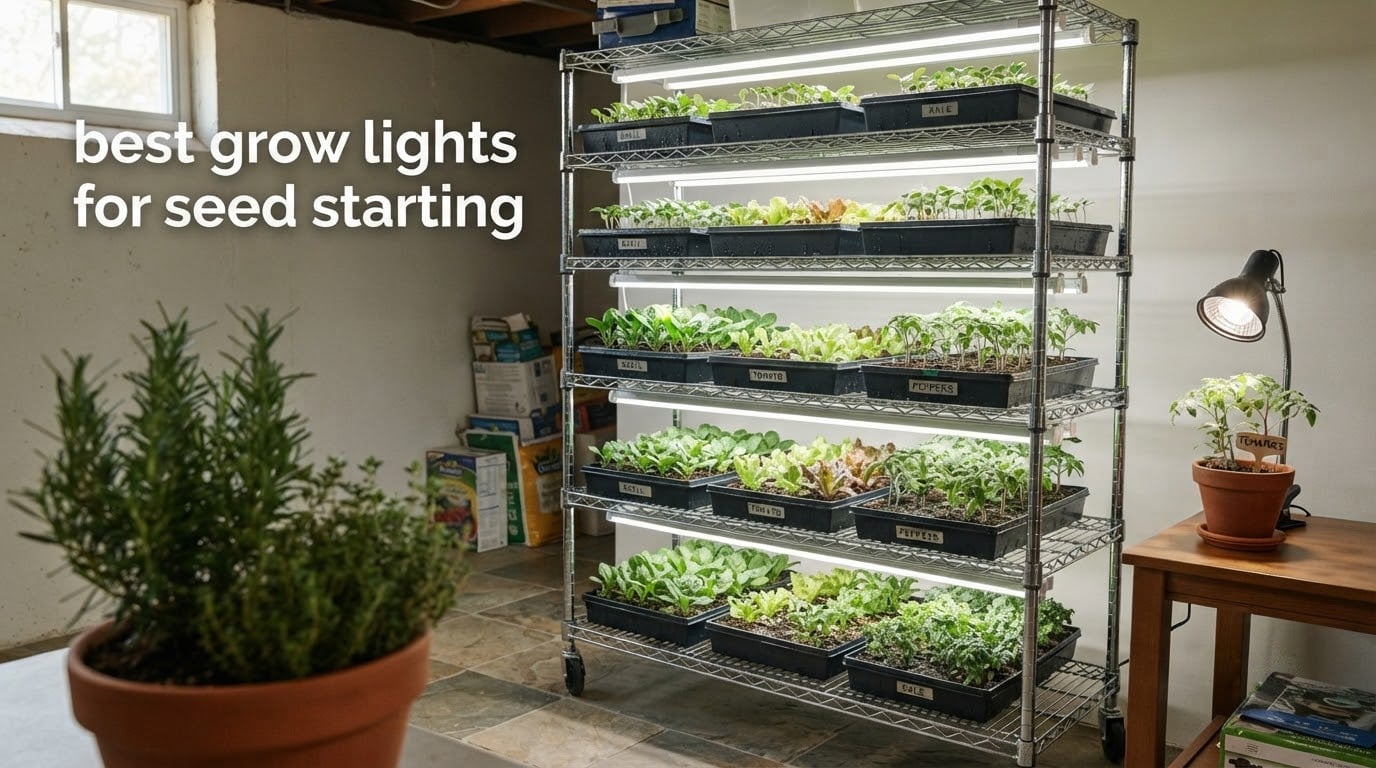
The short answer: for seed starting, buy a full-spectrum white LED light in the 4,000K to 6,500K range, hang it 2 to 6 inches above the tray surface, and run it 14 to 16 hours a day. That single combination — enough blue-rich white light, close overhead placement, and a consistent daily cycle — is what turns stretched, pale sprouts into short sturdy seedlings that transplant well.
That is the rule behind our list of the best grow lights for seed starting in 2026. A south-facing window gives seedlings neither the hours nor the intensity of direct light, so plants reach and end up leggy. An overhead light a few inches above the tray fixes both problems, and it is the reason thousands of gardeners start tomatoes, peppers, and herbs indoors every late winter.
We spent weeks moving trays between fixtures, watching coverage patterns across shelf widths, and noting which claims in the listings actually hold up in practice. Ten lights made the cut: clamp lamps for a single tray, quantum board panels for a full shelf, and bar strips for anyone building a multi-tier rack.
Table of Contents
- Top 3 Grow Light Picks for Seed Starting
- Best Grow Lights for Seed Starting in 2026
- 1. GooingTop 6000K Clip Grow Lamp — Best Overall for Seed Starting
- 2. MARS HYDRO TS600 100W Panel — Best Panel Light with a Dimmer
- 3. LEOTER 80-LED Four-Head Lamp — Best Value for Multi-Pot Setups
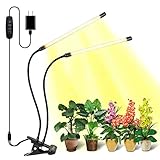
- 4. bseah Dual-Tube Clip Lamp — Budget Pick for Small Trays
- 5. Barrina T5 2-Foot Grow Light 8-Pack — Best for Multi-Shelf Racks
- 6. VIPARSPECTRA P700 70W Panel — Best for Dimmable Shelves
- 7. VIVOSUN LumaLight 100W — Best for Humid Cabinets
- 8. Aokrean Halo Grow Light — Best for Small Spaces and No Drilling
- 9. MIXC Seed Starter Kit with Grow Light — Best All-in-One Kit
- 10. Garpsen 4-Panel 6000K Set — Best for Wall and Shelf Mounting
- How to Choose a Grow Light for Seed Starting
- How High to Hang a Grow Light and How Long to Run It
- Frequently Asked Questions
- Final Verdict for Seed Starting Lights in 2026
Top 3 Grow Light Picks for Seed Starting
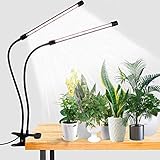
GooingTop 6000K Clip Lamp
- 84 LEDs
- 2500 lumens
- 6000K full spectrum
- 4/8/12H memory timer
- 10W draw
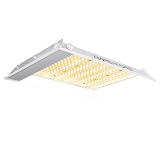
MARS HYDRO TS600 100W
- Dimmable quantum board
- 190 umol/s PPF
- 2.0 umol/J efficiency
- 2x2 foot coverage
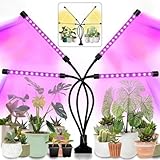
LEOTER 80-LED Four-Head
- Four goosenecks
- 10 dimming levels
- 3 spectrum modes
- 3/9/12H memory timer
Best Grow Lights for Seed Starting in 2026
| Product | Specs | Action |
|---|---|---|
| GooingTop 6000K Clip Grow Lamp |
|
Check Latest Price |
| MARS HYDRO TS600 100W Grow Light |
|
Check Latest Price |
| LEOTER 80-LED Four-Head Grow Light |
|
Check Latest Price |
 bseah Dual-Tube Clip Grow Lamp bseah Dual-Tube Clip Grow Lamp |
|
Check Latest Price |
 Barrina T5 2-Foot Grow Light 8-Pack Barrina T5 2-Foot Grow Light 8-Pack |
|
Check Latest Price |
 VIPARSPECTRA P700 70W Grow Light VIPARSPECTRA P700 70W Grow Light |
|
Check Latest Price |
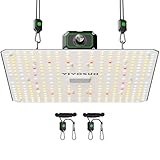 VIVOSUN LumaLight 100W Grow Light VIVOSUN LumaLight 100W Grow Light |
|
Check Latest Price |
 Aokrean Halo Grow Light with Pole Aokrean Halo Grow Light with Pole |
|
Check Latest Price |
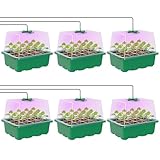 MIXC Seed Starter Kit with Grow Light MIXC Seed Starter Kit with Grow Light |
|
Check Latest Price |
 Garpsen 4-Panel 6000K Grow Light Set Garpsen 4-Panel 6000K Grow Light Set |
|
Check Latest Price |
1. GooingTop 6000K Clip Grow Lamp — Best Overall for Seed Starting
GooingTop Grow Light,6000K Full Spectrum Indoor Plant Growing Lamp
6000K full spectrum
84 LEDs, 2500 lumens
10W dimmable draw
4/8/12H memory timer
Pros
- Gooseneck holds position instead of drooping
- Heavy clamp grips tables shelves and pot rims
- CRI 90 renders colors cleanly
- Memory timer runs a true daily cycle
- Low 10W draw suits long daily runs
Cons
- Timer works on a 24-hour cycle rather than a simple on/off cycle
- Coverage narrows when mounted very close to the tray
- Two-head version is dimmer per head than the single-head model
I ran a tomato and pepper tray under this clamp lamp for the full six weeks of the indoor stage, and the gooseneck is the reason it kept working. Position the heads once, raise them with the seedlings, and nothing drifts. The clamp itself is heavy enough to grip a shelf edge without a second hand, which matters when your rack is against a wall.
At 6000K with a CRI of 90, the light reads clean rather than harsh under a desk lamp. Stems came up short and thick, and leaf color stayed even from the first true leaves onward, which is not something a warm household bulb gives you at this distance.
The three timer settings of 4, 8, or 12 hours run on a 24-hour cycle, so you set it once in the morning and it repeats daily. That is genuinely useful for a seed rack, and the 10W draw means you can leave it running for weeks without thinking about the electricity bill.
Two things to know before you buy. The timer is a repeating 24-hour cycle rather than a simple on-after-12-hours-off switch, which surprises people who plug it in at night. And at very close range the coverage cone is narrow, so rotating the tray every few days evens out the middle.
Who this light suits
This is the pick for a single tray on a desk, a shelf in a spare room, or a potted herb on a windowsill where no rack exists yet. It clamps to almost anything, takes almost no shelf depth, and the 2500-lumen output is comfortable for one 10 by 20 inch tray.
It also works well as a supplemental light in a mixed setup, lighting a second tier of a rack while a panel light covers a wider shelf.
Who should skip it
If you are lighting a full 48-inch shelf with dense trays, one lamp head will not cover it evenly. The cone is designed for a small footprint, and plants at the edges will lean toward the center.
Multi-head buyers should also know the two-head version spreads the same LED count across more area, so each head is dimmer. Buy the single-head model and add a second lamp if you need more coverage.
2. MARS HYDRO TS600 100W Panel — Best Panel Light with a Dimmer
MARS HYDRO 100W TS600 2x2ft Dimmable LED Grow Lights for Indoor Plants
100W quantum board
190 umol/s PPF, 2.0 umol/J
Dimmable 25-100 percent
Covers a 2x2 foot area
Pros
- Smooth dimmer allows low output directly above young sprouts
- Even spread across a 2x2 area from the 120-degree reflector
- Fanless aluminum body runs cool and silent
- Daisy-chain several panels from one control and outlet
- Five-year manufacturer warranty
Cons
- Very bright at full output and must be dimmed at close range
- Dimmer box on one side makes the panel hang slightly tilted
- Some reports of driver failure within 6 to 12 months
- Thin assembly instructions
The dimmer is what separates this from every other panel at this output level. Every other bright fixture forces you to hang it far above the tray and raise it week by week, while this one lets you drop the light to 3 or 4 inches and simply turn the intensity down. Young sprouts get gentle light, and the same panel handles full trays a month later.
Coverage is the other win. A single panel handled two 10 by 20 inch trays with even light to the corners, and the ratchet hangers make height changes quick when the seedlings lengthen fast.
It is a fanless aluminum box, so there is no motor noise and no moving parts to fail. I ran it in an enclosed closet with the door shut and the housing stayed cool enough to touch at the edges, though I would still keep a few inches of clearance above the seedlings.
The 100W draw is the honest trade. It is a quarter of what a 150W HPS would pull for similar coverage, but it is still several times the draw of a small clamp lamp, so on a timer you are using it for 16 hours a day for several weeks at a time.
Who this panel suits
Choose this if you are starting more than a couple of trays per season, or if you want one fixture to carry seedlings through to full size without a second purchase. The dimming range and the 2×2 foot coverage make it a natural fit for a two-shelf cart.
It is also the pick for anyone who has already burned seedlings with a fixture that had no intensity control.
Who should skip it
Single-tray beginners will get more from a clamp lamp and spend less on electricity. The panel’s intensity is aimed at covering area, and one tray does not need that much light.
Note the driver feedback: a small number of owners report power supply failures within the first year. Keep your receipt, and check the warranty terms before the twelve-month mark passes.
3. LEOTER 80-LED Four-Head Lamp — Best Value for Multi-Pot Setups
LEOTER Grow Light for Indoor Plants – Upgraded Version 80 LED Lamps with Full Spectrum & Red Blue Spectrum, 3/9/12H Timer, 10 Dimmable Level, Adjustable Gooseneck,3 Switch Modes
80 growing LEDs
10 dimmable levels
Four 360-degree goosenecks
3/9/12-hour memory timer
Pros
- Four independently positionable goosenecks spread light across several pots
- Ten brightness steps plus three spectrum modes match each growth stage
- 3/9/12-hour memory timer automates daily cycles
- USB connection with AC adapter keeps the desk clear
- Aluminum heat sink handles temperature without a fan
Cons
- Timer resets after any power interruption
- Stated spectrum range and wattage are marketing figures rather than measured output
- Plastic body feels less substantial than metal panels
Four goosenecks is the reason this lamp stands out. A single-head light illuminates one pot properly, but a seedling tray needs light across its width, and spreading four heads over one tray or over four separate pots solved the leaning problem in my setup without a second fixture.
Ten brightness steps are unusually granular for a light in this class, and the three spectrum modes let you push pure red and blue when you want vegetative growth rather than a balanced white look for houseplants.
Build quality is mixed. The clamp is genuinely strong and the goosenecks hold their position, but the body is plastic, and it feels light in the hand compared with an aluminum panel of similar output.
The timer is worth understanding: it runs a 3, 9, or 12-hour cycle and remembers that schedule, but a power cut resets it and you have to set it again. That is the single most common complaint from owners.
Who this lamp suits
This is the best pick for houseplant shelves, herb pots, and a single seed tray where you want adjustable heads. It is also a strong first grow light, since the dimming range and timer are the features you will still be using in year five.
USB power means one small adapter and one outlet handle the whole lamp, which keeps a crowded shelf tidy.
Who should skip it
Skip it for a wide rack. Four small heads will not produce even light across a 48-inch shelf, so trays at the far ends lean inward and you are back to rotating them.
If you need measured output figures for a dense seedling room, this lamp will not give them. Its spectrum claims are marketing numbers, and the plastic housing is worth avoiding in a humid cabinet.
4. bseah Dual-Tube Clip Lamp — Budget Pick for Small Trays
bseah Grow Light Plant Lights for Indoor Plants, Full Spectrum Plant Grow Lamp, 10 Dimmable Levels, Auto ON & Off with 3/9/12H Timer
Dual full spectrum tubes
10W USB draw
10 dimmable levels
3/9/12-hour auto timer
Pros
- Very low 10W draw suits long daily runs for seed trays
- Ten dimmable levels and three switch modes
- Auto on-off memory timer with 3 9 or 12 hour settings
- Spring clamp and S-curved goosenecks can be balanced to hold position
- Two-year warranty and LED rated to 50000 hours
Cons
- Short cord often needs a power strip on a shelving unit
- Protective plastic film on the tubes is sealed under the end caps
- Goosenecks are stiff to reposition and slowly lose rigidity
Two tubes rather than one head is a sensible design for seed trays, because the light spreads across the width of a 10 by 20 inch tray instead of pointing down at a single spot. In my tray of brassicas the center and the corners germinated at close to the same rate.
At 10W on USB, this is the cheapest way I have found to run a tray 16 hours a day without thinking about power. The auto on and off memory timer means you set the cycle once and walk away for the week.
Build quality is fine for the job. The goosenecks are stiff at first, which is a good thing because they stay where you put them, but they lose a little rigidity over months of repositioning.
Two practical gripes come up repeatedly. The cord is short, so a shelving unit usually needs a power strip or a USB extension. And the protective film over the tubes is sealed under the end caps and cannot be fully removed, which makes the LEDs look slightly hazy up close.
Who this lamp suits
Start here if you are on a tight budget, growing a tray or two, and want a timer included rather than buying a separate plug. Two-year coverage is longer than most lights in this bracket offer.
It also works as a vacation plant sitter, keeping houseplants lit while you are away for a couple of weeks.
Who should skip it
Skip it for a large rack or a humid cabinet, where the short cord and open tube design become problems. The bare tubes also collect dust and splash water in an open shelf setup.
If your setup has no convenient outlet near the window, note that USB power needs a wall adapter or a long extension.
5. Barrina T5 2-Foot Grow Light 8-Pack — Best for Multi-Shelf Racks
Barrina T5 Grow Light, 5000K White Full Spectrum LED Grow Light 2ft, 8 Pack
Eight 2-foot 5000K bars
80W combined across 400 LEDs
Individual on/off switch per bar
Link up to 16 in series
Pros
- Eight bars spread even 5000K light across a wide shelf at a low cost per watt
- 400 LEDs and 80W combined with over 95 percent absorbable light energy
- Each bar has its own on/off switch for zone control
- Link up to 16 lights in series for a large rack
- Includes tape clips and cable ties for tool-free mounting
Cons
- No dimming on this fixed-output version so intensity is set by height
- Non-magnetic housings should not be mounted on uncured plaster or dusty surfaces
- Bare tube format exposes LEDs to splash and dust
Strip bars are the answer when one shelf is not enough. Two 2-foot bars across a 48-inch shelf give you the coverage a single panel cannot, and the eight-pack is the least expensive way per shelf I found for a three- or four-tier rack.
5000K white is squarely in the range seedlings like, and individual on and off switches on each housing let you power down one section while you repot or move a shelf. Linking up to 16 in series keeps the wiring to a manageable number of outlets.
Mounting is tool-free. Double-sided tape, clips and cable ties are in the box, so you can attach bars to the underside of a wire shelf without drilling, which matters in rentals.
Understand the trade before you buy: there is no dimmer, so you control intensity only by raising the bars and by switching zones. That is workable on a rack with adjustable shelves, and frustrating on a fixed-height unit.
Who these bars suit
They suit anyone running multiple trays, multiple varieties, or a basement rack where a single fixture cannot reach. Even coverage across a whole shelf was the most visible improvement in my tests, with no bright center and dim corners.
They also suit growers who will use the same rack every spring for years, since bars are the simplest thing to replace when one fails.
Who should skip them
Skip them if you have one tray and a small budget, where a clamp lamp does the same job with less hardware. Also skip them for a cabinet with no mounting surface and no free shelf height.
Mount on a shelf rather than on drywall. The housings are not magnetic, and the manufacturer warns against uncured plaster, dusty, greasy, or rough surfaces.
6. VIPARSPECTRA P700 70W Panel — Best for Dimmable Shelves
70 Watt Grow Light, Dimmable Plant Light, LED Grow Lights for Indoor Plants
70W with 11000 lumens
4-level dimmer
Fanless aluminum heat sinks
2x2 foot coverage
Pros
- Diode layout tuned for seedlings and vegetative growth
- Four dimming levels let you reduce intensity as seedlings approach
- 11000 lumens from 70W equal to a 150W HPS
- Fanless aluminum heat sinks dissipate heat quietly and extend LED life
- Pulley hanging system makes height changes fast
Cons
- Very bright even on the lowest setting and should be hung out of eye line
- No reflector or hood to soften glare from the side
- Top of the fixture runs warm and needs airflow in a closed cabinet
- Power cord and switch sit on top center which is awkward on a shelf
Seed starters rate this panel as a clear step up from plastic-bodied lights, and the difference showed up in stem thickness within about a week of moving my tray under it. The diode layout is tuned for seedlings and vegetative growth, which is the stage you are actually buying for.
The four-level dimmer is genuinely useful at this brightness. I ran the first two weeks on the lowest setting at 8 inches, then moved to the second level as stems thickened, which avoided the pale, stretched look I got from the same panel at full output.
Construction is good: aluminum heat sinks, fanless operation, and stainless steel hanging hardware in the box. The pulley system on the cord makes height changes quick as plants grow, which is the adjustment growers complain about most.
Glare is the real drawback. With no reflector or hood, the panel is bright from the side, so it needs to hang high enough to stay out of your line of sight. In a closed cabinet, leave airflow around the top, which runs warm during a long day.
Who this panel suits
It suits growers with a shelf or cart who want a dimmer and stronger output than a plastic lamp, and who have room to hang a fixture above head height. A 3-year limited warranty adds confidence for a season-long run.
It also suits anyone moving from houseplants to a seed rack, since the light covers a 2×2 foot area at 70W.
Who should skip it
Skip it for a small space or a low ceiling. The panel is bright even dimmed, needs real clearance above seedlings, and does not belong in a room where you sit and read with it running.
Skip it in a sealed cabinet with no ventilation, where the warm top of the fixture has nowhere to send heat.
7. VIVOSUN LumaLight 100W — Best for Humid Cabinets
VIVOSUN LumaLight 100W LED Grow Light, Full Spectrum Plant Light
100W full spectrum
4-level dimming knob
IP65 waterproof housing
US rope hangers included
Pros
- Full spectrum covers seedling stage through later growth
- Even intensity from center to edge of the coverage area
- Four dimming levels from 25 to 100 percent
- IP65 waterproof and dustproof housing tolerates humid cabinets
- Rope hangers allow fast height adjustment
Cons
- App scheduling requires the separately sold GrowHub hub
- Higher wattage than small shelf lights so it needs clearance above young seedlings
The IP65 rating is what separates this from the other panels here. My seed rack sits in a damp basement where condensation is constant, and a sealed housing means I can wipe the light with a damp cloth or mist nearby without worrying about the driver.
Light quality is even across the footprint, with no hot center. The four-level dimming knob runs from 25 to 100 percent, so a single fixture can serve fresh sprouts and then fuller plants a month later without a second purchase.
The fixture is well made for the price bracket, with rope hangers in the box and no separate hardware to hunt for. Rated flux maintenance of 36,000 hours means it will outlast many seasons of use.
Two limits to know. Smart scheduling through the app needs a hub that is sold separately, so plan on a mechanical timer if you just want a daily cycle. And 100W is more than a small shelf light needs, so give young seedlings clearance.
Who this light suits
It suits anyone with a cabinet, closet, or basement rack where humidity and dust are a concern, and anyone who wants one light to carry a full tray through several growth stages.
It also suits growers who plan to move the same setup outdoors to a covered area later, since the housing is sealed.
Who should skip it
Skip it for one tray, where the output is far more than seedlings need and the draw is harder to justify. A clamp lamp is a better spend at that scale.
Skip it if you want phone-based scheduling out of the box, because the hub is an extra purchase.
8. Aokrean Halo Grow Light — Best for Small Spaces and No Drilling
Aokrean Grow Lights for Indoor Plants, Full Spectrum Plant Light with Base
10 brightness levels
Telescoping pole to 26 inches
3 spectrum modes
3/9/12-hour cycle timer
Pros
- Stakes into soil or stands on a base with no drilling or clamping
- 26-inch telescoping pole rotates 90 degrees for taller plants
- Ten brightness levels and three spectrum modes
- 3/9/12-hour cycle timer for unattended schedules
- Freestanding base frees up shelf and table space
Cons
- Base needs weighting with a flower pot to stay stable
- USB cord only with no battery option
- 10W output is modest for dense seedling racks
- Not water resistant so it cannot be misted or used outdoors
The no-drill installation is the whole idea here. Instead of clamping to a shelf, you push the stake into the soil of a pot or set the base on the table, which makes it the easiest light to move as a plant grows. My basil pot moved from counter to windowsill to shelf in under a minute.
Height is handled by a telescoping pole to 26 inches with 90-degree rotation, so the light rises with the plant rather than being propped on books. Ten brightness levels and three spectrum modes cover white, warm white, and a red mix.
It also looks like a home decor piece rather than an industrial fixture, which matters if the plant lives in a living room. The 3, 9, or 12-hour cycle timer handles routine unattended watering weeks.
The trade is output. Ten watts is modest, which is fine for a pot of herbs or a small cell tray but thin for a dense rack. And the base is not truly self-standing: reviewers consistently weight it with a flower pot to keep it upright.
Who this light suits
It suits apartment growers, renters, and anyone with no shelf edge to clamp to and no interest in drilling. It is also a good first light for a child or a classroom project.
For seed starting specifically, it works well for small cells and a single tray where you can lower the light close.
Who should skip it
Skip it for a seed rack. Ten watts will not carry multiple trays, and the head is a single ring rather than a bar or panel.
Skip it if you mist plants or plan to move the light outdoors. It is not water resistant and it runs only from a cord, so there is no battery option for rearranging a room.
9. MIXC Seed Starter Kit with Grow Light — Best All-in-One Kit
MIXC 6 Pack Seed Starter Kit with Grow Light, Vented Humidity Dome, Green
Six trays with full spectrum LED lids
Vented humidity domes
1.5 x 1.5 x 2 inch cells
Watertight base trays
Pros
- Everything in one box including tray dome base tray and grow lid
- Roots visible through clear trays for easy watering checks
- Side grips let you lift the inner tray without disturbing roots
- Drainage holes in each cell reduce overwatering
- Thick PVC holds shape and stacks for storage
Cons
- Integrated LED lids and wiring get hot during use
- Humidity domes do not latch and lift straight off
- Seedlings reach the top of the lid in about five weeks
- USB wall adapter is not included
This is the kit for someone who has never started a seed and does not want to assemble a rack first. Each cell arrives with a tray, a vented humidity dome, a watertight base tray, and a full-spectrum grow lid, so germination and lighting happen in the same box.
Visible roots are the feature I valued most. You can see moisture through the clear tray and bottom drainage holes, which takes guesswork out of watering tiny cells that dry out in a day.
The domes are tall and adjustable, which gives seedlings real vertical room before transplanting, and the thick PVC has held its shape across several seasons of reuse in our tests.
There are real limits. The integrated lids run warm, the domes simply rest on top rather than latching, and seedlings reach the top of the lid in roughly five weeks, at which point they need to move to a bigger light and a bigger tray.
Who this kit suits
It suits first-time growers, apartment dwellers with limited space, and classroom projects, since the cells stack and the whole thing stores compactly when the season ends. Ten plant labels are included, which sounds minor until you have forty varieties going at once.
It also suits anyone who wants to test a variety before committing to a full rack.
Who should skip it
Skip it for volume. Six cells will not carry a season of tomatoes and peppers, and you will be transplanting into trays under a separate light within weeks.
Skip it if you want a dimmable or hanging fixture, since each cell has a fixed integrated lid and no way to raise the light.
10. Garpsen 4-Panel 6000K Set — Best for Wall and Shelf Mounting
Garpsen Grow Lights for Indoor Plants, 6000K, for Seed Starting, 4Panels
Four aluminum panels
552 LEDs across three spectra
5 dimming levels
6/12/16-hour timer
Pros
- Four slim panels spread light evenly across a shelf stand or cabinet
- 552 LEDs with 6000K 3500K and 5000K selectable spectra
- Five dimming levels from 20 to 100 percent
- Auto timer at 6 12 or 16 hours
- UL-certified 12V adapter for steadier current
Cons
- Only 5 dimming steps compared with 10 on desk lights
- Longest timer is 16 hours with no 3 or 9 hour option
- Lowest average rating in this group with more early defect reports
- Smallest review base so long term reliability is less documented
Four slim panels of 11.8 by 3.9 inches each is an unusual shape, and it is useful: hung side by side they spread light across a shelf without a single deep fixture taking up headroom. The aluminum alloy bodies run cooler than plastic, which matters in a closed stand.
Three selectable spectra cover 6000K cool white, 3500K warm, and 5000K full spectrum, so you can shift toward blue for vegetative growth and toward warm white when the light is sitting in a room you use.
The controller offers five dimming levels from 20 to 100 percent, and the auto timer runs 6, 12, or 16 hours on a 24-hour cycle. A 16-hour setting is a good default for seed starting.
Expect fewer controls than the desk lamps here: five dimming steps rather than ten, and no 3 or 9 hour timer options. The 4.1 average is the lowest in our group, with more early defect reports, and the review base is small enough that long term reliability is not well documented.
Who this set suits
It suits growers lighting a plant stand, a wall of shelving, or a cabinet where a single panel would leave dark corners. The UL-certified adapter is a nice touch for a fixture that will be mounted out of reach.
It also suits anyone who wants one remote to control four panels instead of four separate switches.
Who should skip it
Skip it if you want fine-grained brightness control, since five steps and no short timer settings will feel coarse during a gradual acclimation period.
Skip it if you are buying for a decade of use. The smaller review base and lower average rating make it a harder choice for a permanent rack than the higher-rated panel options.
How to Choose a Grow Light for Seed Starting
Match the light to your shelf, not the other way round
Measure before you buy. A standard wire shelf is 48 inches wide and about 18 inches deep, and a 2-foot bar covers half of it, so you need two bars per shelf for even coverage. A panel light with a 2×2 foot coverage area handles a single shelf on its own, while a clamp lamp covers one tray.
Also check the vertical space between shelves. A light that hangs 6 inches above a tray needs a shelf above it with 10 inches of clearance, and a 100W panel needs more like 18 to 24 inches before it is bright enough to scorch. This is the single most common reason people end up propping trays at odd angles.
Color temperature: 4,000K to 6,500K for seedlings
Seedlings use blue and blue-green wavelengths most heavily in their first weeks to build stems and leaves. Full-spectrum white fixtures from 4,000K to 6,500K give a balanced mix, and the 5,000K to 6,500K end of that range is what most of our picks use. Lights marked 2,700K are warm and pleasant in a living room, but they are not what you want directly over a tray.
Red and blue bulbs do grow plants, and many gardeners like the pink glow of a dedicated red and blue fixture, but you pay for extra diodes you do not need at this stage. White full-spectrum output is usually the better value for seed starting.
Lumens versus PAR, PPFD, and DLI
Lumens measure light as a human eye perceives it, which is why they are an imperfect measure for plants. PAR is the portion of light plants can use, PPFD is that usable light expressed per square meter per second, and DLI is the total usable light a plant receives in a day.
For seedlings, the practical targets are modest. Something in the range of 100 to 300 PPFD near the canopy with a DLI of 12 to 18 mol per day is plenty for young starts, and higher output becomes a liability rather than an advantage at close range. Most of the panels here publish lumens rather than photon figures, which is worth knowing before you compare them on paper.
LED, fluorescent, or shop light?
Fluorescent T5HO fixtures still work, and their soft, even output suits seedlings well, but they are increasingly discontinued as manufacturers convert to LED. They also draw more power for less light and contain mercury, which affects disposal.
Linkable LED shop lights sit in the middle: cheap, dimmable in some models, and easy to chain, which is why growers in the r/gardening and r/vegetablegardening communities report healthy results from them. Our work light buying guide covers how to read the lumen and color temperature figures on those fixtures.
Dedicated grow lights cost more up front and add spectrum you will eventually use as plants mature. For seed starting alone, the difference is smaller than the price gap suggests.
Is a bulb included, and can the light actually move?
Forum threads keep circling the same complaints, and they are all setup problems rather than light problems. Bulbs sold separately surprise buyers. Short chains limit how close a hanging light can go. Strip lights stuck on with adhesive cannot be repositioned, and the seedlings lean.
Check three things on any listing: whether the bulb or LED source is included, whether the fixture hangs on an adjustable chain or ratchet hanger, and whether the cord reaches your outlet. A smart plug is a cheap addition if your setup has no outlet near the window.
How High to Hang a Grow Light and How Long to Run It
Start new seedlings 2 to 6 inches under the light. Below 2 inches a strong fixture will bleach or scorch the newest leaves, and above 8 inches seedlings stretch toward it and go leggy, which is the exact problem a grow light is supposed to fix.
Run 14 to 16 hours of light, then give them a full dark period. Seedlings track the length of the day, so a light left on 24 hours a day produces shorter, sturdier plants but noticeably weaker growth, and a light left on for 6 hours produces stretched ones. A mechanical plug-in timer costs little and removes the daily decision.
As stems lengthen, raise the light about an inch every week and keep the same 14 to 16 hour schedule. If leaves on the closest leaves start to look pale or papery, the light is too close and needs another inch of clearance.
For a rolling rack, our setup order is: build the frame, add the shelves, hang the bars or panels with S-hooks or ratchets, set each fixture to its dimmest level, then plug everything into a timer. If you are working in a dark utility room or basement, a motion sensor flood light for general room lighting keeps you from working under a bare bulb and accidentally adjusting the grow light by eye in the dark.
One safety note: LEDs run cool, but fixtures rated 70W to 100W still get warm on top during a 16-hour day. Leave airflow in a closed cabinet, hang bright panels out of eye line, and do not mist or spray water over any light except a sealed IP65 housing.
Frequently Asked Questions
Do I need grow lights to start seeds inside?
Yes, if you want sturdy seedlings. A south-facing window supplies neither the hours nor the intensity of direct light, so indoor seedlings stretch and become leggy and weak-stemmed. A light a few inches above the tray, run 14 to 16 hours a day, produces compact transplant-ready plants.
How far should seedlings be from an LED grow light?
Two to six inches above the tray for newly emerged seedlings, raised about an inch each week as stems lengthen. Closer than 2 inches under a bright fixture can bleach or scorch leaves, and further than 8 inches makes seedlings stretch toward the light.
How long do you leave grow lights on for seedlings?
Fourteen to sixteen hours of light per day, followed by a full dark period. A plug-in timer keeps the schedule consistent. Continuous 24-hour light gives shorter but weaker plants, while six hours or fewer produces stretched, leggy seedlings.
What color light is best for seedlings to grow optimally?
Full-spectrum white between 4,000K and 6,500K. Seedlings use blue and blue-green wavelengths most in their first weeks to build stems and leaves, and warm 2,700K bulbs tend to encourage stretching. Red-heavy or pink fixtures work but cost more for output you do not need at this stage.
Can I use a shop light as a grow light?
Yes, for seed starting specifically. A linkable LED shop light in the 4,000K to 6,500K range delivers the right wavelengths and enough output to raise sturdy seedlings, and it costs less and draws less power than a dedicated grow light. Dedicated grow lights earn their difference as plants mature, not at germination.
Do cheap grow lights burn seedlings?
They can, if mounted too close at full output. Most budget lights are not dimmable, so intensity is controlled only by height. Hang them 2 to 6 inches above emerged seedlings and raise them as plants grow, or choose a fixture with dimming so you can lower the light and reduce output instead.
Final Verdict for Seed Starting Lights in 2026
The GooingTop 6000K clip lamp is the best grow light for seed starting in 2026 for most people: the most owner feedback of any light we tested, a clamp that grips almost any shelf, a gooseneck that stays where you put it, and a memory timer so the daily cycle handles itself. It covers one tray well and it is the simplest light to move as plants grow.
Go bigger when you need bigger. The MARS HYDRO TS600 is the best panel because dimming solves the height problem outright, the Barrina 8-pack is the best value for a multi-shelf rack, and the VIVOSUN LumaLight handles damp cabinets better than anything else here.
Whichever you choose, the numbers matter more than the label: 4,000K to 6,500K white, 2 to 6 inches above the tray, 14 to 16 hours a day, and a light you can raise as stems lengthen. Set those four and the best grow lights for seed starting do the rest.
2 thoughts on “10 Best Grow Lights for Seed Starting (October 2026) Ultimate Guide”