
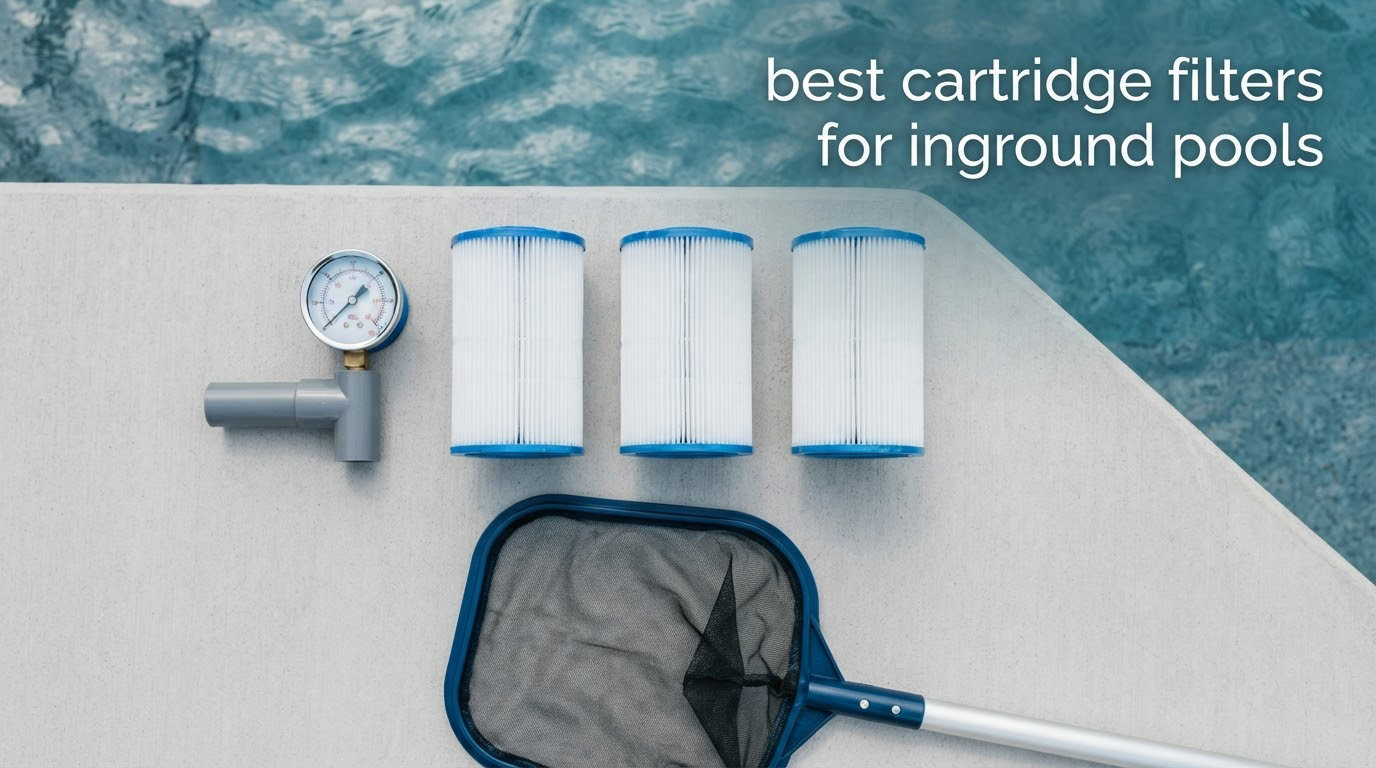
A cartridge filter is the single piece of equipment that decides how clean an inground pool stays, and the wrong one costs you in cloudy water and higher pump power draw. Most owners do not pick a bad filter on purpose, they pick a bad fit. A cartridge that is too small for the pump creates a flow penalty, a cartridge that does not match the housing will not seat, and a cartridge with too little pleated area for the pool size turns into a monthly cleaning chore instead of a seasonal one.
That is why this is a model-by-model roundup instead of a category page. Below we break down 10 of the best cartridge filters for inground pools currently on the market, with the real numbers that matter: filtration area in square feet, outside diameter, end-cap opening size, media type, NSF/ANSI 50 certification status and the exact housings each one replaces. Nothing here is rounded up from a marketing page.
The other reason inground owners gravitate to cartridge media is water. A cartridge filter is rinsed with a garden hose and put back, it never discharges to a drain the way a sand or D.E. filter does. On a 30,000-gallon pool that difference adds up across a season, and it is the motivation that shows up again and again in pool owner discussions. We have updated this guide for 2026, and we have included what happens when the correct-size tank will not physically fit your equipment pad, which is a surprisingly common late-stage purchase failure.
If you are also planning the sound side of your pool build, our picks for the best waterproof speakers for pools are worth a look before the equipment pad gets crowded.
Table of Contents
- Top 3 Cartridge Filter Picks for Inground Pools
- Best Cartridge Filters for Inground Pools (October 2026)
- 1. POOLPURE C1200 Replacement Cartridge – Best Overall Match for Hayward-Style Housings
- 2. POOLPURE CCP420 Four-Pack – Best Value for Pentair Clean and Clear Plus Owners
- 3. POOLPURE CC100 Replacement – Best Rated Option for Pentair Clean and Clear 100
- 4. Optimum OPT-320 Four-Pack – Best Four-Pack for Pentair CCP320 Housings
- 5. Optimum OPT-460 Four-Pack – Best Long-Reach Cartridge for Jandy CL460
- 6. TOREAD C1750 Replacement – Highest Certified Filtration Area for Hayward 1750 Tanks
- 7. Poolzilla 150 sq. ft Cartridge – Best Budget Pick for Pentair 150-Series Tanks
- 8. Cryspool 08056 Cartridge – Best Cross-Reference Coverage for Jandy 150 Series
- 9. XtremepowerUS 200 SF System – Best Complete Filtration System With Gauge and Relief Valve
- 10. In The Swim AA18016 – Best Standard-Grade Starter Element for Hayward Star Clear
- Is Pentair or Hayward Better? Brand and Certification Notes
- How to Choose the Right Cartridge Filter Size
- How to Measure Your Equipment Pad and Check Clearance
- Cartridge vs Sand vs DE: What Inground Owners Actually Save
- How to Clean and Replace a Cartridge Filter
- Common Mistakes That Shorten Cartridge Life
- Frequently Asked Questions
- What is the best cartridge filter for an inground pool?
- What size pool filter do I need for a 30000 gallon pool?
- How do I know what pool filter cartridge to buy?
- What is the average lifespan of a cartridge pool filter?
- How much does it cost to replace a pool filter cartridge?
- Are cartridge pool filters better than sand filters?
- Why does my cartridge filter pressure gauge keep climbing after rinsing?
- How often should I replace a cartridge pool filter?
- Final Verdict by Pool Situation
Top 3 Cartridge Filter Picks for Inground Pools
Three cartridges stand out from this set because they pair the widest housing fitment lists with published filtration areas and stated certification. The C1200 replacement leads on review volume and cross-reference coverage, the four-pack Pentair unit wins on planning convenience, and the 100 sq. ft Pentair replacement has the highest average rating of any cartridge we covered.

POOLPURE C1200 Replacement
- 120 sq. ft filtration area
- Trilobal media
- Replaces Hayward C1200 and CX1200RE


POOLPURE CC100 Replacement
- 100 sq. ft filtration area
- Replaces Pentair PCRP100
- Reported four-plus season life
Best Cartridge Filters for Inground Pools (October 2026)
All ten cartridges appear side by side below, with the spec that decides most purchases first. Filtration area is measured in square feet of pleated media across the whole element, and it is the number to match to your pump and pool volume rather than the tank brand.
| Product | Specs | Action |
|---|---|---|
| POOLPURE C1200 Replacement |
|
Check Latest Price |
| POOLPURE CCP420 Four-Pack |
|
Check Latest Price |
| POOLPURE CC100 Replacement |
|
Check Latest Price |
 Optimum OPT-320 Four-Pack Optimum OPT-320 Four-Pack |
|
Check Latest Price |
 Optimum OPT-460 Four-Pack Optimum OPT-460 Four-Pack |
|
Check Latest Price |
 TOREAD C1750 Replacement TOREAD C1750 Replacement |
|
Check Latest Price |
 Poolzilla 150 sq. ft Cartridge Poolzilla 150 sq. ft Cartridge |
|
Check Latest Price |
 Cryspool 08056 Cartridge Cryspool 08056 Cartridge |
|
Check Latest Price |
 XtremepowerUS 200 SF System XtremepowerUS 200 SF System |
|
Check Latest Price |
 In The Swim AA18016 Standard In The Swim AA18016 Standard |
|
Check Latest Price |
1. POOLPURE C1200 Replacement Cartridge – Best Overall Match for Hayward-Style Housings
POOLPURE C1200 Pool Filter Replace Hayward CX1200RE, HAY823C, Pleatco PA120
120 sq. ft media
23 1/4 in long
8 15/16 in diameter
4 in end openings
Pros
- Widest cross-reference list in the set
- Exact drop-in fit for Hayward C1200 and CX1200RE
- Trilobal fabric releases dirt easily when rinsed
- NSF/ANSI 50 certified by IAPMO
Cons
- Build feels lighter than a genuine OEM Hayward element
- Support bands make the pleats slightly slower to rinse
- End-cap straps can wear after many seasons
This is the cartridge we kept coming back to while building the roundup, because it does the least amount of explaining. It is a 120 sq. ft element measuring 23 1/4 in long with an 8 15/16 in outside diameter and 4 in openings at both ends, and it drops into the housing without adaptation. With 4505 reviews behind it, the fit questions that normally plague aftermarket cartridges have already been answered by other owners.
The media is a Trilobal fiber fabric, which the manufacturer describes as carrying roughly three times the adsorption surface of conventional point-bond filter fabric, with a 50-micron layer. In practice that means it holds dirt between rinses rather than pushing it straight through to the other side, and the dirt-locking weave is what makes a hose rinse effective instead of a frustrating one.
The listed housing coverage is the real headline here. It replaces Hayward Star Clear Plus C1200 and CX1200RE, HAY823C, Unicel C-8412, Porpoise PP-B2, Clearwater II ProClean 125, Aladdin 22002, Filbur FC-1293 and AK-7005 cartridges, which covers a large share of the older inground housings still in service. The material is NSF/ANSI 50 certified through IAPMO, a detail several competitors in this list skip.
Owners describe the durability story in plain terms. Reviewers report multi-season life and note that the fabric resists staining between the pleats, though a minority find the feel a step below the original Hayward element and mention the bands slow the rinse a little. The end-cap straps are the part most likely to show age on a cartridge that has been in service for years.
Check this before you buy
The critical measurement is the outside diameter and length, not the branded name. This element is 8 15/16 in across and 23 1/4 in long, so a housing that takes a wider 10 in element will not accept it no matter what the part number suggests. Measure the old cartridge before ordering, because a cartridge at the wrong size cannot be returned once the box is open.
Also check the end openings. Both ends here are 4 in, which matches the common Hayward Star Clear family, and that diameter is what determines whether the element slides freely or has to be worked into place. If your housing was built around a 6 in opening, you want the CC100-style cartridge covered later in this guide instead.
Who it suits and who it does not
This is the safest pick for an owner with a Hayward Star Clear Plus canister who wants a certified element with a long compatibility list and does not want to hunt for a spare later. It is the one we would point a first-time buyer toward, because the number of housings it fits is large and the failure mode of buying the wrong size is so expensive in time.
Skip it if you have a Pentair Clean and Clear canister, a Jandy housing, or any tank that uses a 10 in wide element. Those owners should look at the Pentair and Jandy-compatible options further down, where the opening diameters and part cross-references differ completely.
2. POOLPURE CCP420 Four-Pack – Best Value for Pentair Clean and Clear Plus Owners
POOLPURE CCP420 Pool Filter Replaces Pentair Clean and Clear Plus 420 4Pack
105 sq. ft each
Four cartridge pack
26 in long
3 in end openings
Pros
- Direct fit for Pentair CCP420 and 160301 housings
- Four-pack spreads replacement cost across the year
- Trilobal media releases dirt on a back-flush
- Reinforced ABS end caps hold up under service
Cons
- Narrow 3 in openings take effort to seat by hand
- Some buyers want heavier-gauge media than a standard aftermarket cartridge
Buying four at once is the reason this cartridge makes the list, and it is a reason grounded in how cartridge filters actually fail. They do not break suddenly, they clog, and the replacement is always a bad day to discover you did not keep a spare. A four-pack of 105 sq. ft elements means the second one is already on the shelf when the pressure gauge starts climbing.
Each element measures 26 in long with a 7 in outside diameter and 3 in openings at both ends. The listed housing fitment covers Pentair CCP420, 160301, Waterway Crystal Water 425, 570-0425, SD-00163, AK-60431, Aladdin 20503 and Filbur FC-6470, and the media is NSF/ANSI 50 certified through IAPMO.
Reviewers consistently point at the fit and the practical value. Owners confirm the cartridges seat in the Pentair Clean and Clear Plus 420 canister, and the Trilobal media is reported to release dirt easily when back-flushed. The reinforced end caps and strengthened core are called out as holding up under routine service rather than deforming at the centre.
The one recurring friction is the narrow opening. A 3 in end opening is not a problem once the element is aligned, but it does take more deliberate handling than the wide-open 6 in style found in other housings. A few buyers also asked for a heavier gauge of media than they are used to from an original equipment cartridge, which is a preference rather than a defect.
How to confirm the fitment
Read the part numbers on your existing canister rather than the tank brand. The Pentair Clean and Clear Plus family covers a lot of ground, and the CCP420, 160301 and the Waterway Crystal Water 425 housings all use this 26 in element. If the number on your tank is CCP420, this pack is right. If it is CCP320, the element is shorter and the four-pack later in this guide fits instead.
Then confirm the depth. At 26 in this cartridge needs a housing with room to seat it fully without the end cap riding on the rim. A tank that is physically too short will accept the element only part way, and a partially seated element leaks around the sealing band rather than filtering.
Who it suits and who it does not
This is the best fit for a Pentair Clean and Clear Plus 420 owner who wants to stop ordering replacement elements one at a time. For anyone with heavy tree cover or a high debris load, the four-pack also doubles as a spare set, which matters because cartridge media should never be run past the point where the pleats start to shred.
It is not the right choice for a small equipment pad situation where you need a short element, and it is not the pick for very large pools that need more total filtration area. Those owners get more from the higher-area 175 sq. ft and 200 sq. ft options further down.
3. POOLPURE CC100 Replacement – Best Rated Option for Pentair Clean and Clear 100
POOLPURE CC100 Pool Filter Replaces Pentair CCRP100, R173215, PAP100, 1Pack
100 sq. ft media
23 5/8 in long
10 1/16 in diameter
6 in end openings
Pros
- Highest average rating in this roundup
- Exact fit for Pentair Clean and Clear and Posi-Clear PCRP100
- Multiple owners report four-plus years of service
- Simple drop-in install with no adaptation
Cons
- Molded-in strap can snap after years of use
- Bottom end cap can bow after extended high-flow service
This cartridge carries the highest average rating of anything in our comparison at 4.7 stars, and the review themes explain why. The most common comment is not about filtration, it is about longevity, with multiple owners describing four or more seasons of continuous service before replacement. For a cartridge that gets rinsed rather than discarded, that is the number that matters most.
The element is 100 sq. ft, 23 5/8 in long, with a 10 1/16 in outside diameter and wide 6 in openings at both ends. Those wide openings are the easiest in this group to install by hand, and they are the reason this cartridge suits anyone who dislikes wrestling media into a tank. Fitment covers Pentair Clean and Clear 100, Posi-Clear PCRP100, R173215, 59054200, PAP100, Unicel C-9410 and Filbur FC-0686.
The fabric is the same Trilobal construction used across this brand, described as carrying roughly triple the adsorption surface of conventional media, with a 50-micron layer and 4 oz. thickened polyester. The material is NSF/ANSI 50 certified through IAPMO, which matters if you are replacing on a public or rental property where certification documentation gets asked for.
Reviewers report the water staying clear for long stretches between cleanings, which is the practical proof that the media is doing its job. The reported drawbacks are both about very long service rather than early failure: a molded-in strap that has snapped for some owners after years of use, and a bottom end cap that can start to bow after extended high-flow running.
Why the wide 6 in openings matter
Opening diameter is the spec most buyers never check, and it is the one that tells you whether installation will be a two-minute job or a ten-minute one. At 6 in at both ends, this element has the roomiest openings of the Pentair-compatible cartridges here, so it drops in quickly and seats evenly the first time.
Even seating matters for filtration, not just convenience. A cartridge that goes in crooked leaves an unfiltered bypass gap between the end cap and the housing rim, and the symptom shows up as a pressure gauge that behaves strangely and water that will not clear no matter how long you backflush.
Who it suits and who it does not
This suits a Pentair Clean and Clear or Posi-Clear PCRP100 owner who wants the best-documented service life in the group and does not mind a single-cartridge format. It is a good match for pools in the mid-size range where 100 sq. ft of pleated area comfortably outpaces the pump flow.
Choose something else if you want a spare on hand, since this is a one-pack and you would be ordering again when the element finally needs replacing. Large pools with heavy debris loads are better served by the 150 sq. ft and 175 sq. ft elements, which hold more dirt between cleanings by design.
4. Optimum OPT-320 Four-Pack – Best Four-Pack for Pentair CCP320 Housings
4PK Pool Filters Compatible Replacement for Pentair® Clean & Clear Plus 320
80 sq. ft each
20 in long
7 in diameter
3 in inside diameter
Pros
- Fits Pentair Clean and Clear Plus 320 without modification
- Performance reported on par with the OEM element
- Made in USA with Reemay spunbond media
- Support bands resist element collapse
Cons
- No NSF/ANSI 50 certification listed in the specifications
- Heavier to ship because of the four-pack format
At 20 in long and 80 sq. ft per element, this is the compact option in the set, and compact is the word that matters if your equipment pad is already crowded. It is built around Reemay spunbond polyester, a different media construction from the Trilobal fabrics elsewhere in this roundup, and the support bands around each element are designed to stop the pleats collapsing inward under pressure.
Fitment covers the Pentair CCP320, 160340, 178580 and R173573 housings, plus Waterway Crystal Water 80 sq ft with part 817-0081, Unicel C-7470, Pleatco PCC-80, Filbur FC-1976 and FC-6465, and Aladdin 18005. Made in the USA, it is sold as a four-pack, which is the practical way to buy replacement media for this housing size.
Owner feedback is direct and consistent. Reviewers confirm the fit in the Pentair Clean and Clear Plus 320 without forcing, describe filtration performance as on par with the original equipment cartridge, and note that the four-pack format makes seasonal replacement planning straightforward. There is no recurring quality complaint in the reviews, which is unusual for an aftermarket cartridge.
One gap is worth stating plainly. The listed specifications do not claim NSF/ANSI 50 certification, and that absence is the reason this cartridge sits below the certified options rather than alongside them. If you manage a rental or public pool where material certification is documented, look for a certified element instead.
When 80 sq. ft is enough
Filter area is not something to maximise. What matters is matching pleated area to the flow your pump actually pushes through the filter, because extra surface area beyond that point simply adds dirt-holding capacity you never use. Eighty square feet suits a pool in the smaller-to-mid range, or a larger pool paired with a moderate pump.
The four-pack is also the practical choice if you want to rotate elements. Swapping in a clean cartridge while the used one dries is how owners keep pressure rise low during a heavy spring cleaning period, and it costs nothing extra beyond ordering a second set up front.
Who it suits and who it does not
This suits a Pentair CCP320 owner who wants a US-made element with a 4.7 average rating, a media type that holds up to repeated hose cleaning, and enough spares to cover several seasons. It is a strong fit for a pool with a smaller footprint and a tight service envelope.
It is the wrong choice for a pool with heavy tree cover, a spa spillover, or a high-turnover variable-speed pump running at high speed for long hours. Any of those push you toward more area, and the 120 sq. ft, 150 sq. ft or 175 sq. ft elements later in this guide give you substantially more dirt-holding capacity between rinses.
5. Optimum OPT-460 Four-Pack – Best Long-Reach Cartridge for Jandy CL460
4PK Pool Filter Cartridge Compatible Replacement for Jandy® CL460, R0554600
27 in long
7 in outside diameter
3 in inside diameter
Four pleated elements
Pros
- Correct dimensions for Jandy CL460 and CV460 canisters
- Pleated Reemay media holds up to repeated cleaning
- Four elements cover multiple seasons
- Drop-in fit without shimming
Cons
- No NSF/ANSI 50 certification listed in the specifications
- The 27 in body is bulky to handle when wet
This is the longest element in the roundup at 27 in, and that length is not a quirk, it is simply how the Jandy CL460 canister is built. If your housing is a Jandy, you will rarely find a shorter aftermarket part that seats properly, and forcing a wrong-length element into this tank is a common way to crack an internal guide ring.
The media is 100% Reemay spunbond polyester in a pleated, round configuration, with a 7 in outside diameter and a 3 in inside diameter. Support bands ring each element to resist collapse. Fitment covers the Jandy CL460 and CV460 housings, OEM R0554600 and A0558000, Unicel C-7468, Pleatco PJAN115, Filbur FC-0810 and Aladdin 21501.
Reviews concentrate on two things. Owners confirm the dimensions are correct for the Jandy canisters and report the pleated Reemay media surviving repeated cleaning without degradation. Across 891 reviews there is no widespread quality complaint, which is a good sign for a part that has to be handled wet and dropped into a deep tank.
Two honest caveats. The specifications do not list NSF/ANSI 50 certification, and a 27 in cartridge that weighs over 20 pounds in a four-pack is genuinely awkward to lift when it is saturated, particularly if your tank sits at ground level or behind a raised wall.
Get the length right before anything else
For this housing, length is the make-or-break dimension. Measure from the top of the tank interior to the seat at the bottom and compare against the 27 in body plus the free space needed above the end cap. A cartridge that bottoms out with no clearance will not seal against the upper plate, and water will short-circuit around the media instead of passing through it.
Check the inside diameter next. At 3 in this element is a narrow-core design, and narrow cores are more rigid, which is why the support bands are less critical here than on a wide-core element. If your old cartridge had a 6 in core, this is the wrong family for your housing.
Who it suits and who it does not
This suits a Jandy CL460 or CV460 owner who wants a spare set on hand and a certified-media upgrade path later if they decide they need it. The four-element pack covers a multi-year replacement rhythm for a pool that is not overworked, and the pleated geometry handles normal debris well.
Skip it if you cannot comfortably lift a wet 27 in cartridge, or if your pump is oversized for the tank. A high-flow pump paired with a smaller area creates exactly the flow penalty this roundup is meant to help you avoid, and in that case a larger-area element in a different housing is the better long-term move.
6. TOREAD C1750 Replacement – Highest Certified Filtration Area for Hayward 1750 Tanks
C1750 Pool Filter Replace PA175, Hayward CX1750RE, Unicel C-8417, Ultral-B4
175 sq. ft media
28 3/16 in long
8 15/16 in diameter
4 in openings
Pros
- Largest certified area among the drop-in replacements
- Replaces Hayward C1750 and CX1750RE and Pleatco PA175
- Trilobal fabric rinses back to like-new condition
- Reinforced centre core resists deformation
Cons
- A minority report rapid clogging and monthly cleaning
- Internal centre guide rings can crack on a forced off-centre install
- Higher one-star share than most in this group
At 175 sq. ft this is the most filtration area we found in a certified drop-in replacement, and it is the number to focus on if your pool is large, surrounded by trees, or fed by a spa spillover. The element measures 28 3/16 in long with an 8 15/16 in outside diameter and 4 in openings, and it is NSF/ANSI 50 certified through IAPMO with a PHTA membership.
Fitment is broad within the Hayward large-capacity family. It replaces Hayward Star Clear Plus C1750, C17502, C17502S and CX1750RE cartridges, Pleatco PA175 and PA175-M, Unicel C-8417 and C-8417RA, Filbur FC-1294M, AK7011, SD-00106 and Ultral-B4. The media is described as a Trilobal fabric with a weave roughly 25 percent thicker than standard.
The build details are aimed at durability. Reinforced chlorine-resistant end caps and a strengthened centre core support the pleats at high flow, and the manufacturer claims capture of more than 99 percent of impurities including hair, dust and leaves. Most owners report the fabric rinses back to close to new condition after cleaning and that the reinforced parts hold their shape over months of in-ground service.
This is also the least uniformly reviewed cartridge in the roundup, and that deserves attention. A minority of owners report the media clogging fast enough to need monthly rather than seasonal cleaning, and a detailed complaint describes filter pressure doubling within a month. The internal centre guide rings can also crack if the cartridge is forced into the housing off-centre, so seat it straight.
Is more filtration area always better
No, and this cartridge is a good example of why. Extra area helps when your pump is pushing hard or your debris load is high, because it slows the pressure rise that triggers cleaning. If your pump is a modest single-speed unit on a small pool, 175 sq. ft is more capacity than you will use, and you would be paying to hold dirt you never accumulate.
The counterpoint is cleaning interval. Doubling or tripling your area does not double or triple how long you can run, because dirt-holding capacity scales unevenly and the pleats still need rinsing on a schedule. The realistic gain is fewer rinses per season rather than a filter you never touch.
Who it suits and who it does not
This suits a Hayward C1750 or CX1750 owner with heavy debris, a large pool, or a variable-speed pump that runs at high speed for many hours a day. The reinforced core and the certified high-area media are both aimed squarely at that use, and the 175 sq. ft gives you real headroom over the 120 sq. ft option in the same diameter family.
Be cautious if your reviews history shows a history of failing elements. If you are on your third cartridge in two seasons, the problem is more likely pump sizing or a water balance issue than the media, and another replacement will not fix it. Address the pressure and chemistry first, then change the cartridge.
7. Poolzilla 150 sq. ft Cartridge – Best Budget Pick for Pentair 150-Series Tanks
Poolzilla 1 Pack Replacement Cartridge for CC150, CCRP150, PAP150, Unicel C-9415, R173216, 59054300, Filbur FC-0687, 160317, 160355, 160352, Predator 150, 150 sq. ft. Filter Cartridge
150 sq. ft media
31 1/8 in long
10 1/16 in diameter
6 in end openings
Pros
- Broad fitment list across Pentair 150-series and Unicel C-9415
- Dirt-Trap pleated geometry holds flow under buildup
- Maintains flow through a full season
- Backed by a 6-month return assurance and 12-month defect warranty
Cons
- One of the higher one-star shares in this comparison
- The 31 in body is heavy and awkward when saturated
This is the longest element in the roundup, at 31 1/8 in, and the length is dictated by the Pentair 150-series canister rather than by design preference. Pair it with an 8 in deep housing and it is a poor fit; pair it with the correct deep tank and it delivers 150 sq. ft of media, which is more area than most owners in this group need.
The element has a 10 1/16 in outside diameter with 6 in openings at both ends, and uses pleated fabric with Dirt-Trap geometry designed to capture more contaminants than round fabric. Fitment covers Pentair Clean and Clear 150, Posi-Clear PCRP150, Predator 150, R173216, 59054300, PAP150, Unicel C-9415, Filbur FC-0687 and Aladdin 25005.
Two things set it apart from the bargain end of the category. The media is NSF/ANSI 50 certified through IAPMO, and the cartridge carries a 6-month assurance return policy alongside a 12-month defect warranty, which is more after-sales cover than most aftermarket media offers. The stated service life with maintenance is roughly 1 to 2 years.
Owners value the fitment breadth most, along with the media holding flow through a full season of service and washing back to usable with a hose. The reservation in the reviews is that roughly 8 percent of ratings sit at one star, the highest 1-star share among the Pentair-compatible cartridges here, and the long body is heavy at 5.5 pounds plus whatever it absorbs.
Measuring for a deep-tank element
An element this long needs depth in the housing, not just diameter. Lift the lid and measure from the top sealing surface to the bottom seat, then subtract the space the lid and clamp occupy. You need the cartridge length plus a few inches of clearance, and if you are short on depth this cartridge cannot be made to work with a shorter element from another brand.
Measure the diameter too. A 10 1/16 in element will not enter an 8 15/16 in tank no matter how the part number reads, and this confusion between the 100 sq. ft and 150 sq. ft Pentair families is one of the most common sourcing mistakes owners make. The old cartridge in your hand is the only reliable reference.
Who it suits and who it does not
This suits an owner of a deep Pentair 150-series or Predator 150 canister who wants maximum area, written certification, and a return policy that gives you room to test fit. For a large pool or a heavy debris load, 150 sq. ft is a meaningful step up from 100 sq. ft.
It is the wrong pick if you cannot manage the weight, if your housing is shallow, or if you want a spare element on hand tomorrow, since this is a one-pack format. Owners who need depth rather than diameter should read the sizing notes later in this guide before ordering.
8. Cryspool 08056 Cartridge – Best Cross-Reference Coverage for Jandy 150 Series
Cryspool 08056 Pool Filter Cartridge Compatible with Jandy CS150, PWWCT150
150 sq. ft media
23 5/16 in long
8 15/16 in diameter
4 in openings
Pros
- Fits Jandy CS150 and Hayward Clear Plus C1502 cross-references
- Build feels sturdier than the cartridge it replaced
- Trilobal pleats wash back to like-new performance
- Several owners report clearer water than the OEM element
Cons
- Tight fit going into the housing and needs care to seat
- A few owners question longevity against a genuine OEM element
What makes this cartridge useful is the cross-reference list, which is the longest in the set for the 8 15/16 in diameter family. It fits Jandy CS150 and R0462300, PJANCS150, X-Stream CC1500, C-8414, FC-1287, Clearwater II 150, ProClean 150, SD-00371, Clear Plus C1502, CX1520RE and 817-0150N from 2006 onward.
The element measures 150 sq. ft, 23 5/16 in long, with an 8 15/16 in outside diameter and 4 in openings. The media is a Trilobal fibre construction with deep-penetration pleat geometry designed to release impurities when washed, and reinforced end caps and pleats that hold their position inside the canister.
Reviewers are unusually positive about build quality for an aftermarket part. Several owners describe it as sturdier and more durable than the element it replaced, and a few report clearer water than the original equipment Hayward cartridge they were running. The pleats are reported to wash back to like-new performance rather than gradually losing efficiency.
The consistent caveat is installation. A tight fit going into the housing means the element needs care to seat, and if it goes in crooked the seal will not hold. A small number of owners also question how it will compare to a genuine OEM element over many years, which is a reasonable question for a part with a shorter service history.
Using the cross-reference list properly
Treat the list as a starting point, not a decision. Find your tank brand and model, then confirm the physical dimensions against your existing cartridge: 23 5/16 in long, 8 15/16 in outside diameter, 4 in openings. Cross-references only work when the housing dimensions match exactly, and brands occasionally revise a tank geometry mid-production run.
If the numbers match but the part number on your tank is not listed, order cautiously and keep the old cartridge until you have confirmed the seal. A cartridge that seats properly and stops a hose rinse is a five-minute test, and the one-pack format here makes that low risk.
Who it suits and who it does not
This suits a Jandy CS150 owner, or anyone whose old cartridge is a Hayward Clear Plus C1502 pattern, who wants 150 sq. ft of area in a short element. Short matters when clearance above the tank is tight, because this 23 in body needs less vertical room than the 31 in deep-tank cartridge earlier in this guide.
It is not the right choice for a Pentair Clean and Clear 100 or 150 canister, since those use a 10 in wide element. If your existing cartridge measures 10 in across, you need the Pentair-compatible options in this roundup instead of this one.
9. XtremepowerUS 200 SF System – Best Complete Filtration System With Gauge and Relief Valve
XtremepowerUS Swimming Pool Cartridge Filter, High Flow Filter System for In-Ground & Above Ground Pools & Spas, 2-Inch Ports, Heavy-Duty Pool Water Filtration (200 SF)
200 sq. ft element
150 gpm rated flow
2 in ports
10-15 micron capture
Pros
- Complete system with element
- gauge and relief valve included
- Handles large pools and spas at a 150 gpm rated flow
- Corrosion and UV resistant resin housing
- Extruded core keeps the element from deforming
Cons
- Only captures particles down to 10-15 microns
- The 24 x 24 x 39.5 in housing needs real pad space
- Highest one-star share of the products reviewed
This is the only complete tank system in the roundup rather than a replacement element, and that changes what you are buying. You get a 200 sq. ft pleated cartridge with an extruded core, a housing rated at 150 gpm with 2 in inlet and outlet ports, a real-time pressure gauge and an automatic relief valve that alerts above 150 kPa, all in a weather, UV and corrosion-resistant resin shell.
Manufacturer capacity guidance is pools up to 36,000 gallons at 4 hours of filtration, or up to 72,000 gallons at 8 hours. Filtration is specified at 10-15 microns. Replacement elements are sold separately under part 75215, and the same housing is also offered in 175 sq. ft and 425 sq. ft configurations if you need to change the area later.
Reviewers who wanted an all-in-one solution with monitoring built in tend to rate it well, and the built-in gauge and relief valve are the features owners mention most. The corrosion and UV resistant housing is called out as a plus for year-round outdoor exposure, and the extruded core is credited with stopping the pleats deforming under pressure.
The trade-offs are real and worth weighing. At 10-15 microns this is a coarser element than the paper-media cartridges in this list, so very fine particles pass through where a sand filter would catch them. The housing is also 24 x 24 x 39.5 in and weighs about 30 pounds, so it needs a pad that can actually carry it, and the 4.0 average reflects complaints about sizing and installation.
Is a complete system worth it here
It depends on whether your existing tank is serviceable. If your current canister housing is intact, replacing the element is cheaper and gives you a wider choice of certified media, so a whole new system is rarely the economical move. A new system makes sense when the housing is cracked, the lid no longer seals, or the port size no longer matches your existing plumbing.
Check the 2 in ports carefully against your current plumbing. Most inground systems run 2 in, but if yours is already 2 in you are confirming rather than adapting, and if you are moving from a different size you will need conversion fittings and, in most jurisdictions, a look at local code before the change.
Who it suits and who it does not
This suits a large pool or pool and spa combination that needs a lot of turnover, and an owner who wants pressure monitoring built into the housing rather than added as a separate gauge. The 150 gpm rating gives you genuine headroom over a single-element household cartridge tank.
Skip it for fine-particle filtration, since 10-15 micron capture is the weakest number in this comparison. It is also a poor fit for a small equipment pad, and owners with a mixed satisfaction rate report sizing and installation problems often enough that a full system from a proven brand may suit you better if your pad is tight.
10. In The Swim AA18016 – Best Standard-Grade Starter Element for Hayward Star Clear
In The Swim Standard Pool Filter Cartridge
Standard-grade element
Designed for Hayward Star Clear C1750
Crack and chemical resistant
Hose-rinseable
Pros
- Snug exact fit across Hayward Star Clear C751 through C1750 canisters
- Cleans off easily with a garden hose
- Filtration reported on par with premium Pleatco elements
- Repeat buyers purchase the same element each season
Cons
- Several sizes share one listing so the variant must be matched carefully
- One detailed review reports green water within a week
- Heavy packaged weight for a single cartridge
Part AA18016 is the standard-grade element for the Hayward Star Clear C1750, cross-referenced against Pleatco PA175, Unicel C-8417 and Filbur FC-9530, and built to meet or exceed the original equipment specifications. The same family covers C751, C900, C1200, C1500 and C1750 housings in both standard and premium versions, which is useful if your tank size changes over the life of the pool.
Owners describe a snug, exact fit in the Hayward canisters and a cartridge that cleans off with a garden hose without needing a soak. Filtration performance is reported as on par with premium Pleatco elements, and repeat buyers come back for the same element each season, which is the clearest signal that it holds up in real service.
Two practical points before you order. Several sizes and styles share a single listing, so the variant selector has to be matched to your tank rather than assumed from the product title, and the packaged weight is heavy for a single cartridge, which usually reflects the outer box rather than the media itself.
One detailed review describes a cartridge that turned pool water green within a week with no resolution from the vendor past a 30-day window. A single report is not a pattern, but it is a reminder that a bad element can cost you a season, so keep your old cartridge until the new one has proven itself in the water for a couple of weeks.
Standard grade or premium
Standard-grade media is the sensible starting point for a straightforward pool with a modest pump and normal debris. The construction is described as crack resistant and resistant to chemical deterioration, and it rinses clean with a hose, which is all most owners need for two to three seasons before a replacement.
Move up a tier if you run a variable-speed pump at high speed for long hours, if you are surrounded by trees, or if you have a history of torn pleats. More area and heavier media cost more up front and buy fewer cleaning cycles, which pays off faster the harder your pump works.
Who it suits and who it does not
This suits a Hayward Star Clear owner who wants a simple, well-fitting, hose-cleanable element without premium pricing, particularly one whose tank is a common C1200 or C1750 size. The single-cartridge format is also a sensible first purchase to confirm fit before committing to a multi-pack.
It is not the right choice if you need written material certification for a commercial property, or if you want the deepest cross-reference coverage. Check the variant selector against your tank model number, and if the listing does not clearly show the size you need, choose a product that lists the filtration area and dimensions explicitly.
Is Pentair or Hayward Better? Brand and Certification Notes
Neither brand is better at filtering, because neither of them made most of the cartridges in this roundup. The comparison that matters is between OEM media and the aftermarket replacements, and on that point the Pentair-fitment options in this list carry NSF/ANSI 50 certification through IAPMO, while the Optimum Reemay elements do not list it. Hayward-fitment coverage is broad and well represented, with certified options at 120 sq. ft, 150 sq. ft and 175 sq. ft.
What Pentair and Hayward do own is the housing. If your tank is a Clean and Clear, Clean and Clear Plus, Posi-Clear or Predator, your element must be 10 1/16 in across with 6 in openings, and that single fact eliminates most of this roundup instantly. Hayward Star Clear, Clearwater II, ProClean and Clear Plus tanks use narrower 8 15/16 in or 7 in elements with 4 in or 3 in openings, which points you at a different group entirely.
Jandy sits in its own category. CL460 and CV460 canisters take a long 27 in element, while the CS150 and PWWCT150 use a shorter cartridge in the 8 15/16 in family. When owners describe sizing confusion between brands, this is why: the naming conventions differ, the 90, 100 and 105 sq. ft labels do not map cleanly across manufacturers, and a tank brand alone will not tell you the size.
How to Choose the Right Cartridge Filter Size
Choose a cartridge by matching four things in order: your pool volume, your pump flow rate, the tank it has to fit inside, and the openings on your existing element. Ignore the first three and you will either under-filter, over-filter, or discover the problem when the cartridge will not go in.
Find your pool volume in gallons. It should be on a label somewhere near the equipment pad or in your original build paperwork. If you cannot find it, measure the pool’s length, width and average depth and use the standard 7.5 gallons per square foot of surface times average depth.
Find your pump’s rated flow in gallons per minute on the nameplate. This is the number the filter has to accept without creating a flow penalty, and it is more important than the pool volume when you are choosing media area.
Aim for a turnover target. Turning the pool volume over once per day is the working standard for cartridge media, and the filter area you pick should comfortably support that at your pump flow.
Read the filtration area of each candidate. As a rule of thumb, roughly 100 sq. ft of pleated area suits the common mid-size inground pool, 150 sq. ft and above suits larger pools, heavy tree cover or high-turnover systems, and 80 sq. ft suits smaller pools on modest pumps.
Match the physical dimensions. Length, outside diameter and the opening diameter at each end must match your housing and your old cartridge, and the length must clear the tank interior with room for the lid to seal.
Confirm the design flow rating is at or above your pump’s output. If the filter is rated below what the pump can push, the extra pressure shows up as a flow penalty, higher energy use and a shorter cartridge life.
For a 30,000-gallon inground pool running a common two-speed or variable-speed circulation pump, the filters in this roundup that make sense are the 100 sq. ft, 120 sq. ft and 150 sq. ft elements, with 175 sq. ft and 200 sq. ft worth considering if the pump is large or the pool has heavy debris and a spa spillover. The 80 sq. ft element fits comfortably but leaves less headroom for a pool of that size.
If your pump is oversized, a variable-speed pump actually makes the problem easier to fix, because you can dial the flow down to match the filter. That single adjustment removes most of the pressure penalty without buying anything, and it is the first thing to try before changing equipment.
How to Measure Your Equipment Pad and Check Clearance
Measure the pad before you order, because a tank that will not fit is the most common late-stage purchase failure and cartridges at the wrong size cannot be returned once opened. You need three measurements, not one.
Footprint. Measure the width and depth available with nothing on it. Account for the pump, the heater and any valve manifold already in place, and leave working room on at least one side.
Vertical clearance above the tank. Lift the current lid and measure from the tank rim to the underside of any overhang, soffit or deck. You need enough room to lift the element straight up and out without tilting it into the coping.
Service access. The space in front of the tank has to let a wet cartridge come out. A cartridge that weighs 20 pounds or more and is 27 to 31 in long needs a clear straight lift, not a sideways slide.
If the correct-size tank will not fit, the fix is usually a low-profile or vertical tank rather than a smaller element. A short element still has to go somewhere, and a slimmer vertical housing in the same 8 to 10 in diameter class can often be swapped in without moving any plumbing, since the port positions are often the same.
For the sound side of the pad, our best waterproof Bluetooth speakers for pools roundup covers what survives a wet season outdoors.
Cartridge vs Sand vs DE: What Inground Owners Actually Save
Cartridge media wins on water and loses on fine-particle filtration, and that trade-off is the whole decision. A sand filter backwashes several times a season and each cycle discharges hundreds of gallons to a drain, while a D.E. filter discharges the same way and additionally needs the powder handled carefully. A cartridge filter is rinsed with a hose and put straight back, so nothing leaves the pool.
That is the motivation that shows up most often when inground owners switch. On a large pool the volume of water saved across a season is substantial, and it is the reason pool owners who are worried about water loss choose cartridge media over backwashing systems. Add the fact that cartridge filters need no multiport valve and no backwash schedule, and the maintenance picture is simpler as well.
Where cartridge media loses is micron rating. A sand bed typically captures finer particles than a pleated paper cartridge, and the complete system in this roundup captures down to 10-15 microns, the coarsest figure here. A pentair-fitment cartridge with Trilobal media claims 50-micron filtration, which is standard for this category and adequate for routine clarity but not a substitute for a sand bed in heavy silty conditions.
On algae, the nuance matters. As one Troublefreepool discussion put it, some algae is too small for filters to catch, and cartridges usually do better with dead algae than sand filters do. In practice a cartridge catches floc and dead cells very well, so an existing algae bloom needs chemical treatment first and filtration second, and a filter alone will not clear green water.
How to Clean and Replace a Cartridge Filter
Clean the element when the pressure gauge reads roughly 8 to 10 psi above the clean-tank baseline, and not on a fixed calendar. Cleaning too often wears the media out faster, and cleaning too rarely lets dirt compact into the pleats where a hose will not shift it.
Turn the pump off and relieve the pressure before opening the lid. Water above the element comes out first and it will not stop on its own.
Lift the element out and hose it from the inside out, aiming along the pleats rather than across them. A spray nozzle held perpendicular to the pleat pack drives debris deeper into the media.
Soak only when rinsing is not enough. A diluted trisodium phosphate or citric soak loosens oils and scale, and the rule is a short soak followed by another rinse, not an overnight chemical bath.
Let the element dry fully before it goes back in. A wet element goes back into a tank that is already warm and damp, which is exactly the condition that encourages microbial growth on the media.
Reset the pressure gauge to the clean reading once it is sealed so you have a real baseline for next time.
On lifespan, expect roughly 1 to 2 years for a standard-grade element kept on a sensible cleaning schedule, and 3 years or more for heavier media in a gentler service load. One owner in this set reported four-plus seasons of continuous service on a 100 sq. ft cartridge, which is the upper end rather than the norm. Replace rather than reuse when the pleats feel soft, the end-cap bands crack, or the element will not return to its original shape.
Common Mistakes That Shorten Cartridge Life
The most expensive mistake is pairing a large pump with a small filter area. The pump pushes more water than the media can accept, pressure rise accelerates between cleanings, energy use climbs, and the element loads up far faster than it should. If your gauge climbs quickly and your element is always dirty, check the pump and filter pairing before blaming the cartridge.
The second mistake is running a damaged element. A torn pleat lets debris pass straight through the media and into the return, which is both a clarity problem and a way to circulate dirt back into the pool. If you can see daylight through the pleats, the element is finished, and cleaning it will not fix that.
The third is skipping water balance. Cartridge media captures what is in the water, and unbalanced chemistry means scale and metal deposits in the pleats, which do not rinse out. When an element clogs within weeks, check calcium hardness and sanitizer before replacing it, because a new cartridge in the same water will fail the same way.
The fourth is forcing installation. A cartridge pushed in off-centre can crack internal guide rings, and a cartridge that bottoms out with no clearance will not seal. If the element needs pressure to go in, you have the wrong size or the wrong housing, and forcing it is what turns a sizing mistake into a cracked part.
Frequently Asked Questions
What is the best cartridge filter for an inground pool?
The best cartridge filter is the one that matches your tank dimensions, has at least as much filtration area in square feet as your pump flow needs, and carries NSF/ANSI 50 certification. For most mid-size inground pools, a 100 to 120 sq. ft element on a common Hayward or Pentair housing is the right starting point, while 150 sq. ft and above suits larger pools, heavy tree cover or high-turnover pump setups.
What size pool filter do I need for a 30000 gallon pool?
For a 30,000 gallon inground pool, look for a cartridge with roughly 100 to 150 sq. ft of filtration area, matched to your pump flow rate. The 100 sq. ft, 120 sq. ft and 150 sq. ft cartridges in this roundup all cover that range, with 175 sq. ft and 200 sq. ft worth considering if you run a large pump, a spa spillover or heavy debris. Tank fitment matters more than area, so measure your existing cartridge first.
How do I know what pool filter cartridge to buy?
Measure the element you are replacing: length, outside diameter and the opening diameter at each end. Then match those three numbers plus the tank brand and model to the fitment list on the replacement. Cross-reference part numbers are helpful but not reliable on their own, because manufacturers change housing geometry within a model run. Never order by pool volume alone.
What is the average lifespan of a cartridge pool filter?
Most cartridge elements last roughly 1 to 2 years with sensible cleaning, and heavier media in a gentler service load can reach 3 years or more. The best-documented result in this roundup is a 100 sq. ft element reported by its owners as running four-plus seasons of continuous filtration. Replace when the pleats soften, the end-cap bands crack or the element no longer returns to its original shape.
How much does it cost to replace a pool filter cartridge?
Replacement cartridge cost varies more by quantity and media grade than most buyers expect. Single elements sit at one end of the range, multi-packs of four spread the cost across several seasons, and premium media with heavier weave and wider fitment costs more than standard-grade. Check the current listing for the exact figure, and remember that four-packs reduce the per-element cost noticeably.
Are cartridge pool filters better than sand filters?
Cartridge filters are better if you want to conserve water, avoid a backwash discharge and keep maintenance simple, since they are rinsed with a hose and reinstalled. Sand filters are better at capturing very fine particles, which matters in silty or dusty conditions. Cartridges do very well on dead algae and floc, but an existing live algae bloom needs chemical treatment before filtration can clear it.
Why does my cartridge filter pressure gauge keep climbing after rinsing?
A pressure gauge that climbs and then falls only a little after a rinse usually means compacted debris or scale is lodged deep in the pleats, where a hose cannot reach. A short soak in trisodium phosphate or citric acid followed by a second rinse is the standard fix. If the gauge still climbs quickly, check water balance and make sure your pump flow is not exceeding what the filter area can handle.
How often should I replace a cartridge pool filter?
Replace a cartridge when the pleats feel soft or torn, when the end-cap bands or straps crack, when the element will not return to its original shape, or when a rinse no longer brings the pressure gauge back near its clean baseline. Cleaning on pressure readings rather than a fixed calendar typically gets you two to three seasons of service before a replacement is needed.
Final Verdict by Pool Situation
Start with the POOLPURE C1200 if you have a Hayward Star Clear style canister and want the widest fitment list and written certification. Pentair Clean and Clear Plus 420 owners should take the four-pack CCP420, Clean and Clear 100 owners should take the CC100 for its reported multi-season life, and large pools or heavy tree cover justify the 175 sq. ft TOREAD C1750. Measure your old cartridge before you order anything, and if the correct tank will not fit your pad, resolve that before the purchase, not after.
This roundup of the best cartridge filters for inground pools was built for 2026 and will be revised as fitment lists and certifications change.