

The single most misunderstood number in the mini split world is the low temperature rating, and getting it wrong is how a ductless heat pump for cold weather ends up sitting idle through January. Two different temperatures are being described by the same phrase, and the difference between them is the difference between a system that carries your house and one that quietly hands the job to expensive backup heat.
Our team has spent the past several months reading the spec sheets, warranty terms, and owner reviews behind every cold-climate-rated system on the market, and this is the result: the best mini split heat pumps for cold climates in 2026, ranked model by model, with the actual Fahrenheit figures in the open. Every system below publishes a documented low ambient rating. Nothing that cuts out near 60F made the list.
Before the rankings, one thing worth settling. If your winters rarely drop below 40F, you probably do not need a cold rated system at all, and a standard high-efficiency unit will heat and cool your space fine for less. Cold headroom you never spend is headroom you paid for and never used. If you live somewhere with regular nights below 30F, keep reading, because the rest of this article is built for you.
Table of Contents
- Top 3 Cold Climate Mini Splits in 2026
- All 7 Best Mini Split Heat Pumps for Cold Climates in 2026
- 1. DELLA Optima Series 9,000 BTU Hyper Heat – Best Overall Cold Climate Mini Split
- 2. Daikin Aurora 24,000 BTU Low Ambient – Best for Full Rated Capacity at 5F
- 3. OYLUS 17,000 BTU Inverter Heat Pump – Best Budget Cold Climate Unit
- 4. Cooper and Hunter 24,000 BTU Hyper Heat – Best for Garages, Workshops, and Additions
- 5. DELLA Ultra Hyper Heat 12,000 BTU – Best for Severe Cold
- 6. MRCOOL Olympus 18,000 BTU Hyper Heat – Best for Open-Plan Mid-Size Spaces
- 7. Cooper and Hunter 9,000 BTU Concealed Ducted Hyper Heat – Best for Hidden Ceilings
- What Cold Climate Actually Means: Two Temperatures, Not One
- How to Choose a Cold Climate Mini Split
- Read both cold-weather temperatures before anything else
- HSPF2 and SEER2, and what numbers earn their money back
- The 20 degree rule and when you need backup heat
- Defrost cycles and the base pan heater
- Sizing: one wall head versus a multi-zone system
- Reliability, parts availability, and the warranty registration trap
- Professional install versus DIY
- Frequently Asked Questions
- Which Cold Climate Mini Split Is Right for You
Top 3 Cold Climate Mini Splits in 2026


All 7 Best Mini Split Heat Pumps for Cold Climates in 2026
Nothing in this category has published a real side-by-side spec table, so here is ours. Read the two temperature columns together, not separately, because a system rated to run at -22F while delivering reduced output is a different purchase from one rated at -13F with full capacity at 5F.
| Product | Specs | Action |
|---|---|---|
| DELLA Optima 9K Hyper Heat |
|
Check Latest Price |
 Cooper and Hunter 24K Hyper Heat Cooper and Hunter 24K Hyper Heat |
|
Check Latest Price |
| OYLUS 17K Inverter Heat Pump |
|
Check Latest Price |
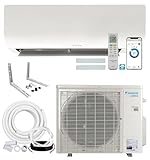 Daikin Aurora 24K Low Ambient Daikin Aurora 24K Low Ambient |
|
Check Latest Price |
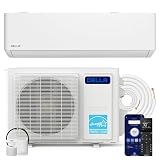 DELLA Ultra Hyper Heat 12K DELLA Ultra Hyper Heat 12K |
|
Check Latest Price |
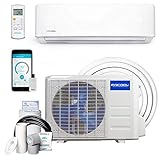 MRCOOL Olympus 18K Hyper Heat MRCOOL Olympus 18K Hyper Heat |
|
Check Latest Price |
 Cooper and Hunter 9K Ducted Hyper Heat Cooper and Hunter 9K Ducted Hyper Heat |
|
Check Latest Price |
1. DELLA Optima Series 9,000 BTU Hyper Heat – Best Overall Cold Climate Mini Split
DELLA Optima Series 9,000 BTU Mini Split AC, Hyper Heat Down to -13°F, Up to 400 Sq. Ft, 24 SEER2 230V, Energy Star, WiFi & Alexa, Inverter AC with 0.75 Ton Pre-Charged Heat Pump & 16.4ft Kit
9,000 BTU
Heating to -13F
24 SEER2 and 10 HSPF2
400 sq ft
230V R-454B
Pros
- Genuine -13F heating rating
- 24 SEER2 with 10 HSPF2
- Quiet at 27 dB
- 268 reviews of real-world use
- 16.4ft pre-flared line set included
Cons
- Sizing caps out around 400 sq. ft
- Professional installation and line-set vacuuming required
This is the model we kept coming back to while comparing the whole class, and the reason is not the spec sheet. It is that this is the only cold rated system in the group with 268 reviews behind it, which means owners have already put it through real winters and reported back.
The hardware underneath is genuinely good for the size. You get a 9,000 BTU inverter compressor rated for heating down to -13F, a 24 SEER2 cooling figure and a 10 HSPF2 heating figure, running on R-454B refrigerant at 230 volts. The Gold plated fin coil treatment is what resists freezing on the outdoor coil, and the package includes a 16.4ft pre-flared and insulated copper line set plus a drain extension.
Control is handled through the Della+ app, remote, or Alexa, with six operating modes, 4D airflow, eco and sleep modes, and a timer. The indoor head runs at 27 dB per the spec sheet, which puts it in bedroom and home office territory. It is Energy Star rated, ETL listed, and AHRI certified, and the manufacturer warranty listed on the product is limited lifetime.
Owners consistently point at three things: the heating output holds up in genuinely cold conditions, the efficiency is high for the capacity class, and the machine is quiet. The recurring gripe is sizing rather than performance, because 9,000 BTU covers roughly 400 square feet of conditioned space and nothing more.
How it heats in a real cold snap
The -13F figure here is an operating floor, not a full capacity claim. This system does not publish a 100 percent rated capacity temperature, so in a design cold snap you should expect reduced output below roughly 20F and plan a backup heat source rather than assuming the head carries the house alone.
What you can count on is that it keeps running when a standard unit would call for backup. That is the whole point of the Hyper Heat designation, and it is why this unit sits at the top of our list for anyone heating a bedroom, a small office, or a lower-level room where freezing nights are the norm.
Who should skip it
Skip it if you are conditioning an open-plan living space or anything above about 400 square feet. A single 9,000 BTU head will not evenly heat a large room, and stretching a 0.75 ton system across that much floor area is exactly how you end up with short-cycling and warm and cold corners.
Skip it if you want to install it yourself. Even with a precharged line set in the box, this system requires a proper vacuum, a 15A maximum fuse on the circuit, and professional installation to keep the warranty meaningful.
2. Daikin Aurora 24,000 BTU Low Ambient – Best for Full Rated Capacity at 5F
Daikin 24,000 BTU 19.5 SEER2 Aurora Low Ambient Heat Pump Mini Split A/C
24,000 BTU
100 percent heat at 5F
Continuous to -13F
21 SEER2 and 9.6 HSPF2
12 year warranty
Pros
- Only system here with 100 percent capacity at 5F
- Continuous operation to -13F
- 12 year manufacturer warranty
- Built-in Wi-Fi with Daikin One Home
- Titanium Apatite air-purifying filter
Cons
- Product page efficiency figures are inconsistent
- Dimension fields on the listing are placeholders
- Licensed HVAC installation required
This is the most important pick on the list if your winters are severe, and the reason comes down to one sentence in the spec sheet. The Daikin Aurora delivers up to 100 percent of its rated heating capacity at 5F while still running continuously down to -13F, which is the exact combination most cold rated systems never claim.
Cooling runs from 50F to 114.8F with up to 100 percent cooling capacity at 104F, so the same condenser handles summer as well as winter. Heating output is 24,000 BTU, cooling output is 22,400 BTU, and the unit is listed at 21 SEER2, 9.6 HSPF2, 12 EER2, and 1.8 COP on R-32 refrigerant at 208 to 230 volts.
Everything else on this system is aimed at long life and low maintenance. You get a titanium apatite photocatalytic air-purifying filter, an anti-corrosion treated heat exchanger, Hot Start cold draft prevention, humidity control, and a 12 year manufacturer warranty backed by an AHRI certification number. It also carries built-in Wi-Fi for the Daikin One Home app plus Alexa and Google Home voice control, which is unusual at this price point.
Owners rate it very highly, crediting real heating output in cold weather and the length of the warranty. The honest caveat is the review base itself, with 11 reviews on record, and the fact that the published efficiency fields on the listing disagree with the marketing figures. Confirm the AHRI certificate number before you sign anything.
Why the 5F number matters more than the -13F number
Most of the cold rated category advertises a single low temperature figure, and buyers read it as a promise of full heat. It is not. A -13F floor typically means the compressor keeps running, not that it is still producing 100 percent of rated output at that temperature. A published 100 percent capacity figure at 5F is a much stronger, much rarer promise.
This is the difference between a system that can be your primary heat for a Zone 6 winter and one you will still pair with a heat strip. When you are choosing a ductless heat pump for cold weather as your main heat source, the 5F capacity number is the one that decides your operating costs.
Who should skip it
Skip it for a small space. At 2 tons and up to 24,000 BTU of heating, this is a system for an open great room, a renovated main floor, or a substantial addition, and it will overshoot badly in a 900 square foot apartment.
Skip it if your space is small, and note that the condenser and indoor head both need licensed HVAC installation. Bring up the conflicting efficiency figures on the product page with your contractor so the quote matches the actual submittal rather than the headline numbers.
3. OYLUS 17,000 BTU Inverter Heat Pump – Best Budget Cold Climate Unit
Oylus 17000 BTU Mini Split AC/Heating System – Pre-charged Split Air Conditioner with Heat Pump, 17 SEER2, 230V Energy Efficient, Works Down to 5°F, Ductless, Covers Up to 1250 Sq. Ft.
17,000 BTU
5F to 122F range
Heated base pan
17 SEER2
32 dB sleep mode
Pros
- Honest cold-weather entry price
- Heated base pan reduces outdoor icing
- 32 dB sleep mode
- 133F high-temperature self-clean cycle
- 1195 kWh annual cooling use
Cons
- 17 SEER2 is modest against premium inverter hardware
- 17000 BTU can undersize large open areas
- One year manufacturer warranty is the shortest here
Budget cold climate hardware usually means a unit with a warm weather rating and optimistic marketing. This one is different. It publishes a 5F to 122F operating range and states that heating output holds up to -4F, and it adds a heated base pan so the outdoor drain pan does not freeze solid while the system is working.
The heating capacity is listed at 16,500 BTU against 17,000 BTU of cooling, and the feature list rates it for conditioned spaces up to 850 square feet. Cooling efficiency is 17 SEER2 with an annual cooling consumption of 1,195 kilowatt hours.
There are real features for a budget unit. You get six fan speeds, 4D auto swing, a 32 dB sleep mode, an I-Feel sensor, a 24 hour timer, a child lock, and a 133F high-temperature self-cleaning cycle that reduces filter maintenance. The indoor head operates at 32 dB.
Owners report strong satisfaction, especially around low temperature heating and the quiet sleep mode. Read those reviews with the volume in mind, because 17 reviews is a small sample and long term durability data simply does not exist yet for this listing.
Where the 5F range and heated base pan actually help
The heated base pan is the feature most worth knowing about here. Water in the outdoor unit drain pan freezes, backs up, and can damage the cabinet or the drain line, and it is the most common winter failure on budget ductless hardware. A factory pan heater removes that failure mode entirely.
The 5F lower operating bound is what keeps the compressor from locking out during a January night, and holding output to -4F is a real improvement over a standard unit that fades hard in the twenties. Where it does not help is in a true cold snap below -4F, and you should treat that as the point where backup heat takes over.
Who should skip it
Skip it if efficiency is the priority. At 17 SEER2 you are buying a lower seasonal cost per BTU than a premium inverter system, and the gap shows up every single year you run it.
Skip it if you need a long warranty. One year of manufacturer coverage is the shortest in this group, and on a heat pump that is a thin margin. Also skip it for very large open areas, because 17,000 BTU will undersize a big shop or barndominium at peak heating demand.
4. Cooper and Hunter 24,000 BTU Hyper Heat – Best for Garages, Workshops, and Additions
Cooper & Hunter 24,000 BTU 230V Hyper Heat Mini Split, 22.3 SEER2
24,000 BTU 2 ton
Heating to -22F
22.3 SEER2
24.5 dB
R-454B at 230V
Pros
- Rated for heating as low as -22F
- Very quiet outdoor operation
- 2 ton capacity for open areas
- Smart kit and 16ft install kit included
- Free US-based technical support
Cons
- Some reports of weak output near and below 30F
- Recurring complaints of unresponsive after-sales support
- Line set liquid line may need trimming and re-flaring
- 200 lb condenser needs a two-person mechanical move
If your project is a garage, a basement workshop, a four-season porch, or a new addition with no ductwork, capacity matters more than elegance. This 2 ton system puts 24,000 BTU of heating behind a Hyper Heat inverter compressor rated for ambient temperatures as low as -22F on R-454B refrigerant at 230 volts, with 22.3 SEER2 cooling efficiency.
Installer reviews are the strongest praise here. HVAC professionals who have fitted this system report that the outdoor unit is barely audible at the unit, that it handles sub-zero conditions without anyone having to intervene with manual defrosting, and that the resulting bills came in lower than central air setups.
The package is well supplied. You get the outdoor condenser, the indoor wall mount, a smart kit for app and voice control, a 16ft insulated copper line set, a 16ft communication cable, a 16ft drainage extension, and the accessories a technician needs. Indoor noise is listed at 24.5 dB, which is among the quietest figures in this roundup.
The negative reviews are worth taking seriously rather than skipping. With 25 reviews on record, a few owners report the system not performing as expected around 30F and below, and a recurring theme of unresponsive manufacturer support after the sale. The condenser weighs 200 pounds, so plan the pad, the path through any gate, and a second person for the move.
What 2 tons of capacity buys you in a cold garage
Two tons is 24,000 BTU, and in a space with a high ceiling and no interior walls, that is the difference between a room you can work in at 7am and one you cannot. Open geometry lets one head throw air the whole distance, which is why single-zone sizing works so much better in shops and garages than in a chopped-up floor plan.
For a finished living space you will be looking at multiple heads rather than one big one, and a multi-zone system is usually the better architecture. For an open great room or a workshop, one 2 ton head is often exactly right, and the -22F rating gives you real headroom through a January cold snap.
Who should skip it
Skip it if support matters more to you than capacity. The reports of unresponsive after-sales service are the most common complaint in the reviews, and a warranty you cannot get help with is not much of a warranty in a cold snap.
Skip it if you need transparent cold-weather data. The listing advertises -22F but does not publish a 100 percent rated capacity temperature, so you are buying the operating floor, not a capacity guarantee. And plan for the line set to need trimming and re-flaring, because that is what installers report.
5. DELLA Ultra Hyper Heat 12,000 BTU – Best for Severe Cold
DELLA 12000 BTU Mini Split AC, Soft Airflow, 25 SEER2 230V, Ultra Hyper Heat Down to -22°F, Energy Star, Heat Pump, Up to 550 Sq. Ft, Smart WiFi Alexa, 1 Ton Ductless Inverter System, 16.4ft Kit
12,000 BTU
Heating to -22F
25 SEER2 and 10.5 HSPF2
550 sq ft
30 dB mute mode
Pros
- Only combination in the group above 10 HSPF2
- Soft indirect airflow avoids direct drafts
- 30 dB in mute mode
- Energy Star certified and AHRI listed
- Recent Red Dot design award
Cons
- Only four reviews so little long-term data
- Line-set vacuuming and a 20A fuse required
- 1 ton capacity limited to about 550 sq. ft
This is the deepest cold rating in the group, and it comes on a more capable machine than the Della Optima. The Ultra Hyper Heat 12,000 BTU is rated to operate down to -22F, which is 9 degrees deeper than the -13F floor carried by several other systems in this roundup.
The efficiency figures are the strongest set we could verify anywhere in this group. You get 25 SEER2 and 10.5 HSPF2, which is the only combination in the roundup above 10 HSPF2, on an inverter rotary scroll compressor running at 230 volts. The unit is 1 ton, rated for rooms up to about 550 square feet, and is Energy Star certified with a 5 Star rating and a limited lifetime warranty.
The comfort features are unusually well considered for this price class. Soft indirect airflow distributes air without blowing directly on occupants, the indoor head runs at 30 dB in mute mode, and the Gold Fin coil treatment is what supports the -22F claim. Control runs through the remote, touch panel, the Della+ app, or Alexa, with an I Feel sensor that reads temperature at the remote location. It also picked up a recent Red Dot design award.
Every one of the four reviews on record is 5 star, and owners single out the extreme cold heating performance, the efficiency, and the soft airflow. Treat that as encouraging rather than conclusive, because a four review sample tells you nothing about year six reliability.
Reading a -22F rating honestly
Here is where buyers get caught. A -22F rating means the unit keeps running at that temperature. It does not mean it is producing 24,000 BTU of heat, or in this case 12,000 BTU, while it does so. Published figures from owners running this class of system in extreme cold show meaningful capacity loss well before the operating floor is reached.
What a deep floor buys you is a system that stays in heating mode instead of calling for backup heat every night from December through February. That is a real and measurable saving, and it is why we rank this unit so highly for severe cold even without a published full capacity temperature.
The package includes a 16.4ft pre-flared copper line set at 1/4 inch and 3/8 inch plus a drain hose. Note the requirement: the set is pre-charged but must be vacuumed, and the circuit needs a 20A fuse, so plan on professional installation.
Who should skip it
Skip it if you want an established long-term record. Four reviews is not a durability history, and this is a recent Red Dot winner on a relatively new listing, so nobody has data on a second-year inverter board yet.
Skip it for large spaces. One ton covers roughly 550 square feet, so anything bigger means multiple heads or a different system architecture. And skip it if you were counting on a self-install, because the vacuuming and fuse requirements are the same as any other factory charge system.
6. MRCOOL Olympus 18,000 BTU Hyper Heat – Best for Open-Plan Mid-Size Spaces
18k BTU 20 SEER MrCool Olympus Hyper Heat Ductless Heat Pump Split System – Wall Mounted
18,000 BTU 1.5 ton
Hyper Heat designation
20 SEER
230V R-410A
Remote control
Pros
- Hyper Heat cold-climate designation
- 18000 BTU suits mid-size rooms and open areas
- Owners report very quiet operation indoors and out
- Remote control operation
- Straightforward 230V single-zone setup
Cons
- Only two reviews on record
- No Fahrenheit low-temperature rating published
- Non-inverter compressor and R-410A refrigerant are dated
The MRCOOL Olympus fills a specific gap: 18,000 BTU, which is the size most homeowners land on for a mid-size open living area or a small addition. The Hyper Heat designation marks it as cold capable, and the system is rated at 20 SEER with a 230 volt supply and remote control operation.
The owner feedback we found comes from an installer who fitted two of these and described them as working well and extremely quiet, both at the indoor head and outside. That is useful signal, but two reviews from one person is the thinnest evidence base in the roundup and we will not pretend otherwise.
Here is our honest concern with this system, and it is a spec concern rather than a quality concern. The listing does not publish a low temperature heating rating in Fahrenheit, does not list dimensions or weight, and describes a non-inverter compressor running older R-410A refrigerant. Those three things together make it the hardest system here to evaluate against a competitor on paper.
What the 18,000 BTU size is really for
1.5 tons sits between a large room and a small wing of a house. It works well in an open great room with a vaulted ceiling, a converted garage, or a main-floor renovation where you want one head instead of two. In a chopped-up layout with bedrooms and doors, the same number will leave you with uneven temperatures no matter how good the unit is.
Size is also the most common cause of short-cycling in this category. Too large and the compressor cycles on and off, which wears the drive train and fights the thermostat. Too small and it runs constantly without ever catching up. A Manual J load calculation, not a square footage rule, is what settles it.
Who should skip it
Skip it if you need documented cold performance. Without a published Fahrenheit rating you cannot compare it honestly to the other six systems on this list, and comparing a Hyper Heat label against a number is not a comparison.
Skip it if you plan to keep the system fifteen years. R-410A is in the middle of a refrigerant transition, and a non-inverter compressor on an older refrigerant is the least future-proof combination in this group. If long service life matters, pick hardware on the newer R-32 or R-454B platforms.
7. Cooper and Hunter 9,000 BTU Concealed Ducted Hyper Heat – Best for Hidden Ceilings
Cooper & Hunter 9,000 BTU 230V Hyper Heat Concealed Ducted Mini Split
9,000 BTU concealed ducted
25 SEER2 and 5 Star
Variable speed
R-454B at 230V
Remote plus app
Pros
- Indoor head disappears into a return or ceiling cavity
- 25 SEER2 with a 5 Star Energy Star rating
- Remote and wall thermostat plus app control
- Hyper Series condenser built for cold weather heating
- Variable speed operation
Cons
- Only one review and no reliability evidence
- Ducted air handlers need return and supply duct work
- Large 40 inch by 48 inch outdoor footprint for a 0.75 ton system
This is the only system in the roundup with a concealed slim ducted air handler instead of a wall mounted head, and for some homes that is the whole decision. If you have an existing return run, a finished ceiling, or a renovated room where a visible indoor unit would be a problem, this is the system to look at.
The outdoor side is a Hyper Series 0.75 ton condenser rated at 25 SEER2 with a 5 Star Energy Star rating on R-454B refrigerant at 230 volts, running a variable speed inverter rotary scroll compressor. The combination set includes the remote, a wall thermostat, and app control, which is a genuinely useful range of control options for a small room.
We want to be direct about the limits of what we know here. There is one review on record, the product page lists only a single key feature, and no low temperature heating figure in Fahrenheit is published. The listed outdoor dimensions of 40 inches deep by 48 inches wide by 40 inches high are also large for a system this size, so plan the pad.
When a concealed ducted head is the right call
A ducted air handler makes sense in three situations. You already have short return and supply runs in place from a previous system, you are finishing a ceiling that will be closed up anyway, or the aesthetics of the room genuinely require a hidden indoor unit. In all three cases the install is more involved and costs more than a ductless head.
The efficiency is worth noting. At 25 SEER2 it matches the highest cooling figure in the roundup, and the Hyper Series condenser is built for cold weather heating. Where it is silent is on the cold rating, which is exactly what you should ask a contractor to pull from the AHRI submittal rather than take from a listing.
Who should skip it
Skip it if you are starting from bare walls. A ducted air handler needs supply and return duct work, so on a new addition with no existing duct system the money is far better spent on ductless heads sized for the rooms.
Skip it if you want proven cold weather data or a review history. One review is not evidence, and no Fahrenheit operating floor is published. Ask for the certified submittal and a written capacity curve at 5F before you commit, and make sure the pad can take the outdoor footprint.
What Cold Climate Actually Means: Two Temperatures, Not One
A cold-climate-rated mini split is one whose outdoor unit is engineered to keep pulling usable heat out of freezing air, rather than losing most of its output and leaning on backup electric heat. But every such unit publishes two different numbers, and only one of them describes how warm your house will actually stay.
The first number is the continuous operating floor, the coldest outdoor temperature at which the compressor will still run. Several systems here claim -22F, which is genuinely impressive. The second number is the temperature at which the unit still delivers 100 percent of its rated heating capacity, and only one system in this roundup publishes it: the Daikin Aurora, at 5F.
That gap is the entire story. A unit can absolutely be rated to -22F and still deliver materially less than its nameplate heat output at 20F, which is where most real winter design temperatures sit. Think of the operating floor as the point at which the machine gives up and the full capacity temperature as the point at which it is still doing the job properly.
Two other things belong in this definition. A base pan heater keeps the outdoor drain pan from freezing and is standard on most cold rated hardware here, and the defrost cycle is the periodic reversal the system runs to shed ice from the outdoor coil. A well engineered unit runs defrost on demand and resumes heating quickly. A poorly engineered one runs it constantly right around freezing, and the house goes cold while it does.
How to Choose a Cold Climate Mini Split
Read both cold-weather temperatures before anything else
Start with the full rated capacity temperature, because that is the number that determines whether the unit can carry your heating load. If a listing publishes only a single low temperature figure, treat it as an operating floor, not a capacity promise, and ask the contractor for the capacity curve. The two numbers together are worth more than any efficiency rating on the sheet.
Next, look at the gap between them. A system rated 100 percent at 5F and continuous to -13F is doing full work across most of your heating season. A system rated 100 percent at 20F and continuous to -22F is doing full work only on mild days and leaning on backup heat for the rest of the winter.
HSPF2 and SEER2, and what numbers earn their money back
SEER2 measures seasonal cooling efficiency and HSPF2 measures seasonal heating efficiency. A standard unit sits somewhere around 8 to 9 HSPF2, while the cold rated systems in this roundup that publish the figure run from 9.6 up to 10.5 HSPF2. That spread is real money over fifteen years of heating, which is why the efficiency difference matters more in a cold climate than in a mild one.
Is 8.2 HSPF good? For a mild climate, yes, that is a perfectly serviceable figure. For a primary heating system in a cold climate, it is low, and you are leaving seasonal savings on the table every year. Aim for 9.5 or better, and treat anything above 10 as a genuinely premium machine.
The 20 degree rule and when you need backup heat
The 20 degree rule is the widely used guideline that below roughly 20F outdoor temperature, a heat pump’s heating output and efficiency fall off sharply and supplementary heat becomes necessary. It exists because that is where the economics of moving heat from very cold air start to fail, not because of any single temperature at which equipment fails.
In practice the rule means this. Above 20F, your heat pump should carry the load and your operating cost stays low. Between 20F and the unit’s published full capacity temperature, expect reduced output. Below 20F, plan on backup heat for the coldest hours. If your winters sit mostly in the teens, budget for a heat strip or a secondary heat source regardless of which unit you buy.
Defrost cycles and the base pan heater
Any air source heat pump has to melt ice off its outdoor coil. A well engineered cold rated unit detects the condition and runs a short defrost cycle on demand, typically a few minutes, then resumes. The defrost is not a malfunction and the unit is not broken when it happens.
How often you should expect defrost depends on humidity as much as temperature. In a dry northern climate you might see several cycles a night. In a humid coastal winter, a lower efficiency unit can cycle far more often, and the repeated warm air from the outdoor coil during each defrost shows up as a cold draft indoors. Hot Start technology on the Daikin Aurora exists specifically to suppress that draft.
The base pan heater is the small element in the outdoor unit drain pan that stops water freezing. It is cheap, it prevents a genuinely destructive failure, and it is the first thing to check if a new installation starts leaving water in the pan. Only the OYLUS in this roundup publishes a heated base pan outright. On the two DELLA systems, the MRCOOL Olympus and the Cooper and Hunter condensers, ask the installer to confirm the pan heater is fitted rather than assuming it.
Sizing: one wall head versus a multi-zone system
A single wall mounted head works beautifully in one open space. It is genuinely bad at heating a chopped-up 1,500 square foot house with bedrooms and doors, because a wall head throws air along one wall and cannot move it through a doorway. This is physics, not a product defect, and it is the single most common disappointment in ductless installations.
Multi-zone systems solve it by running one outdoor unit to several independent indoor heads. The tradeoffs are real. A multi-zone system cannot heat one zone while cooling another on most equipment in this class, and the condenser can short-cycle when only one small head calls for a trickle of load. If the zone board fails, every zone goes down. Plan the zone loads carefully so no single head can ask the outdoor unit for more than a modest share of capacity.
Sizing itself comes down to a Manual J load calculation, which credits your building envelope, windows, insulation, and infiltration. Not square footage. Undersizing leaves you short at peak load, and oversizing causes short-cycling and a comfort experience that is worse than a right sized cheaper machine.
Reliability, parts availability, and the warranty registration trap
Which brand of mini split is most reliable? The consistent community answer is the Japanese trinity in order, Mitsubishi then Daikin then Fujitsu, and the reason has almost nothing to do with the badge. It is that boards, sensors, remotes, and inverter modules for those brands remain available and supported for years, so a component failure in season eight is a part swap rather than a write-off.
So what mini split brands to stay away from? Any unbranded white label with no parts pipeline and email-only support. If a year-four inverter board failure cannot be repaired economically, the system was never a good purchase regardless of what the listing said. Also be cautious of any brand whose warranty requires professional installation if you were counting on doing the work yourself, because warranty claims get reduced or denied on owner installs.
The registration trap is real and it is specific. Register within the manufacturer window, which can be as short as 30 to 60 days on some brands, or coverage drops from 7 or 12 years down to 1 or 2. Photograph the serial plate on day one, register the same week, and keep the contractor invoice proving a licensed install.
Professional install versus DIY
Every system on this list requires a proper vacuum of the line set, the correct fuse size, and refrigerant work done to code. Even when a precharged kit is included, the manufacturer still requires the vacuum, and a system opened to atmosphere without one will have refrigerant issues within a season or two.
There is a second reason to use a licensed technician even on owner-supplied equipment. Contractors commonly refuse to install owner-supplied hardware, or will void their labor guarantee if they do. The result is that a low equipment figure quietly becomes a much larger installed number with weaker protection on the labor side, which is the biggest unflagged cost surprise in this entire category.
If you are still weighing the hardware, our guide to room-sized systems for small spaces covers the same zone-based comfort idea from the audio side, and the sizing logic in that piece applies to any compact system you are trying to fit into a smaller footprint.
Frequently Asked Questions
Do mini split heat pumps work in cold weather?
Yes, if you buy a cold-climate-rated model. A standard mini split holds full heating capacity only to about 47F and fades badly below that, which in a real winter means it either struggles or falls back on electric resistance heat. Cold rated units add low ambient compressor technology, a freeze resistant outdoor coil, a base pan heater, and demand driven defrost, so they keep running and keep producing useful heat well below freezing. Units in this roundup are rated to operate between 5F and -22F.
Which mini split brand is best for cold climates?
The community consensus order is Mitsubishi, then Daikin, then Fujitsu, and on this list the Daikin Aurora is the strongest documented performer because it publishes 100 percent rated heating capacity at 5F along with continuous operation down to -13F. That dual specification is what lets it carry a heating load instead of calling for backup heat. The DELLA Optima is the best value among units with a real review history.
What mini split brands to stay away from?
Avoid unbranded white labels with no parts pipeline and email-only support, because a year-four inverter board failure then totals the unit with no economical repair. Also be cautious of any brand that requires professional installation for warranty coverage if you planned a self install, since claims are routinely reduced or denied on owner installs. Finally, walk away from any listing that publishes no Fahrenheit low temperature rating at all, because you cannot verify what you are buying.
What is the 20 degree rule for heat pumps?
The 20 degree rule is the guideline that below roughly 20F outdoor temperature, a heat pump’s heating output and efficiency drop off sharply and supplementary heat becomes necessary. Above 20F the heat pump should carry your load at low operating cost. Between 20F and the unit’s published full capacity temperature, expect reduced output. Below 20F, plan on backup heat for the coldest hours of the night.
Is a cold-climate heat pump worth it?
It is worth it if your winters regularly drop below 30F and you heat with electricity, because the alternative is electric resistance heat at several times the running cost. It is not worth it if your winters rarely fall below 40F, where a standard high efficiency unit heats and cools your space fine for considerably less. Cold headroom you never spend is headroom you paid for and never used.
How cold is too cold for a mini split?
The limit is published in two numbers, and the second one is the one that matters. The operating floor is where the compressor stops, which on cold rated units here ranges from 5F down to -22F. The full rated capacity temperature is where the unit still produces 100 percent of its nameplate heat, and far fewer products publish it at all. When a unit runs past its full capacity point it is still heating, but at reduced output, so you need backup heat.
Which Cold Climate Mini Split Is Right for You
Our top pick for 2026 is the DELLA Optima Series 9,000 BTU Hyper Heat, because it pairs a genuine -13F rating with 24 SEER2 efficiency and a 268 review history that tells you what owners actually experience after a winter. If your winters are severe and your space can take 2 tons, the Daikin Aurora is the better machine, because a published 100 percent rated capacity at 5F is worth more than any other single spec in this category.
The rest sort by situation. Cooper and Hunter 24,000 BTU Hyper Heat for a garage, workshop, or addition where capacity and a -22F floor matter. DELLA Ultra Hyper Heat 12,000 BTU for the coldest locations and the smallest conditioned space. OYLUS 17,000 BTU if you want honest cold weather performance at the lowest entry point, accepting modest efficiency and a one year warranty. MRCOOL Olympus 18,000 BTU for an open mid-size space where you can accept undocumented cold data. Cooper and Hunter 9,000 BTU concealed ducted when the indoor head must disappear into a ceiling.
If you want help narrowing this to one model, three numbers decide it: the square footage of the space, the lowest temperature your local design record expects, and how much of your winter load you want the heat pump to carry on its own. Give a contractor those three figures and ask for the capacity curve and the HSPF2 figure in writing, and you will end up with the best mini split heat pumps for cold climates decision made on evidence rather than on a marketing line.