

A garage is the easiest door on most houses to force, and it is also the door you stand in longest while fumbling for keys. One well-aimed motion sensor flood light fixes both problems at once: it throws bright LED light across the door, the driveway apron and the blind side of the structure the second anyone approaches, then goes dark again so you are not lighting the street all night.
We put together the best motion sensor flood lights for garages by reading the spec sheets, the failure reports and the dial-by-dial owner complaints, then sorting the field by what actually matters on a garage: coverage geometry from a 10 to 12 foot mount, real lumen output instead of watt equivalents, a weather seal that survives four seasons, and a relay that does not stick on. Every pick below is hardwired, solar or otherwise honest about what it takes to install.
Updated for October 2026. If your garage doubles as a workshop, the lighting is only half the job, and our picks for [10 Best Speakers for Garages and Workshops](https://www.puritybymonster.com/best-speakers-for-garages-and-workshops/) cover the other half.
Table of Contents
- Top 3 Motion Sensor Flood Light Picks for Garages (October 2026)
- All 12 Best Motion Sensor Flood Lights Compared in 2026
- 1. LEPOWER 58W 3-Head Motion Sensor Flood Light for Garage Driveways
- 2. LEPOWER 40W 2-Head Motion Sensor Flood Light for Compact Garages
- 3. JJC 2-Head Motion Sensor Flood Light for Eave and Soffit Mounting
- 4. Onforu 75W 3-Head Motion Sensor Flood Light for Maximum Output
- 5. LUTEC 32W Motion Sensor Flood Light for Dusk-to-Dawn Garages
- 6. UME 19W 2-Head Motion Sensor Flood Light for Small Spaces
- 7. LUTEC 72W 3-Head Motion Sensor Flood Light for Wide Driveways
- 8. LUTEC 80W 4-Head Motion Sensor Flood Light for Large Yard Coverage
- 9. SANSI 25W 2-Head Motion Sensor Flood Light for Four-Season Durability
- 10. Abovizo 85W 3-Head Motion Sensor Flood Light for Crisp Daylight White
- 11. Onforu 32W 2-Head Motion Sensor Flood Light for Entry-Level Installs
- 12. YSEAGA 4-Head Solar Motion Sensor Flood Light Pair for No-Wiring Installs
- How to Choose a Motion Sensor Flood Light for a Garage?
- Frequently Asked Questions
- Final Verdict: Which Motion Sensor Flood Light Fits Your Garage
Top 3 Motion Sensor Flood Light Picks for Garages (October 2026)

LEPOWER 58W 3-Head Flood
- 7000 lumens
- 72 ft PIR range at 180 degrees
- Three adjustable heads plus adjustable sensor
- IP65 aluminum body
- 5700K

LEPOWER 40W 2-Head Flood
- 4000 lumens in a compact body
- Four sensitivity settings to 72 ft
- ETL listed
- IP65 aluminum
- 5500K

Onforu 32W 2-Head Flood
- 3200 lumens at 6500K
- 19 to 72 ft adjustable range
- Dusk-to-dawn standby at 30 percent
- IP65
- Two adjustable heads
All 12 Best Motion Sensor Flood Lights Compared in 2026
Every fixture below is rated for outdoor wall or eave mounting. Lumen figures are the manufacturer’s stated output, and detection range is the published maximum at the widest sensitivity setting, which is almost never what you end up using.
| Product | Specs | Action |
|---|---|---|
| LEPOWER 58W 3-Head Flood |
|
Check Latest Price |
| LEPOWER 40W 2-Head Flood |
|
Check Latest Price |
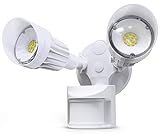 JJC 2-Head Motion Flood JJC 2-Head Motion Flood |
|
Check Latest Price |
 Onforu 75W 3-Head Flood Onforu 75W 3-Head Flood |
|
Check Latest Price |
 LUTEC 32W Motion Flood LUTEC 32W Motion Flood |
|
Check Latest Price |
 UME 19W 2-Head Flood UME 19W 2-Head Flood |
|
Check Latest Price |
 LUTEC 72W 3-Head Flood LUTEC 72W 3-Head Flood |
|
Check Latest Price |
 LUTEC 80W 4-Head Flood LUTEC 80W 4-Head Flood |
|
Check Latest Price |
 SANSI 25W 2-Head Flood SANSI 25W 2-Head Flood |
|
Check Latest Price |
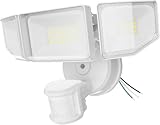 Abovizo 85W 3-Head Flood Abovizo 85W 3-Head Flood |
|
Check Latest Price |
| Onforu 32W 2-Head Flood |
|
Check Latest Price |
 YSEAGA Solar 4-Head Pair YSEAGA Solar 4-Head Pair |
|
Check Latest Price |
1. LEPOWER 58W 3-Head Motion Sensor Flood Light for Garage Driveways
LEPOWER LED Security Light Motion Sensor Outdoor Lights, Easy to Install
7000 lm at 58W
72 ft range at 180 deg
3 adjustable heads
IP65 aluminum
5700K
Pros
- 7000 lumens from a 58W draw
- Three adjustable heads plus an adjustable sensor head
- 72 ft sensing range at a 180 degree angle
- IP65 aluminum body with strong heat dissipation
- Runtime selectable at 1/5/10 minutes
Cons
- Manual text mislabels the dial layout
- Adjustment dials are very sensitive to small moves
- Some side panels or individual LEDs failed after install
This is the fixture we keep coming back to because the geometry works on a garage. Mounted at the usual 10 to 12 foot height, one head washes the door and the trim, one covers the driveway apron, and the third picks up the side path or the neighbor-side corner that never gets lit. The sensor head tilts independently, so you can pull the detection cone away from the street and still aim the lamps at the driveway.
Output is 7000 lumens at 5700K, which lands in daylight-white territory rather than warm residential white. It is bright enough that you can find a dropped key fob in the driveway gravel without sweeping the beam with your hand, and the aluminum body plus IP65 sealing is what we want facing four seasons of rain and snow. The manufacturer warranty is one year, which is the shortest in this group and worth noting honestly.
The recurring theme in owner feedback is brightness and straightforward wiring. People replacing an old hardwired box report that the job is quick because the manufacturer recommends a 4 inch junction box, and the three-wire-plus-ground connection is conventional. Coverage from a single unit is the other thing owners keep mentioning: the 72 foot range and 180 degree angle mean the light reaches the end of a standard driveway without a second fixture.
The complaints are about controls, not output. The instruction manual does not accurately describe the physical dial layout, so a lot of owners spend the first few nights learning the settings by trial and error, and the dials themselves are very sensitive to small movements. A smaller number of buyers report a side LED panel or individual diodes failing after installation. None of that changed the output, but it does mean the first weekend with this fixture involves tuning rather than plugging in.
If you are coming from a halogen flood, the jump is dramatic. The 58W draw is the electrical equivalent of a 175W traditional lamp, and the fixture weighs 1.7 pounds, so it is not a two-person ladder job if the box is already in place. Plan on testing the sensor from the ground with the test mode before you climb back up.
How it performs on a two-car and three-car facade
On a standard two-car garage, 7000 lumens spread across three heads is more than enough, and you can dial the sensitivity down so the light only fires inside your own apron. On a three-car garage or a wide driveway, the extra head count is the difference between one fixture and two, and the 180 degree detection cone still covers the full apron without pointing into the road. A Minnesota homeowner on r/HomeImprovement made the point that matters most in this category: the deciding factor was a fixture rated for four seasons, not raw lumens. This one is rated IP65 and built on aluminum, which is the right answer to that concern.
When to pick something else
If your garage is tight to the street and a neighbor is sensitive to light, 7000 lumens at 5700K will feel like a floodlight rather than a security light unless you aim it steeply downward. If you are mounting under a shallow eave, check the depth: at 8.24 inches tall this is one of the deeper housings, and a low soffit can foul the upper head. If you want a warm, neighbor-friendly 3000K tone instead, this fixture does not offer one.
2. LEPOWER 40W 2-Head Motion Sensor Flood Light for Compact Garages
LEPOWER Hardwired LED Security Lights Motion Sensor Outdoor, 40W 4000LM
4000 lm at 40W
72 ft range at 180 deg
2 adjustable heads
IP65 aluminum
5500K
Pros
- 4000 lumens in a compact two-head housing
- Four sensitivity settings reaching 72 ft
- Aluminum body rated for a 50000 hour lifespan
- Adjustable heads and sensor for flexible aiming
Cons
- Requires real electrical wiring to install
- Sensitivity and timer settings take experimentation to dial in
Smaller garage, smaller footprint, same sensor. At 10.12 by 4.51 by 7.55 inches and 1.6 pounds, this two-head unit fits under a low eave or on a narrow wall beside a single-car door where the bigger three-head housings physically will not mount. The 4000 lumens at 5500K is a sensible output for a one or two-car garage: bright enough to cross the apron safely, not so bright that it floods the neighbor’s bedroom window.
The PIR sensor is specified at up to 72 feet with a 180 degree angle, and the four sensitivity settings let you cut the reach back toward 10 or 20 feet once you have found the right zone for your driveway. Runtime is selectable at 1, 5 or 10 minutes. That combination is what you want for a garage: a short hold time is enough for someone to walk from the door to the car, and a long one wastes lamp hours and annoys anyone looking out a nearby window.
Reviewers consistently point to strong output for the size and a durable aluminum body rated for a 50,000 hour lifespan. The optical filter lens is doing real work here, tightening the beam so the light stays on your apron instead of washing the sky. Installation is a genuine wiring job, and that is the honest downside: if there is no junction box on that wall, this is not a DIY afternoon without an electrician.
Tuning the sensitivity and timer switches takes practice, and several owners describe the first few nights as trial and error. The four settings are stepped rather than continuous, which means you set it, walk the driveway, and adjust again. Budget an evening for that on a new install.
Where this one earns its rating is the ratio of usable light to physical size. If your garage is a single-car, a narrow lot, or a shop with a low ceiling, the 7000-lumen three-head fixtures are more light than the space can use. This is the sensible middle of the list.
Where the two-head layout shines
Two heads means you can commit both to the job: one for the door and the keypad, one for the apron, with the sensor head above them holding the detection zone. That is easier to aim than a three-head layout competing for the same wall. Homeowners with a fenced side yard often aim head two at a gate rather than trying to stretch one lamp across a fence line, which is where the compact size pays off.
What to watch before you buy
It is hardwired only, and it wants a standard junction box, so a detached rental garage or a carport with no existing wiring is the wrong application. The 40W draw and 5500K output are on the cooler side of this list, so if you want a softer, warmer glow at the door, look at the modes offered by the fixture below rather than this one. And if you have ever had a fixture stuck on overnight, note that the relay here is conventional, so a whole-house surge protector on that circuit is cheap insurance.
3. JJC 2-Head Motion Sensor Flood Light for Eave and Soffit Mounting
JJC LED Security Lights,Motion Sensor Flood Light Outdoor Fixture,3000LM 27.5W(120W Equiv.),IP65 Waterproof,5000K Daylight White ETL Listed Outdoor Lighting White (Not Solar Powered)
2000 lm at 27.5W
On-time, auto, and dusk-to-dawn modes
2 adjustable heads
ETL listed
Pros
- Three working modes: on-time
- motion auto
- and dusk to dawn
- Two adjustable lamp heads for aiming
- Aluminum body with ETL listing and a two-year warranty
- Fits standard wall or eave mounting
Cons
- Listed output of 2000 lm trails larger fixtures in its class
- Hardwired only so wiring is required
At 7 by 5.5 by 5.5 inches and 2.1 pounds, this is the smallest housing here, and the semi-flush wall and eave mounting is the reason. If your garage has a soffit you cannot clear or a door header with limited height, a deep three-head flood will not sit flat. This one does, and the two adjustable heads can be aimed down and out to cover the door and the apron anyway.
The mode selection is the distinguishing feature. This fixture offers on-time, auto motion and dusk-to-dawn, and the dusk-to-dawn mode is what garage owners use most: a low ambient level after dark so the door is always findable, then full output when someone approaches. That is a different behavior from a pure motion flood, and plenty of people prefer it.
How it performs around a garage door
With 2000 lumens at 5000K, this is a light-duty fixture by the standards of the rest of this list. It will comfortably light a door, a keypad and the first few feet of apron, and it will follow someone to the car in a single-car setup. On a wide two-car driveway you would feel the difference between this and a 7000-lumen unit, and the fix is a second fixture rather than a strained eye.
Detection is the same PIR approach the bigger fixtures use, and because the housing is compact the sensor sits close to the door plane, which makes it easier to keep the cone off the sidewalk than a wide-angle head mounted further out. Owners report solid outdoor performance in garages and yards, and the two-year manufacturer warranty is a step up from the one-year coverage on some budget three-head units.
One discrepancy is worth flagging before you order. The product listing headline advertises a higher figure than the technical specifications panel, which states 2000 lumens for a 27.5W draw. We went with the specification panel because that is the number the manufacturer publishes in the structured data, and it is the safer number to plan coverage around.
When to pick something else
If you need real light on a driveway, this is not enough output and stretching the claim does not help you. It is also hardwired with no plug, solar or battery option, so it only makes sense where a box already exists. For a warm 3000K tone at the door, this fixture runs 5000K daylight white, which is the wrong color for neighbor-sensitive installs.
4. Onforu 75W 3-Head Motion Sensor Flood Light for Maximum Output
Onforu 75W LED Flood Light Motion Sensor Outdoor, 7000lm Dusk to Dawn Flood Light, Security Light with Three Head, IP65 Waterproof Exterior Floodlight, 6500k Wall Light for Entryway Stairs Yard Garage
7000 lm from 112 LEDs
72 ft range at 180 deg
3 heads, 270 deg coverage
IP65
6500K
Pros
- 7000 lumens from 112 LED beads
- Three adjustable heads across a 270 degree zone
- Thin panels sit discreet against siding
- Die-cast aluminum cooling fins with IP65 sealing
- Sensor reaches 72 ft at 180 degrees with a 1 to 10 minute timer
Cons
- Instruction sheet does not match the physical dial layout
- On-body dials are extremely sensitive to small moves
- One report of a side panel arriving non-functional
This is the thin-body option. At 9.3 by 6.6 by 4.4 inches, the housing sits closer to the wall than most three-head floods, which owners consistently notice during daylight hours because it does not look like a bulk add-on to the siding above a garage door. The 112 LED beads deliver 7000 lumens at 6500K, so it is a genuinely bright light in an unobtrusive case.
The 270 degree light spread across the three adjustable heads is the useful number for garage geometry. It means the fixture can cover the driveway, the side path and the wall opposite the door without fighting itself, which is the same reason multi-head units are the most praised feature in garage forums.
The die-cast aluminum heat sink with fin-type cooling is a durability positive in cold climates, because a fixture that sheds heat well keeps its electronics and seal in better shape through freeze-thaw cycles. Combined with IP65 sealing, this is a credible four-season choice for an exposed eave or an open carport.
The control story is the weak point, and it echoes across reviews: the manual describes knob functions that do not match the physical dial layout, so owners learn the settings from the molded symbols on the casing. The dials are also described as extremely sensitive to small movements. Budget a tuning evening rather than assuming a ten-minute install and forget.
One report of a side panel arriving non-functional, with some LEDs staying dimly lit after shutdown, is isolated rather than widespread, but it is worth checking all three heads immediately after install instead of assuming they work.
Is 7000 lumens too much for a residential garage?
It can be. Light trespass is a real complaint in garage forums, and owners are explicit that they do not want prison-yard brightness spilling onto the street. The answer is aiming rather than dimming: tilt the heads down at roughly 30 degrees, keep the top edge of each head below the horizon line, and use the black wall plates and shrouds most of these fixtures ship with to cut the visible glare line. A r/HomeImprovement thread on garage security lighting makes the broader point that durability across seasons decided the purchase, not brightness, and aiming is how you keep high output without becoming the complaint.
Where it falls short
6500K is the coolest white in this roundup, and it is genuinely harsh under an eave at close range. If the light lands on a wall you walk past every night, expect to want a warm 3000K fixture instead. The 75W draw is also the second highest here, and the sensitive dials mean this is a fixture you will adjust more than once.
5. LUTEC 32W Motion Sensor Flood Light for Dusk-to-Dawn Garages
LUTEC 32W 3500 Lumen LED Security Lights Motion Sensor Light Outdoor, 5000K Daylight, IP65 Waterproof, Dusk to Dawn, Motion Detector Flood Light for Garage, Yard, Porch-Black
3500 lm at 32W
69 ft range at 180 deg
Four lighting modes
IP65 aluminum
5000K
Pros
- Much brighter than older incandescent security lights
- Four modes including a practical manual override
- Adjustable heads with distance and timer settings
- Backed by a three-year warranty
- Works best with a 4.13 inch junction box
Cons
- Shallow body needs room for wire nuts behind the box
- Shortest on-time setting is brief for some setups
- Non-standard wiring is awkward outside North America
Mode control is where this fixture earns its place. It runs four lighting modes: test, security, dusk-to-dawn and manual override, and the manual override in particular is the one people miss until they need it. Holding the test switch for a few seconds forces the light on continuously, which is how you change a head position or find a dropped key without waiting for motion.
Output is 3500 lumens at 5000K from a 32W draw, with a 180 degree sensing angle out to 69 feet. The timer adjusts for test, 1, 3 or 10 minutes. For a garage that is lit every night for the sake of a door and a keypad, the dusk-to-dawn mode is the feature that reduces trips in the middle of the night without turning the fixture into a permanent streetlight.
Long-term owners report the fixtures keep working with no degradation, and the three-year warranty with responsive support is among the longest in this group. At 6.88 by 7.08 by 7.67 inches and 1.7 pounds it is a mid-size housing, big enough to cover a two-car apron comfortably, small enough for a side wall.
The practical issue is that it sits nearly flush, which means it needs a standard electrical box with clearance behind it for wire nuts. On a thin-sided wall or a tight eave you may have to recess the box or trim wood to make it fit. The shortest on-time setting is also brief for some setups, so a family walking slowly from a car to the door may want the 3 or 10 minute position.
The wiring configuration is non-standard enough that it is awkward outside North America. If your garage is on a 120V circuit and you are replacing a conventional fixture, this is a clean swap.
What manual override actually does for you
It is the difference between a light you can control and a light you have to beg. On a garage, manual override solves three real problems: testing a newly aimed sensor, cleaning a lens or changing a bulb without a ladder at midnight, and keeping the light on for a 20 minute project on a car. Most fixtures in this list offer a test mode, which covers the first case only. This one separates the override from the test mode, so you can leave it locked on while you work.
Where it does not fit
Do not buy it expecting a two-head layout. The single adjustable light head is fine for a door and a walkway, but a wide driveway will out-run it, and the shallow body is the one place where installers report cutting wood. If you are outside North America or on a non-standard voltage supply, skip it.
6. UME 19W 2-Head Motion Sensor Flood Light for Small Spaces
UME 19W LED Flood Light Motion Sensor Outdoor, 2 Adjustable Head, 2000LM, 5000K, IP65 Waterproof, Dusk to Dawn Security Light with Photocell for Exterior,Outside,Garage,House(Black)
2000 lm at 19W
50 ft sensing range
2 adjustable heads
IP65
5000K
Pros
- Very bright for a 19W draw
- Quick install over an existing hardwired box
- Reliable pickup including small animals
- Heavily adjustable dual heads and sensor head
- Test mode makes initial setup painless
Cons
- No manual sensitivity or brightness adjustment on this model
- No quick-switch override to force the light on
- A small number had a sensor that only worked in test mode
- Included gasket may need taping to stay in place
This is the efficiency pick. 2000 lumens from 19W is roughly 105 lumens per watt, which is why owners describe it as dramatically brighter than the incandescent garage floods it replaces. For a single-car garage, a storage shed wall or a short walkway, that is all the light most people actually need, and the 19W draw is trivial on any existing circuit.
Detection is a PIR sensor out to 50 feet, with lighting time options of 1, 3 or 10 minutes and a test mode for setup. Both heads and the sensor head are adjustable to any angle, so the layout flexibility holds up even with two lamps. The body is polycarbonate rather than aluminum, at 10.47 by 7.05 by 5.74 inches and 1.1 pounds, which makes it the lightest fixture in the roundup and the easiest to handle on a ladder.
Owners praise the quick installation when replacing an existing hardwired box, and report reliable detection including for small animals, which is both useful and a potential false-trigger source worth knowing about before you install it beside a garden path. The 1, 3 and 10 minute timer options are widely singled out as sensible.
What this model does not have is as important as what it does. There is no manual sensitivity or brightness adjustment, and no quick-switch override to force the light on, so you are locked into the factory range and timing. A small number of units had a motion sensor that worked only in test mode, and the included gasket has been reported as needing tape to stay seated on some boxes, which is exactly the kind of detail that turns into water ingress a season later.
Is 2000 lumens enough for a one-car garage?
For a one-car garage, a door, a keypad and the apron in front of a single vehicle, yes. It is the same output class as the JJC fixture, and owners report a dramatic improvement over the incandescent lights these typically replace. For a two-car or wider driveway you would be relying on the light bouncing off the garage door and walls, which works in a light-colored interior and falls apart in a dark one.
Where it falls short
The lack of adjustability is the honest limitation. If your garage faces a sidewalk or a street, you have no sensitivity dial to trim the zone, and the sensor head is your only aiming tool. The polycarbonate housing and the gasket fit are also the two places where this fixture is most likely to disappoint in a four-season install. If durability is the deciding factor, spend up for the ceramic-based option further down.
7. LUTEC 72W 3-Head Motion Sensor Flood Light for Wide Driveways
LUTEC 72W 7500LM LED Security Lights Motion Sensor Light Outdoor, 5000K Daylight, IP65 Waterproof, Dusk to Dawn, 3-Head Motion Detected Flood Light for Garage, Yard, Porch(Black)
7500 lm at 72W
69 ft range at 180 deg
3 rotatable heads
Four modes
IP65 aluminum
5000K
Pros
- 7500 lumens turns a driveway or yard into daylight
- All three heads plus the sensor aim independently
- Timer choices of 1
- 3
- or 10 minutes plus distance settings
- All mounting hardware included
- Fast replacement service when a sensor failed
Cons
- Dusk-to-dawn standby brightness cannot be dimmed
- Wall mounting base is plastic rather than aluminum
- Wiring space is tight against the box on some installs
At 12.99 by 8.07 by 5.12 inches this is one of the larger housings, and the 7500 lumens at 5000K is sized for a wide driveway rather than a door. All three heads rotate independently, plus the sensor, which means you can point one head down the apron, one at a side gate and one at the wall opposite the garage without compromise. The manufacturer rates the aluminum body for a 50,000 hour lifespan and IP65 sealing.
Like the other LUTEC in this list, it carries the same four lighting modes: test, security, dusk-to-dawn and manual override, with a timer adjustable for 1, 3 or 10 minutes and a 180 degree sensing angle reaching 69 feet. The detection reaches is slightly under the 72 feet claimed by some competitors, and the shorter figure is arguably the more honest one to plan around.
Reviewers are emphatic about brightness, describing the effect on a driveway or yard as transforming night into day. The flexible three-head aiming and the mode selection draw the most praise, and the brand’s warranty service is repeatedly singled out, including a fast replacement when a sensor failed. All mounting hardware is included, so hardwiring did not require a parts run.
Two practical complaints stand out. The dusk-to-dawn standby level is not adjustable and can be brighter than you want on a neighbor-sensitive street, and the wall mounting base is plastic rather than aluminum, which is a weak point on a fixture that is otherwise metal. On some installations the wiring space is tight against the outlet box, so check your box depth before you commit.
Can one fixture cover a wide driveway, or do you need two?
One, if the fixture is a three-head unit with independently rotating lamps and roughly 7000 lumens or more. The 180 degree detection angle at 69 feet reaches the far end of a typical two-car or three-car apron from a 10 to 12 foot mount. You need a second fixture when the driveway is longer than the detection cone, when the garage sits at an angle to the apron, or when a fence or shrub blocks the low approach. The alternative to a second fixture is a single high-output unit like this one, which is why multi-head designs are the most commonly praised feature in garage forums.
What to watch
The un-dimmable dusk-to-dawn standby is the one that generates complaints, and it is worth testing before you decide whether you even want that mode on. The plastic mounting base is a durability compromise, and the 12.99 inch width will not fit under a shallow soffit. If a warm color temperature matters to you, this runs 5000K and does not offer an alternative.
8. LUTEC 80W 4-Head Motion Sensor Flood Light for Large Yard Coverage
LUTEC 80W 9000LM Security Light Hardwire Motion Sensor Outdoor Lights
9000 lm at 80W over 2370 sq ft
69 ft at 180 deg
4 heads
Four modes
IP65 aluminum
Pros
- 9000 lumens across four independently aimed heads
- Two-phase output: 20 percent standby jumping to full
- Four modes including a 6-hour always-on option
- Each head and the sensor tilts for precise aiming
- Three-year warranty with fast replacement support
Cons
- Very bright if aimed straight down the driveway
- Sensor is highly sensitive at minimum settings
- One report of the light staying on until the breaker was reset
This is the biggest light in the roundup, and the four-head four-beam design is the reason. Four independently tilting heads cover up to 2,370 square feet, so it is aimed at large lots: a long driveway, an RV bay, a workshop yard or a carport with a wide apron. At 9000 lumens at 5000K from an 80W draw, the manufacturer claims more than 88 percent energy savings against halogen, and the motion sensing still runs 69 feet at 180 degrees.
The two-phase output is the smart part. One mode dims to 20 percent at dusk and jumps to 100 percent on motion, which gives you an always-findable door without paying for full-output hours all night. There is also a 6-hour always-on mode and a test mode, so you can leave the light burning through a project without touching the sensor.
Reviewers praise the total yard and driveway coverage and the dim-then-bright two-stage behavior, and support has resolved defects such as a faulty photocell quickly. The three-year warranty is among the longest offered here, and the aluminum housing carries IP65 sealing.
The brightness is the trade. Owners flag that aiming this straight down a driveway is dazzling, and the practical fix is to angle the heads at a roof overhang or the ground well away from eye level. The sensor is also very sensitive even at minimum settings, which is a problem on a lot where traffic passes at the end of the drive. One report describes a fixture that stayed on until the breaker was reset in daylight, which is the stuck-on relay failure mode garage owners complain about most often, and it is a reminder to pick a fixture with a real warranty behind it.
When four heads and 9000 lumens are the right answer
When the light needs to reach past the driveway. A long drive, a two-story house with a deep apron, a workshop yard with a trailer parked in it, or a lot where a second fixture would mean new wiring. Four heads let you cover that footprint from a single junction box and a single ladder visit, which is the argument for it. For anything smaller, this is a lot of light pointed at a garage door, and light trespass becomes your problem instead of your neighbor’s.
Where it falls short
Dimming, mostly. At 9000 lumens with a 20 percent standby floor, there is no fine control, and the sensor sensitivity is coarse. A dark-sky-minded owner asking on cloudynights would point out that this is a fixture to aim very carefully, not one to point where you like. For most residential lots, one of the 7000-lumen three-head units is the smarter buy.
9. SANSI 25W 2-Head Motion Sensor Flood Light for Four-Season Durability
SANSI Upgraded 25W 3000LM Motion Sensor Outdoor Lights, Security Light
3000 lm at 25W
320 deg angle to 72 ft
Four control modes
IP65
5-year warranty
Pros
- 3000 lumens at 25W saving over 80 percent versus halogen
- Ceramic heat dissipation rated for 50000 hours
- Polycarbonate housing resists UV
- flame
- and corrosion
- 320 degree detection angle reaching 72 ft
- Five-year warranty with ETL certification
- LUX knob sets the ambient brightness threshold
Cons
- Hardwired only with no plug or solar option
- Stepped control knobs take a short learning curve
The durability pick, and the reason is the materials rather than the marketing. Instead of an aluminum heat sink, this fixture uses ceramic-based heat dissipation rated for a 50,000 hour service life, and the housing is polycarbonate chosen specifically because it resists UV, flame and corrosion better than the cheaper plastics used elsewhere in this category. It is ETL certified with a five-year warranty, the longest coverage in the roundup.
Output is 3000 lumens at 25W and 5000K, with a 320 degree detection angle reaching 72 feet and lighting time adjustable from 10 seconds to 10 minutes. The 10-second minimum is unusually short and genuinely useful on a garage, where a car pulling into the drive only needs the light while the driver is walking to the door.
The widest detection angle here at 320 degrees means the sensor sees around the corner of the garage better than a 180 degree unit, which is exactly what you want on a building with a side wall that blocks the cone. Four control modes cover AUTO motion, dusk to dawn, on-time and test, and the LUX knob lets you set the ambient brightness threshold the photocell uses to decide it is dark. On a street with a bright porch light nearby, that threshold is the difference between a light that works and one that never turns on.
The learning curve is the cost. The control knobs are stepped rather than continuous, and owners describe a short adjustment period before the settings make sense. It is hardwired only, so there is no plug or solar variant, but for a permanent install that is an advantage rather than a limitation.
Does it work in cold weather?
It is the best-specified answer in this list for a four-season climate, and the reasoning is mechanical rather than marketing. Ceramic-based heat dissipation moves heat away from the LED board more effectively than an aluminum fin, and the polycarbonate body does not become brittle the way cheaper ABS housings can in sustained freezing. A r/HomeImprovement poster who lost two hardwired garage fixtures in about two months said they would replace them with anything rated for four seasons rather than anything brighter, and this is the fixture on the list that best answers that requirement. It still carries IP65 weatherproofing, so sleet and driving rain are covered.
Where it falls short
Output is modest by the standards of this roundup, so a wide driveway is not the job. The color temperature is fixed at 5000K with no warm option, and the stepped knobs mean you will adjust these dials more than once. It is also the smallest of the durability-minded picks, at 8.23 by 6.06 by 4.72 inches, so a three-car facade is one fixture short of comfortable.
10. Abovizo 85W 3-Head Motion Sensor Flood Light for Crisp Daylight White
Abovizo 85W LED Security Lights Motion Sensor Light Outdoor, 8500LM Dusk to Dawn, IP65 Waterproof, 6500K, 3 Head Motion Detected Flood Light, Floodlight for Outside, Garage, Yard, Porch (White)
8500 lm at 85W and 6500K
72 ft range at 180 deg
3 heads
Dusk-to-dawn dim mode
IP65
Pros
- 8500 lumens at a crisp 6500K
- Three adjustable heads plus an adjustable sensor head
- Dusk-to-dawn low-brightness mode that jumps to full
- All mounting hardware included
- Works well for small animals using a pet door
Cons
- Instructions are hard to read and written in broken English
- One unit detected motion only at about 3 ft
- Detection range on some units fell well short of 72 ft
8500 lumens from 84 LED beads at 6500K, in an aluminum housing rated IP65, and it is the brightest color temperature in the roundup. If you want light that reads as midday rather than as a home, this is the fixture. The 180 degree sensing angle is published out to 72 feet, and lighting time adjusts to 1, 3 or 10 minutes with three sensitivity levels.
Two working modes, dusk-to-dawn and motion sensor, and the dusk-to-dawn mode is the one garage owners mention approvingly. It runs at a low brightness and jumps to full on motion, which means the door is always findable without the light burning at full output all night. The three heads plus the sensor head are all adjustable, so the aiming flexibility matches the rest of the multi-head fixtures here.
Most reviewers confirm strong brightness, easy wiring and good sensitivity, and the dim-then-bright behavior draws particular praise. The installation itself is a simple two-wire-plus-ground job with all mounting hardware included, and pickup works well for small animals, which owners with dogs using a pet door specifically mention.
The documentation is the weak point. Reviewers repeatedly call the instructions hard to read and written in broken English, which turns a straightforward install into a guessing game around the mode switch. There is also at least one account of a unit whose motion detection was effectively limited to about 3 feet no matter how the settings were changed, and other reports of detection range falling well short of the published 72 feet. That variance in sensor performance is the thing to watch on this pick, and it is a reason to test the sensor from the ground before you finish the install.
Is 6500K too harsh for a garage?
For some homes, yes. 6500K is a cool, blue-leaning white and it exaggerates every color in the space, which makes a garage that already has plywood and tool steel look like an operating room. It also scatters more at the eye at close range than 3000K does. Where it works well is a large, open bay, an RV or carport space, or a driveway where you want maximum visual acuity and maximum deterrent effect rather than atmosphere. Garage owners who find 5000 to 6500K too harsh tend to gravitate toward 3000K warm-white fixtures, and none of the hardwired units in this roundup offer a warm option, so that is a limitation of the whole category as much as this one.
What to watch
Sensor consistency is the main risk, followed by the documentation. The three sensitivity levels are also stepped, so precise zone narrowing is not possible. If you need a tight, controllable detection cone more than you need maximum output, pick a fixture with a continuous sensitivity dial and a wider angle instead.
11. Onforu 32W 2-Head Motion Sensor Flood Light for Entry-Level Installs
Onforu 32W 2 Head Motion Sensor Outdoor Lights, 3200LM 6500K LED Security Light Hardwired, Dusk to Dawn, Motion Detector Light for Outside, IP65 Waterproof Flood Lights for Garage, Yard(Black)
3200 lm at 32W and 6500K
19 to 72 ft range
2 heads
Dusk-to-dawn at 30 percent
IP65
Pros
- 3200 lumens of 6500K daylight white
- Covers up to 1150 sq ft with an adjustable 19 to 72 ft range
- Dusk-to-dawn standby at 30 percent before jumping to full
- Heads and sensor are easy to re-aim after mounting
- All mounting parts included
Cons
- Detection area is smaller than expected at maximum sensitivity
- Stepped controls take a minute or two to learn
- Foam gasket is too narrow to seal a round box cleanly
3200 lumens at 6500K from a 32W draw, covering up to 1,150 square feet, in a hardwired two-head housing. The detection range adjusts from 19 to 72 feet, and the 180 degree angle is standard. For a two-car garage where you want daylight white at the door and the apron without a three-head housing, the numbers line up well with the job.
The dusk-to-dawn standby at 30 percent brightness is the feature that separates this from a basic motion flood. It gives you an always-on ambient level after dark and full output on approach, which on a garage door means you are never fumbling in the dark for the keypad. Lighting time is selectable at 1, 3 or 10 minutes, and the IP65 rating is stated for high heat and freezing cold.
Owners are pleased with the brightness-to-cost ratio and with the daylight color temperature compared to the halogen setups these replace, and they find the controls workable once learned. All mounting parts are included, the wiring is simple, and heads and sensor are easy to re-aim after mounting, which matters more than people expect on a first install.
Two technical gripes recur. The detection area is smaller than expected even at maximum sensitivity, which is a reasonable trade for a cheaper unit but does mean you should not plan on 72 feet of reach. The foam gasket is too narrow to properly mate the hexagonal base to a round electrical box, so the weather seal is imperfect out of the box. Add a dab of sealant around the box on install, because water getting behind a motion sensor is the fastest way to kill one.
The controls are stepped rather than continuously adjustable, which takes a minute or two to learn and means you cannot fine-tune the zone the way you can on a dial-based fixture.
When this is the right pick
When you are replacing an existing hardwired fixture and want a visible jump in output for the least money. A 3200-lumen 6500K two-head unit covers a two-car apron and the side path without new wiring, without a bigger housing and without a three-head fixture you do not need. It is also a reasonable second fixture for the far corner of a lot, where a dedicated two-head unit is easier to aim than splitting one multi-head fixture across two distant zones.
Where it falls short
The detection shortfall is the honest limitation, and it is the reason this is not higher in the list. If your approach path comes from a long driveway or a sidewalk, the effective zone is narrower than the published 72 feet and you may end up cranking sensitivity, which pulls the problem back in the other direction. The gasket fit means you should plan a sealing step at install, and 6500K is not a neighbor-friendly color.
12. YSEAGA 4-Head Solar Motion Sensor Flood Light Pair for No-Wiring Installs
YSEAGA 4 Head Solar Lights Outdoor Waterproof, 288 LED 2800LM Motion Sensor Outdoor Lights with Remote Control, Solar Flood Lights Outdoor for Patio, Garage, Yard, Wall, IP65 Security Lights 2 Pack
Up to 2500 lumens from 288 LEDs
26 ft motion range
4 heads, 270 deg
IP65
Solar two-pack
Pros
- No wiring or electricity needed
- Four adjustable LED heads with wide aimable coverage
- Wireless remote switches modes without climbing down
- Four modes including half brightness and an SOS flash
- Two-pack covers several areas at once
Cons
- Motion detection limited to about 26 ft
- Needs direct sun on the panel to last the night
- All-plastic housing is less rigid than aluminum
This is the pick when wiring is not an option: a rental garage, a detached shop, a carport bay or a shed wall where there is no junction box and no interest in paying an electrician to put one in. Two fixtures, four adjustable heads each, and no cord to the house. The rechargeable battery charges automatically during the day from a flexible solar panel, and the whole unit is IP65 for rain, snow and heat.
Output is up to 2500 lumens from 288 LEDs across a 270 degree lighting angle. The wireless remote is the feature that changes daily use: you can change modes, trigger the light or switch it to constant without climbing down a ladder, which on a wall-mounted fixture at 10 feet is the difference between a usable light and a chore.
Four modes are available through the remote: constant half brightness, a dim-bright-dim motion pattern, motion-activated full output, and an SOS emergency flash. Reviewers are uniformly positive about brightness relative to expectations and about the quick, wiring-free install, and the two-pack format is seen as good value for lighting more than one spot.
The limitations are physical and unavoidable. Motion detection is limited to about 26 feet, which is roughly a third of what the hardwired fixtures reach, so a long driveway approach is out. The panel needs direct sunlight for the battery to last the night, and shaded or overcast placement is where solar units underperform and then need frequent cleaning. The all-plastic housing is also less rigid than an aluminum fixture, and at 1.5W and 5.5V it is a fundamentally different class of light from the rest of this list.
Where a solar fixture is the right answer
When the alternative is no light at all. A detached garage with no power, a rental where you cannot touch the wiring, a garden shed, a carport, or a second location too far from the house to run a circuit. In those cases the 26 foot range is workable because the light only needs to cover a door and a short apron, and the remote means you never have to climb down to change a setting. If the battery is sized for a full night of motion events on a good charge, that is a few car arrivals and a walk back from the mailbox, not a stadium flood.
Where it falls short
Placement decides success or failure. Put the panel where it gets hours of direct sun and the unit works; put it under an eave, beside a tree or on a north wall and you get a light that dims every cloudy week and needs the panel cleaned regularly. For a front-facing garage door where deterrence matters, the shorter detection range and lower output are a real reduction in capability, and none of the hardwired units on this list come close to the reach.
How to Choose a Motion Sensor Flood Light for a Garage?
Power source is the first decision, because it dictates everything else. A hardwired fixture draws from an existing junction box, gives you the strongest output, the longest reach and the most control, and it is the only real option for a front-facing garage door. A solar unit needs no wiring and no box, installs in an afternoon on a wall, and trades away detection range and output. A battery or plug-in fixture is a third path, useful for testing a location before you commit to running a circuit. If you already have a box on the wall, hardwired is almost always the answer.
How many lumens do you need for your garage?
Start with the area you actually need lit, not the size of the building. A single-car garage with a door, a keypad and a short apron is covered comfortably by 2000 to 3500 lumens. A two-car garage with the full driveway in front of it wants 3000 to 7500 lumens, and a three-car garage or a wide apron with an RV bay parked in it wants 7500 lumens and up. Multi-head fixtures spread that output over several directions, so total lumens tell you how bright the space is, not how wide it reaches.
Color temperature is the second half of the brightness question. Everything in this roundup runs between 5000K and 6500K, which is daylight white, because that is what security lighting is optimized for. Warm 3000K is easier on the eyes and much better for neighbors, but you will have to look outside this list for it, and the tradeoff is a slightly lower perceived brightness. If a neighbor has ever complained about your exterior lighting, color temperature is the first dial to change, and aiming is the second.
Detection range and detection angle decide what sets it off
Range is how far the sensor sees, angle is how wide it sees. Most garage fixtures publish a 180 degree cone, and the SANSI in this roundup is the outlier at 320 degrees, which lets it see around the corner of a building. Published range runs from 26 feet on the solar unit to 72 feet on several hardwired models, but published range assumes maximum sensitivity, which is almost never where you should leave it. The practical number is what you get after you turn the dial down to exclude the street, and on several fixtures here that is a good deal less than the headline figure.
Range and angle together determine coverage geometry, and this is the part no competitor explains clearly. A sensor mounted at 10 to 12 feet with a 180 degree cone covers a fan of ground that reaches roughly 40 to 50 feet out from the wall at typical mounting heights, which is enough to cover a two-car apron if the fixture is centered above the door. Mount it off to one side and the cone covers the side path instead, which is why placement above the door is the default.
Weather rating, cold climates and the failure modes to avoid
Every fixture here is IP65, which covers dust and water ingress from any direction, and that is the minimum for an exposed wall or carport. Below freezing, the differentiator is material and heat management rather than the IP rating alone. Ceramic-based heat dissipation and polycarbonate housings hold up better than cheap plastics and bare aluminum fins, and a longer warranty is usually a proxy for a better seal. The classic garage failure is a relay whose contacts arc closed and latch, leaving the light stuck on until you reset the breaker, and owners on garagejournal.com attribute it to running high-wattage halogen lamps in the fixture and to cheap sensor gaskets. Modern LED output sidesteps most of the arcing, but the gasket is still the weak point. If you are replacing an old halogen flood, look at a fixture with a multi-year warranty and a two-year warranty as a minimum.
Solar units have a different durability profile. They need hours of direct sun, they degrade through shade and cloud cover, and the panel needs periodic cleaning. That is not a flaw so much as a placement requirement, but it is the reason solar fixtures disappoint people who install them on a north-facing wall.
Mounting height, aiming and light trespass
Mount 10 to 12 feet up, centered above the door if you can, and aim the heads down at roughly 30 degrees. That keeps the top of the beam below the horizon line so you are not broadcasting into your neighbor’s windows, and it means the light lands on the apron and the ground rather than on the facade. Keep the built-in shrouds and wall plates in place, because they exist to cut the visible glare line. If you want to go further, the dark-sky approach discussed on cloudynights.com is to aim every head at a surface the light bounces off rather than at anything you look at directly. Aiming one of the 9000-lumen heads at a roof overhang is the single most effective light-trespass fix available.
Narrow the detection zone before you narrow the brightness. Turn the sensor toward your driveway and away from the street, drop the sensitivity setting until passing cars no longer set it off, and only then worry about glare. Owners who do the opposite end up with a light that is dimmer and still triggers on traffic.
Replacing an existing fixture or running new wiring
Replacing an existing hardwired fixture over an existing junction box is a straightforward job for anyone comfortable with basic wiring: three wires and a ground, a mounting bracket, and roughly 15 minutes of work once the ladder is up. Several of the fixtures here are even sized to a specific box diameter, four inches for the LEPOWER three-head and 4.13 inches for the LUTEC, so match the box before you buy.
Running new wiring to a new location is a different project. It means a new box, cable through the wall or an exterior conduit run, and in most places a permit and an electrician. Garage owners tell forum threads they will pay for that because they cannot safely use a ladder later for maintenance, and that is the real argument for hardwiring: a fixture you cannot reach to service is a fixture you will live with. If there is no box at the location you want lit, a solar unit is a legitimate answer, or a battery-powered light, and both are cheaper than a new circuit the first night.
Frequently Asked Questions
What is the best motion sensor light for a garage?
The LEPOWER 58W three-head LED flood is the best motion sensor light for most garages: 7000 lumens, a PIR sensor reaching 72 feet at 180 degrees, three independently aimed heads and IP65 aluminum sealing from one junction box. A two-head unit in the 3000 to 4000 lumen range is enough for a single-car garage, and a solar four-head pair is the answer where no wiring exists.
What is the best floodlight for a garage?
A hardwired LED floodlight with at least 3000 lumens covers a single or two-car garage door and driveway apron, and 7500 lumens or more covers a three-car garage or wide drive. Choose adjustable heads so one fixture can aim at the door, the side path and the apron separately, and pick a fixture with an IP65 rating and a multi-year warranty for four-season durability.
Which motion sensor flood light is the best?
For overall garage use, the LEPOWER three-head at 7000 lumens is the strongest balance of coverage, output and proven long-term ownership. The SANSI two-head is the most durable choice in cold weather, with ceramic heat dissipation, a 320 degree detection angle and a five-year warranty. The YSEAGA solar pair is the best option where running new wiring is not possible.
Why does my motion sensor keep triggering?
The usual causes are a sensitivity dial set too high, a detection cone pointed at the street or sidewalk, moving branches in the wind, animals crossing the zone, and a photocell threshold set so bright that the light never fully disarms. Turn the sensor toward your driveway instead of the road, step the sensitivity down, and use the LUX or photocell adjustment if the fixture has one. Test each change from the ground at night before climbing up.
How do I keep a motion sensor light on all night?
Most fixtures have a test mode, a dusk-to-dawn mode, or a manual override, and the fastest way to use it is usually holding the test switch for a few seconds, which latches the lamp on regardless of the sensor. Several fixtures here, including both LUTEC models and the SANSI, also have a dedicated manual override mode. On a large fixture there is often a 6-hour always-on setting for longer projects.
What are the common problems with outdoor motion lights?
The six most common failures are a relay that arcs closed and latches the light on, a dead or fried PIR sensor, false triggers from traffic, pets, deer or wind-blown branches, water intrusion through a poor gasket, and a solar unit whose battery never holds a full charge. Cheap gaskets and a missing seal between the fixture and the electrical box cause most water problems, so seal the box edge at install.
Final Verdict: Which Motion Sensor Flood Light Fits Your Garage
For most garages, the LEPOWER 58W three-head is the pick. Seven thousand lumens, a 72 foot sensor at 180 degrees, three heads plus a tilting sensor head, and aluminum IP65 construction get you a full two or three-car facade from one box, and the volume of long-term ownership behind it is the strongest evidence available.
Buy the compact LEPOWER 40W two-head for a narrow or low-eave garage, the SANSI if you live where four real seasons destroy fixtures, the 9000-lumen LUTEC four-head if the light has to reach a long drive, and the YSEAGA solar pair if there is no wiring and never will be. Aim every fixture downward before you turn the brightness up, and the neighbor complaints never come.
Updated for October 2026. Pair the lighting with our picks for [12 Best Party Speakers with Lights](https://www.puritybymonster.com/best-party-speakers-with-lights/) if the garage is also the place you host, or with our [10 Best Bluetooth Speakers with Lights Party Speaker](https://www.puritybymonster.com/best-bluetooth-speakers-with-lights-party-speaker/) guide if you want audio that moves outside to the driveway.
1 thought on “12 Best Motion Sensor Flood Lights for Garages (October 2026) Top Picks”