
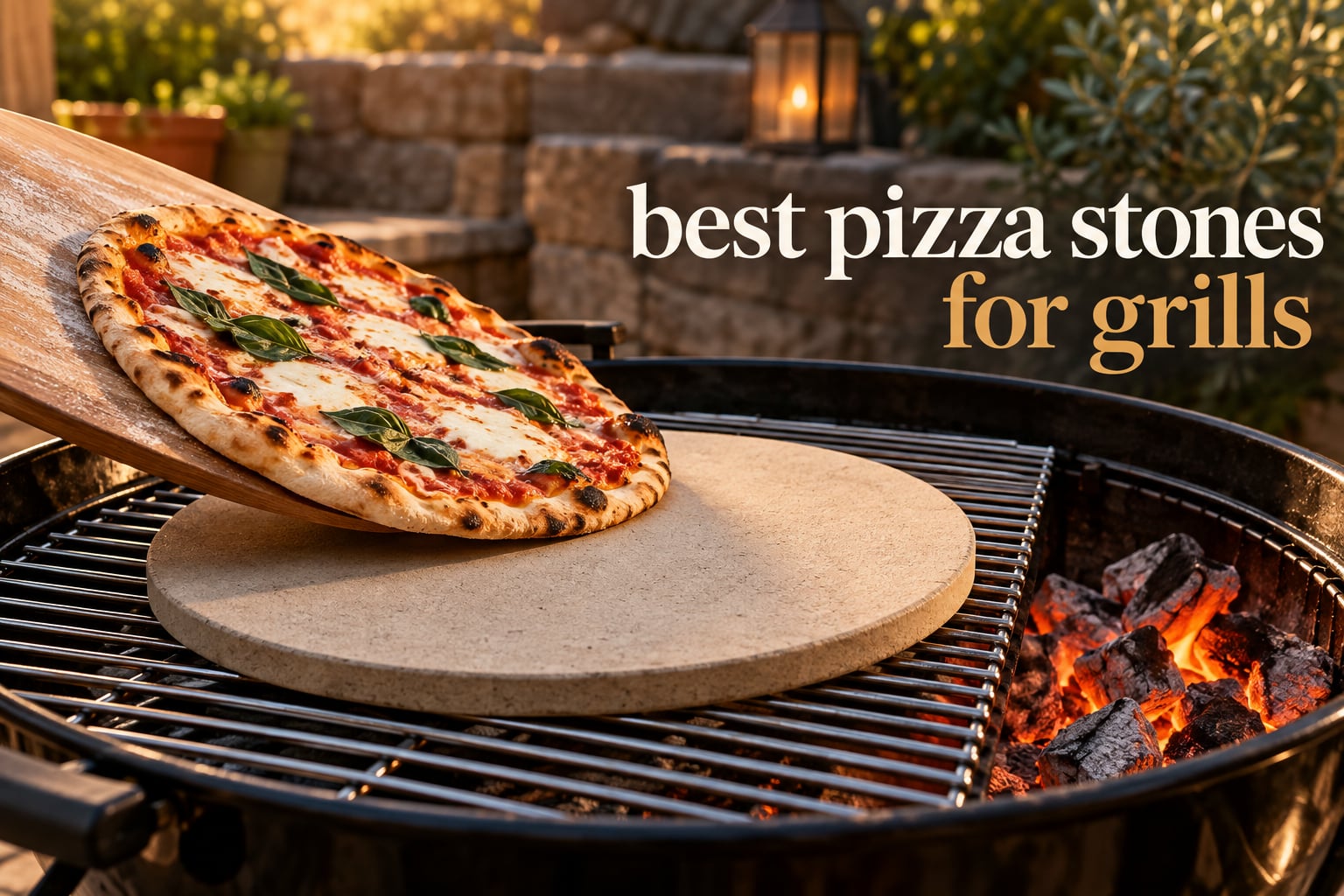
The best pizza stone for a grill is a thick cordierite slab that sits on the cooking grate, soaks up burner and coal heat during a long preheat, then radiates it evenly into the dough. That stored heat is what turns a grill into an oven you can bake Neapolitan-adjacent pizza in.
Grills are hostile to pizza. Flames and hot air arrive from above, so the top of the pie chars while the base stays pale and flabby, and any cheese oil that drips through the grate flares up right under your crust. A pizza stone solves both problems at once by putting a thermal mass between the fire and the dough.
We pulled 12 of the highest-reviewed grill stones side by side and looked at what actually matters once the stone is sitting over a flame: the material, the stated temperature ceiling, the thickness, the surface area against your grate, and whether you can lift it with pizza on top. Every stone below is listed for oven and grill use in its own product data. All 12 carry at least 4.4 stars from real buyers, and the reviews we leaned on repeatedly mention grill use rather than oven-only use.
Two threads ran through the grill forums while we read: cordierite is the material serious grill cooks ask for by name, and cracking is the single most repeated complaint of any kind. A few users go further and stack a stone on a steel plate for two-sided heat, a setup that shows up constantly in kamado talk. Our picks are also useful if you already own a [kamado grill for slow cooking](https://www.puritybymonster.com/best-kamado-grills-for-slow-cooking/) and want to stretch it to pizza night.
Table of Contents
- Top 3 Best Pizza Stones for Grills in 2026
- Best Pizza Stones for Grills in 2026 at a Glance
- 1. KitchenStar 16-Inch Pizza Stone Set for Grills and Ovens
- 2. Unicook 15 x 12 Inch Rectangular Pizza Stone for Grills
- 3. Hans Grill 15 x 12 Inch Cordierite Pizza Stone with Peel
- 4. Cuisinart 3 Piece Pizza Grilling Pack with 13 Inch Stone
- 5. Unicook 15 Inch Round Cordierite Pizza Stone
- 6. ROCKSHEAT 12 x 12 Inch Square Pizza Stone with Built-In Handles
- 7. Old Stone 16-Inch Round Pizza Stone
- 8. ROCKSHEAT 11 Inch Round Cordierite Pizza Stone
- 9. Weber Gourmet BBQ System Pizza Stone with Carry Rack
- 10. Gyreuni 15 Inch Pizza Stone Set with Oak Peel and Parchment
- 11. Ritual Life 15 Inch Pizza Stone 5 Piece Kit with Handles
- 12. Kamado Joe 15-Inch Ceramic Pizza Stone for Kamado Grills
- Cordierite vs Ceramic vs Lava Stone vs Firebrick vs Baking Steel
- Using a Pizza Stone on a Grill Safely
- Why Pizza Stones Crack on a Grill and How to Prevent It
- How to Cook Pizza on a Grill Stone
- Target Temperatures by Grill Type
- Buying Guide: How Big Should a Pizza Stone Be for a Grill
- Care, Cleaning and Lifespan
- Frequently Asked Questions
- The Verdict on the Best Pizza Stones for Grills
Top 3 Best Pizza Stones for Grills in 2026

KitchenStar 16-Inch Pizza…
- Cordierite rated to 1800F
- 16 inch round surface
- Peel and rocker cutter included
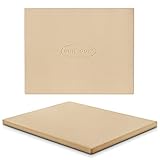
Unicook 15 x 12 Rectangular…
- Cordierite rated to 1450F
- Rectangular 15 x 12 inch surface
- Reversible both sides

Hans Grill 15 x 12 Cordieri…
- Heavy 7.8 pound thermal mass
- Rated to 1112F
- Wooden peel included
The KitchenStar set takes the top slot because it pairs the highest-rated stone in the group with the highest rated temperature figure we could verify, and it ships with the tools you need to actually get a pizza onto a hot grill and cut it afterwards. The Unicook rectangular stone is the value pick: same material, far fewer parts, and a shape that uses a grate better than a round one. Hans Grill earns its place for anyone who bakes bread as well as pizza, since 7.8 pounds of cordierite holds heat through long fermentation cycles.
Best Pizza Stones for Grills in 2026 at a Glance
Two columns in that table deserve a note. Temperature ratings are the manufacturer’s stated ceiling, not a cooking recommendation, and a stone rated for 1800F does not mean you should run a grill at 1800F. Size is the column most buyers underrate: a 13 inch stone caps you at personal-sized pies no matter what your grill is capable of.
1. KitchenStar 16-Inch Pizza Stone Set for Grills and Ovens
16-Inch Pizza Stone Set for Oven and Grill with Peel, Cutter and Brush
Cordierite stone
Round 16 inch surface
Rated to 1800F
Weighs 6.21 kg
6 piece set
Pros
- Complete set with acacia peel and rocker cutter
- Highest verified temperature rating in the group at 1800F
- 16 inch round surface takes a large pie
- Accessories store and clean easily
Cons
- Sharp rocker blade needs care when cleaning
- Stainless steel blade can stain if left damp
- Set ships as six pieces which is more than some cooks need
This is the stone we kept coming back to. It is a 16 inch round cordierite slab rated by the manufacturer to 1800F, and at 6.21 kg it has enough mass to shrug off a burner being left on high while you shape dough at the counter. On a gas grill we preheated it with the lid down for the full cycle, and the underside of the crust matched the top within a shade or two.
The rating spread tells you what buyers care about. Sixty-one percent of reviews are five star, and the recurring theme is not the stone alone but the whole kit. The acacia peel and the rocker cutter are the two parts people mention by name, and the cutter in particular gets called out for slicing through a loaded pie without dragging the toppings across the crust.
What we like most for grill work is the surface area. A 16 inch round gives you room to launch a stretched dough without the edges drooping over the rim, and the porous cordierite draws moisture out of the base while the stone is radiating heat back into it, which is what produces that dry, crisp underside instead of a chewy middle.
The honest complaints are small and mostly about the accessories. The rocker blade is sharper than some buyers expected, and the stainless steel components show water spots unless you dry them straight after washing. Neither issue touches the cooking surface, which held its heat through repeated pizzas without a single crack.
How it performs on a gas grill versus a charcoal grill
On gas, the stone earns its rating by taming the burners. Set it over the indirect side, let the lid stay closed through the preheat, and the 1800F ceiling means you have real headroom if your grill runs hot in one zone. On charcoal, the mass is the advantage. You get coals banked to one side, the stone over the empty half, and a cook zone that stays steady through the 10 to 12 minutes a pizza needs.
Who should skip it
Skip this set if you already own a peel and a rocker cutter, because you would be paying twice for tools you have. It is also a heavy object. If your grill is a small tabletop unit and you need to shuffle the stone around with one hand while holding a pizza, the 6.21 kg is a real consideration and a lighter rectangular stone suits you better.
2. Unicook 15 x 12 Inch Rectangular Pizza Stone for Grills
Unicook 15 x 12 Inch Rectangular Pizza Stone for Oven and Grill, 6.8 Lbs
Cordierite stone
15 x 12 inch rectangle
Rated to 1450F
2.95 kg
Pros
- Cordierite holds heat evenly and resists thermal shock
- Rectangular shape uses grate space better than a round stone
- Reversible smooth surface
- Also bakes bread and focaccia
Cons
- Surface is smaller than a full oven rack so dough often needs dividing
- Needs a long preheat around 500F
- One dough scraper and nothing else in the box
This is the value pick, and it is the one most often named in grill threads as a solid cordierite option. The material is cordierite with a porous structure, the manufacturer rates it to 1450F, and the reversible surface is smooth on both sides so you can flip it if one face starts picking up more colour than the other.
The rectangle is the reason to pick this over a round stone of the same diameter. A 15 by 12 inch cooking area gives you a wider working zone on a grate than a 15 inch circle does, and a square-ish footprint sits more stably between grate bars. It is also the shape that handles a rectangular or oblong dough without the corners dangling.
Reviews comparing it against larger premium stones tend to land on the same conclusion: the thickness and weight are more substantial than the price suggests, and the heat retention between pizzas is genuinely good. The stone is also listed for gas and charcoal grill use, not just ovens, which is exactly the paragraph most listings leave out.
At 2.95 kg it is light enough to reposition with one hand once you are used to the heat, which matters when you want to move the stone out of a direct burner zone. The trade-offs are size and patience. A 15 by 12 surface means a full-size dough has to be divided into quarters, and it wants a slow preheat around 500F before you launch anything.
Rectangular or round for a grill grate
Rectangular wins on grate coverage. A round stone leaves triangular dead zones in the corners of a rectangular cooking grate, and those corners are exactly where you want to land a pizza edge without overhang. Round wins on pizzas that are genuinely round and on grates that are circular, like a kamado or a kettle with a round grate. If you are buying for a standard rectangular gas grill, this rectangular shape is the smarter geometry.
Who should skip it
Skip it if you cook for a crowd. Multiple personal pizzas are fine, but a 15 by 12 surface will not hold a family-sized pie without cutting the dough into pieces first, and that is a step most people would rather not take on a Friday. If your priority is one large pizza, move up to the 16 inch options.
3. Hans Grill 15 x 12 Inch Cordierite Pizza Stone with Peel
Hans Grill Rectangular Pizza Stone with Peel, 15 x 12 Inch Cordierite Stone
Cordierite stone
15 x 12 inch rectangle
Rated to 1112F
7.8 pounds
Pros
- Heaviest stone in the group at 7.8 pounds for serious thermal mass
- Even heat distribution gives a crisp base
- Works in a domestic oven and on a gas BBQ
- Sturdy foam packaging doubles as a storage box
Cons
- Included wooden peel has slots that catch soft dough
- Peel handle is short on a hot grill
- Needs a 20 to 45 minute preheat at full temperature
What separates this stone is mass. At 7.8 pounds it is the heaviest cordierite slab in the group, and that is not a flaw, it is the whole point for anyone who bakes more than pizza. Bread, calzone and frozen pizzas all benefit from a surface that is still radiating heat well after the door is closed.
The stated ceiling of 1112F is lower than several competitors here, but for grill use that is a sensible figure rather than a shortfall. You are baking pizza, not trying to fireproof a kiln, and a stone that survives years of cycling to 600F is worth more than one that advertises a number twice as high and then cracks on a cold morning.
Grill performance is where this one earns its reputation. Buyers running it on a gas BBQ report even, crisp results, and several note that the stone tolerates the temperature swings of an outdoor grill better than lighter slabs do. The material is described as toughened porous cordierite, FDA safe, rated to 600C.
The peel is where the criticism lands, and it is worth being blunt about. Reviewers describe slotted wooden peels that let soft dough drop through the gaps, a blade that is small, and a short handle that is awkward when your hands are near a hot grate. The stone is good. The peel is an afterthought, and if you already own a peel with a solid blade, this is the package to skip for the bare stone alone.
What the extra weight means at the grill
Thermal mass is the trade. The stone stays hot long enough to cook a second pizza immediately after the first with no reheat, which is exactly what you want when guests are waiting and you do not want to go back out to the side burner. In exchange, lifting it out of a hot grill takes two hands and a real grip. Plan where it will sit before you light the burners, not after.
Who should skip it
Skip it if you have a small gas grill with a narrow grate, because a 7.8 pound stone is genuinely awkward to reposition while it is hot, and if you plan to move the stone to create a two-zone fire you will be doing that with full attention. It is also more stone than you need if you only ever cook frozen pizzas on weeknights.
4. Cuisinart 3 Piece Pizza Grilling Pack with 13 Inch Stone

Cuisinart 3 Piece Pizza Grilling Pack, 13” Round Pizza Stone for Grill with Cutter and Foldable Stainless Steel Peel, Complete Set to Build Your Own Pizzas at Home
13 inch round cordierite
Folding steel peel
5.7 pounds
1 year warranty
Pros
- Stone fits Blackstone pizza ovens and Traeger grills
- Folding stainless peel stores compactly
- No chemical smell even at 500F
- Backed by a one year limited warranty
Cons
- 13 inch stone is small and larger dough hangs over the edge
- Included pizza wheel is miniature and bends on thick crust
- Peel is slightly smaller than the stone
This pack exists for a specific situation: a grill owner who wants everything in one box. You get a 13 inch round cordierite stone, a folding stainless steel peel and a pizza wheel, and the folding handle on the peel is what makes it realistic in a small garage or an apartment patio where a full-length wooden peel will not fit in a drawer.
On the grill itself the stone behaves like any good cordierite slab. It absorbs heat from the burners, radiates it into the dough, and gives you a browned base without the flare-ups that come from bare grates. Buyers mention no chemical smell even at 500F, which matters more than it sounds when you are cooking outside and can actually smell your pizza.
At 5.7 pounds it is light enough to move with one gloved hand, and the shape is genuinely friendly to a circular grate. It also drops into pizza ovens and pellet grills, so if your cooking spreads across a couple of appliances you are not buying a one-trick tool.
The recurring gripes are size and the cutter. Thirteen inches is a personal pizza, not a shared one, and a stretched dough wider than the stone will drape over the edge and cook unevenly. The pizza wheel included is described as miniature, and several buyers report the handle bending on a thick crust. Budget for a better wheel, and treat the peel as adequate rather than excellent.
Is a 13 inch stone big enough for a grill
For personal pizzas, yes. A 13 inch stone will hold a dough ball stretched to about 11 to 12 inches with a workable margin, and that is a perfectly good weeknight pizza. It will not hold a 14 inch pie, and if your group expects a large round pizza to cut up at the table, this is the wrong size. The grill is not the limit here, the stone is.
Who should skip it
Skip it if you already own a peel and a cutter, which most people who already own a grill also do. The accessory value here is real but modest, and it is highest for a first-time grill owner who is starting with nothing in the toolbox.
5. Unicook 15 Inch Round Cordierite Pizza Stone
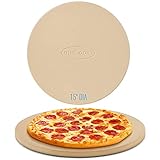
Unicook 15″ Round Pizza Stone for Oven and Grill, Cordierite Baking Stone
Cordierite sintered at 2100F
15 inch round
0.6 inch thick
3 kg
Pros
- Sintered at 2100F for strong thermal shock resistance
- Thick and heavy enough to hold heat between pizzas
- No odor when used as directed
- Includes a plastic dough scraper
Cons
- Needs at least a 30 minute preheat at 400-550F
- Cleaning stuck-on cheese takes real effort
- Round shape wastes corners of a rectangular grate
This is the round-stone answer to the question of a large pizza on a grill, and the manufacturing detail that matters most is on the spec sheet: the cordierite is sintered in a 2100F kiln. That process is what gives the material its reputation for surviving rapid temperature changes, and it is why this stone holds up to the thermal cycling that a grill delivers far better than an oven does.
At 0.6 inch thick and 3 kg you get real thermal mass without the dead weight of the 7.8 pound Hans Grill. That middle ground is why several owners mention buying a second stone to bake two pizzas at once, one under the dough and one held above it for two-sided heat. That sandwich setup comes up constantly in grill forums and it needs two comparable stones to work.
Reviews are consistent about the crust. Crisp, not soggy, with a base that browns rather than steams, and no odour in the kitchen afterwards. The micro-pores in the surface are doing the work of drawing moisture out of the dough during the bake, which is the mechanism behind a better bottom than you get on a bare grate.
The two honest downsides are time and maintenance. Reviewers consistently budget a 30 minute preheat at 400 to 550F before the first pizza, which is longer than an oven but normal for a grill. And because the surface is porous, fused cheese takes real effort to remove, which is why several owners cook on parchment paper or foil even though the stone can take it bare.
Round stone versus two-sided cooking
A single stone under the dough gives you bottom heat only, and on a grill with a wide-open top the cheese can brown long before the base is done. The fix that shows up again and again in grill forums is a second stone held above the pizza on the grate bars, so both surfaces radiate. With 15 inch stones you can build that setup, and the top stone also speeds up the cook noticeably.
Who should skip it
Skip it if you want a fast weeknight cook. Half an hour of preheat plus 8 to 10 minutes a pizza adds up fast, and a lighter 0.4 inch stone is the better tool when you want less waiting. It is also worth avoiding if you cook with a sugary barbecue sauce often, because the sugars fuse into a porous surface far faster than plain cheese does.
6. ROCKSHEAT 12 x 12 Inch Square Pizza Stone with Built-In Handles
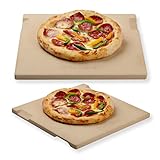
ROCKSHEAT Pizza Stone, 12″x12″ Square Pizza Stone for Oven Grill BBQ, Cordierite Baking Stone for Bread & Pie, Unique Built-in 4 Handles Cooking Stone
Cordierite stone
12 x 12 inch square
Rated to 1400F
Built-in handles
Pros
- Built-in double-faced handles make moving a hot stone easier
- Square shape gives more usable space than a round stone
- Consistently crisp crust on gas grills and ovens
- Fits RV and travel trailer ovens
Cons
- Larger variants are heavy and awkward to store
- Stains quickly from cheese and sauce grease
- A large stone fills most of a small apartment oven rack
The defining feature here is the handle. This stone has a built-in double-faced handle design, so one slab gives you two handled grips, and when a stone is sitting on a hot grate with a cooked pizza on it, having a built-in way to lift it is worth more than it sounds on paper. For most stones, getting the pizza off the grill means sliding a peel underneath and hoping.
The cordierite is burned in a 2200F kiln and rated to 1400F. Thickness is listed at 0.63 inch, which the brand describes as thick without unnecessary weight, and the item weight is 2.85 kg. That is a reasonable middle of the range for a grill stone that needs to be repositioned over a two-zone fire.
Grill cooks report consistent, crisp results on gas grills and ovens, and the square footprint is genuinely efficient. A 12 by 12 inch square covers more of a grate than a 12 inch circle, so you waste less of your indirect zone. For a small grill, that translates directly into more usable cooking area where you thought you had very little.
Long-term owners are happy with heat retention and crust reliability, and they single out the handles as the reason this one stands out from competing slabs. The complaints are about housekeeping. Weight and storage come up, especially for the larger variants in the range, and staining is fast once cheese and sauce grease hit a porous surface. Plan on parchment paper if appearance bothers you.
Do built-in handles survive a grill
The handle is part of the fired stone, not a glued-on part, so there is no adhesive to fail in the heat. That matters on a grill in a way it barely matters in an oven, because on a grill the temperature is uneven and any metal fitting would be the weak point. The flip side is that the handle area is a raised edge, so a dough launched flush against it can catch slightly. A centimetre of clearance on that side solves it.
Who should skip it
Skip it if your cooking is all in a small apartment oven where a 12 by 12 stone blocks the airflow across the rack, and several buyers note exactly that problem. On a grill, that constraint basically does not exist, which makes this one of the few stones that is better suited to outdoor cooking than indoor cooking.
7. Old Stone 16-Inch Round Pizza Stone

Old Stone Round Pizza Stone, 16-Inch
Lead-free clay stoneware
16 inch round
0.59 inch thick
Stated use to 500F
Pros
- Long-standing stoneware construction built to resist cracking
- Absorbs and transfers heat evenly
- Bread pastries and vegetables as well as pizza
- 16 inch surface fits a large pie
Cons
- Manufacturer guidance targets up to 500F in a home oven
- Lower temperature ceiling than the cordierite options
- Must be cleaned without soap and wiped with a dry cloth
Old Stone is the odd one out in this group, and not in a bad way. It is stoneware, a blend of lead-free clays, rather than cordierite. That means the material is a relative newcomer to grill duty here, and the manufacturer guidance leans conservative: recommended for up to 500F in a standard home oven. We have included it because the 16 inch surface is genuinely useful and the cracking feedback is unusually good.
At 7.3 pounds and 0.59 inch thick, this is a heavy, stable slab. Those are the two things that keep a stone from shattering, and buyers do not report cracking the way they do for cheaper pressed stones. It is also the only 16 inch round option here that is not cordierite, which makes it a useful comparison point if you are curious whether the material debate matters in practice.
Heat distribution is the consistent report. It absorbs the burner heat during preheat and transfers it evenly, producing a restaurant-style result on a home grill, and the surface works for bread, pastries and roasted vegetables as well as pizza. One pizza oven, several jobs, no clutter.
The limitation is stated plainly by the brand, and we would rather repeat it than soften it. Guidance targets up to 500F in a standard oven, which is below the 550 to 600F band a lot of grill cooks run at. Care is also soap-free, wiped with a dry cloth, which is standard for a porous baking surface but stricter than some buyers expect.
Is stoneware safe on a grill at 550F
Stoneware is fired at very high temperatures in a kiln, so the material itself is not the weak point. The weak point is the transition, when a hot stone meets a cold surface or a cold gust, and that is where the temperature headroom you have matters. A stone with a conservative rating has less room for error if you are moving it around a lot or running a kamado hot. If you cook a grill as a two-zone fire at 550F and above, cordierite is the safer bet.
Who should skip it
Skip it if your grill runs hot and you plan to push past 500F regularly, or if you want to use the stone in a kamado, where the ceiling will be exceeded by design. Keep it if you mostly cook at moderate heat, want the full 16 inch diameter, and would rather have one surface for pizza, bread and vegetables.
8. ROCKSHEAT 11 Inch Round Cordierite Pizza Stone

K ROCKSHEAT Small Pizza Stone Round for Grill and Oven, 11 Inch Cordierite Grill Pizza Stones, Food Grade Baking Stone for Oven 11″
Cordierite stone
11 inch round
Rated to 1400F
0.47 inch thick
Pros
- No odour even at 500-550F
- Ready to use from the box with no seasoning step
- Works in toaster ovens smokers and gas or charcoal grills
- Shorter preheat than a thicker stone
Cons
- 11 inch suits small personal pizzas rather than large ones
- Thinner models can arrive cracked in transit
- Can feel underpowered in a small toaster oven
This is the low-commitment option. At 11 inches and 0.47 inch thick it is the smallest and lightest stone we looked at, and that is the entire point. You can lift it with one hand, move it across a grate to set up a two-zone fire, and take it off the heat without a wrestling match. For a first grill, a small patio, or cooking for one, that beats a larger slab every time.
The cordierite is burned in a 2200F kiln and rated to 1400F, and the brand states it is ready to use with no seasoning or conditioning required. That last point saves you a step, but the more useful claim is that it works in gas and charcoal grills as well as ovens, toaster ovens and smokers, which means one tool can follow you around the patio.
Users confirm even heating with no smells across all of those appliances, and the cordierite at this thickness still gives a crisp, chewy crust on a grill. It is also the easiest stone here to keep clean, simply because there is less surface area to scrub when cheese fuses to it.
Two real caveats. A minority of buyers report thinner models arriving cracked in transit, so inspect the box before you light anything, and a small toaster oven does not have the mass to bring a thin stone up to temperature properly, which shows up as a disappointing result. On a full-size grill, neither issue applies.
How small is too small for a grill
Eleven inches is the floor, not the sweet spot. It handles a dough stretched to roughly 9 to 10 inches with room at the edge, which is a proper personal pizza but not a pizza you share. Once you find yourself cutting every pie in half to fit, or launching dough that droops over the rim, the size becomes the limiting factor and no amount of grill heat will fix it. Buy the smallest stone that fits your largest dough, and no smaller.
Who should skip it
Skip it if you cook for more than one person, and skip it if your grill is your main oven, because a small stone means two or three rounds per meal and every round needs the same preheat. It is the right pick for a solo cook, a smoker you also use for pizza, and anyone who wants to try grill stone cooking before committing to a slab that takes up shelf space.
9. Weber Gourmet BBQ System Pizza Stone with Carry Rack
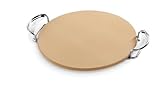
Weber® Gourmet BBQ System Pizza Stone with Carry Rack, 16.7″
Cordierite stone
16.7 by 13.2 inch
Carry rack included
2 year warranty
Pros
- Carry rack makes moving a hot stone off the grill easier
- Cordierite absorbs moisture for a light crispy thin crust
- Fits the Gourmet BBQ System cooking grate
- Backed by a two year manufacturer warranty
Cons
- Metal handles on the rack run hot enough to melt oven mitts
- No usage hints or cooking instructions in the package
- Listed dimensions include the rack
If your grill is a Weber, this is the stone designed around it. The cooking surface is 16.7 by 13.2 inches, a rectangle sized to the Weber Gourmet BBQ System grate rather than to a generic oven rack, and it comes with a carry rack that makes lifting the stone off a hot grill a two-handed, controlled move instead of a scramble.
The rating is the second highest of any cordierite stone in the group, and the review pattern is consistent. Owners like the crisp, authentic thin crust, and several use the same stone in a fire pit or a conventional oven as well as on a Weber kettle, which tells you the thermal performance is not grill-specific luck.
The cordierite here is chosen for moisture absorption, and that is the mechanism behind a light, crisp base rather than a heavy, dense one. A 2.72 kg item weight also makes this one of the lighter 16 inch-class stones, which matters when you are handling it over a grill rather than sliding it onto an oven shelf.
The most reported problem is heat, and it is worth taking seriously. The metal handle on the carry rack gets hot enough that at least one buyer’s oven mitts melted, so treat the rack as a hot object rather than a cool grip. The package also includes no usage hints, which is a missed opportunity given how much handling this stone invites.
Does a grill stone need a carry rack
On a grill, more than in an oven. In an oven the door is below you and the stone slides in. On a grill, the stone has to come up over a grate lip while the surface is at 500F or more, and a rack turns a two-handed lift into something you can do in one controlled motion. Several of the stones in this roundup use handles or racks for the same reason, and it is the single most underrated feature on the list.
Who should skip it
Skip it if you do not own a Weber Gourmet BBQ System, because the sizing advantage disappears and you are paying a brand premium for a rectangle you could get in any dimension. It is also a fair choice only if you will use a carry rack, and if you already own peel and cutting gear, the rack is the piece of value here.
10. Gyreuni 15 Inch Pizza Stone Set with Oak Peel and Parchment
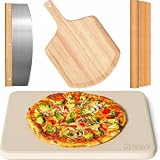
Gyreuni 15”Pizza Stone for Oven and Grill with Pizza Peel,Baking Stone Set
15 x 12 inch cordierite
Rated to 1472F
0.4 inch thick
3.22 kg
Pros
- Consistent crust in oven and on the grill
- Oak peel is durable and doubles as a cutting and serving board
- Includes parchment sheets that reduce sticking and scorching
- Complete bundle with cutter and scraper
Cons
- Included pizza cutter is blunt and burrs on the edges need filing
- Stone is thinner and lighter than expected
- Listing states four stones but one is included
The most useful thing in this set is the parchment paper. Ten sheets come in the box, and on a grill stone they solve the single hardest practical problem in the whole process, which is getting a raw, delicate dough onto a 500F surface and getting it off again without the base tearing or the launch turning into a scramble. Semolina on the parchment, peel onto the stone, pull the paper out with the pizza. It works, and it is why we would start here if you are new to this.
The stone itself is cordierite rated to 1472F at 15 by 12 inches, 0.4 inch thick and 3.22 kg. Users report good heat retention and a consistent crust in both oven and grill use. The oak peel measures 12 by 17 inches with a tapered half-inch blade, which is a real working peel rather than a token one, and it doubles as a serving board.
What makes this a good grill stone specifically is the low profile. At 0.4 inch the stone sits close to the grate, so it comes up to temperature faster and transfers heat to the dough sooner, which shortens the cook on a grill where the top of the pie is browning faster than the base.
Two honest notes. The included pizza cutter is not sharp and the burrs along its unused edges need filing before it will cut cleanly, so buy a proper wheel. And the listing states a four count when only one stone arrives, which is a packaging description error rather than a product fault, but it is worth knowing before you open the box.
Parchment paper on a grill stone, does it work
Yes, and it is standard practice among grill cooks. The paper sits on the stone, the dough goes on the paper, and the paper goes in the oven or on the stone for the whole cook. It does not stop the crust from crisping, because the heat is coming through the paper into the stone and back into the base. What it does stop is sticking, which means you can use a delicate high-hydration dough and launch it without a cloud of semolina. Pull the paper out by the edge at the end, peel, discard.
Who should skip it
Skip it if you bake Neapolitan pizza regularly and have your own peel and cutter already, because the accessory value shrinks quickly once you know what you are doing. Also weigh the thinness against a thicker stone if you want maximum thermal mass for bread or for back-to-back pizzas without a reheat.
11. Ritual Life 15 Inch Pizza Stone 5 Piece Kit with Handles

Pizza Stone for Oven and Grill Set – 5PCS Pizza Making Accessories Kit – 15 inch Pizza Stone with Handles, Pizza Peel, Pizza Cutter, Dough Tool – Baking Stone for Bread – Large Rectangular Oven Stones
Cordierite stone
15 x 12 inch
Rated to 1500F
Removable steel handles
Pros
- Crispy bottom and bubbly top after a proper preheat
- Removable steel handles double as a resting rack
- Works in ovens grills smokers and RV ovens
- Complete kit with peel cutter dough tool and recipe ebook
Cons
- Porous stone is hard to scrub and stays visibly stained
- Varnish on the wooden cutter handle peels if scrubbed
- First-time users may need to find instructions online
This is the most complete kit in the group, and the detail that matters on a grill is the removable steel handle system. The handles detach, the stone can be lifted and repositioned, and the handles then double as a resting rack for the hot stone once the pizza is off. That solves the awkward moment at the end of every grill cook when you need somewhere to put a 4.25 kg slab that is far too hot for your counter.
The cordierite is rated to 1500F, the cooking surface is a 38 cm rectangle, and the item weight is 4.25 kg with a listed thickness of 0.6 inch. That is a serious amount of thermal mass for a home grill, and owners report a crispy bottom with a bubbly top once the preheat is done properly.
Beyond pizza, buyers use it for bread, sourdough, biscuits and cookies, and the manufacturer lists it for ovens, grills, smokers and RV ovens. For anyone who wants one surface for the whole patio cooking operation, that range of use is the selling point rather than any single pizza result.
Cleaning is the honest weakness, and it is shared by every porous stone in this roundup rather than unique to this one. Fused cheese takes real scrubbing, and the stone still looks stained afterwards, which annoys people more than it should. A few buyers also wanted clearer first-use instructions than what came in the box, and the varnish on the wooden cutter handle lifts if you scrub it with a sponge.
Removable handles versus a rack versus nothing
All three solve the same problem: a hot stone with a pizza on it has to come off a grate. Removable handles win for flexibility, because the stone can sit bare on the grate for even heat and the handles only appear when you need to lift. A fixed rack like the Weber design is simpler and more stable but adds height. No handle at all is fine on a grill only if you own a peel wide enough to slide fully under the stone.
Who should skip it
Skip it if you already have peel, cutter and a dough tool, which the five-piece format assumes you do not. It is also more kit than a single cook needs if you make pizza rarely. The stone on its own is a solid 15 by 12 cordierite rectangle with a good handle system, and that is the part worth paying for.
12. Kamado Joe 15-Inch Ceramic Pizza Stone for Kamado Grills

Kamado Joe 15-inch Ceramic Pizza Stone for Brick-Oven Style Pizza Compatible with Kamado Joe Classic Joe 18-inch Charcoal Grill and Smokers, Model KJ-PS23
High-impact ceramic
Round stone for Classic Joe
Rated for 550-600F
2 pounds
Pros
- Highest rating of any stone in the group
- Crispy bottom with a chewy centre in a wood-fired style
- Holds up at the temperatures a ceramic kamado reaches
- Doubles as a second heat deflector when smoking
Cons
- Needs the Kamado Joe Heat Deflector and spacers which are not included
- Will not heat evenly sitting directly on the grill grate
- Opening the lid to check the pizza loses a lot of heat
This is the specialist pick, and it is the highest rated stone in the whole group at 4.8 stars. It is a high-impact ceramic rather than cordierite, built specifically for the temperature a ceramic kamado reaches, and it is the only stone here that is designed around a kamado’s fire rather than adapted to one. If you already cook on a Classic Joe or an 18 inch ceramic grill, this is the one to buy.
Kamado owners report a crispy bottom and a chewy centre in a genuinely wood-fired style, in roughly 9 to 10 minutes at 450 to 525F. That cook time is fast for a kamado, and the reason is thermal mass sitting right above the heat source instead of being warmed from a distance.
The second use is a bonus nobody advertises. Because it is a dense, flat, high-heat slab, it works as a secondary heat deflector when you are smoking, which means one accessory covers two jobs. If you are still choosing a ceramic grill, our [kamado grill guide](https://www.puritybymonster.com/best-kamado-grills-for-slow-cooking/) covers the platforms this style of cooking is built on.
The catch is placement, and it catches people out. The stone will not heat evenly sitting directly on the grate, because in a kamado the heat is radiating from below and from the side walls. It needs the Kamado Joe Heat Deflector plus 1 to 2 inch spacers to sit at the right height, and neither is included. Owners who skip that step report a disappointing first cook, and lid-opening costs a lot of heat in a kamado, so learn the pizza before you open the dome.
Ceramic versus cordierite at kamado temperatures
For a kamado, ceramic is not a compromise. A ceramic grill runs hot enough and stable enough that a cordierite stone rated for 1400 to 1800F is over-qualified and more expensive than you need, while a high-impact ceramic rated for 550 to 600F matches the way that appliance actually cooks. The rule is simple. Match the stone to the appliance, not to the marketing number, and a kamado is the clearest case for that.
Who should skip it
Skip it for a gas or charcoal grill, where the placement instructions do not apply and the heat profile is wrong for a thin ceramic slab. Also skip it if you will not buy the heat deflector and spacers, because without them this stone underperforms its rating. Treat the accessory cost as part of the purchase, not an extra.
Cordierite vs Ceramic vs Lava Stone vs Firebrick vs Baking Steel
The material debate comes down to one thing: how the material handles a sudden change in temperature. A grill produces exactly that. Burners come on, coals shift, wind rolls across a grate, and a cold dough hits a 500F surface. A material that tolerates that swing will last years, and one that does not will show a crack line after a season.
Cordierite is a sintered mineral ceramic fired above 2000F. It has low thermal expansion, which is the technical reason it resists thermal shock, and a porous surface that draws moisture out of dough. Most of the stones in this roundup are cordierite, and it is the material most grill-focused guides name first. Forum consensus treats cordierite as effectively the same material as a proper firebrick.
Ceramic in the general sense covers a lot of pressed clay products with a wide quality spread. Some are excellent. Cheap pressed ceramics are the ones that crack, and they do it because the manufacturer advertised a high temperature rating on a slab with no thermal mass behind it. A named high-impact ceramic built for a specific appliance, like the Kamado Joe stone, is a different category from a generic ceramic pan.
Lava stone is a natural volcanic rock. It is genuinely heat resistant and works, but it is porous, heavy and inconsistent in density, and it can carry a mineral taste into a porous baking surface over time. It is a good grill surface for indirect cooking and a less good pizza stone.
Firebrick is the traditional kamado and pizza oven liner, valued for insulating mass rather than for pizza specifically. It holds heat for a long time but stores it more slowly than a dense cordierite slab, and a full firebrick is heavy enough to weigh down a portable grill.
Baking steel conducts heat several times faster than stone. That means a much shorter cook and a different crust character, more bread-like and less traditional. Several grill cooks who cracked a stone switched to steel, and the stone-on-steel sandwich described in grilling forums is an attempt to get the best of both: steel below for conduction, stone above for top-down radiant heat.
Using a Pizza Stone on a Grill Safely
Yes, you can put a pizza stone on a grill, and it is a well established way to cook. The important part is heat management. Give the stone a full preheat with the lid closed, place it over the indirect side of the fire rather than directly over a burner or a pile of coals, and never move a stone from a hot grate straight onto a cold surface or a damp counter.
Thermal shock is the whole risk. A cold stone dropped onto a hot grate, or a hot stone set down on wet concrete, will crack. If you want to save time, put the stone on the grill with the burners off during a preheat, then bring the burners up under the indirect zone once the stone is warm. That removes the worst temperature jump from the process.
Two more habits keep a grill stone intact. Let it cool on the grate with the lid open rather than hoisting it off at full temperature, and do not put water on a hot stone. Steam in a porous body is a cracking mechanism, and a damp cloth on a 500F stone is the fastest way to test it.
Why Pizza Stones Crack on a Grill and How to Prevent It
Cracking is the most repeated complaint across every grill forum, and the cause is almost always the same. A burner or a bed of coals heats one part of a stone far faster than the rest, and the uneven expansion between hot and cool stone is what splits it. Cheap pressed stones crack because they have little thermal mass, so the gradient across the slab is steeper.
Five things prevent most cracking. First, preheat slowly and fully with the lid down, so the whole stone heats evenly rather than one edge cooking faster. Second, position the stone over the indirect zone, never straddling a lit burner or the edge of a coal pile. Third, use cordierite, which is sintered at over 2000F specifically for thermal shock resistance. Fourth, never quench a hot stone, and never place a cold stone on a hot grate. Fifth, do not drop a stone that is carrying a pizza, because the impact alone is enough.
There is a sixth, quieter one. A soot-blackened, grease-fused stone is working fine, but a stone that has been heated repeatedly with drippings burning on it is being abused. Forum advice is consistent that keeping a dedicated pizza stone, rather than sharing one with brisket, extends its life and keeps the flavour clean.
How to Cook Pizza on a Grill Stone
Preheat is most of the work. Place the stone over the indirect side, close the lid, and give it 30 to 45 minutes. Gas grills settle around 500 to 550F, charcoal sits where your coals are, and a kamado cooks higher. The stone should feel like it is radiating rather than just being warm.
Then build the pizza off the heat. Stretch the dough on a floured or semolina-dusted surface, top it, and slide it onto a peel lined with parchment or semolina. Far easier to handle it at the counter than over an open fire. The parchment leaves with the pizza and gets discarded, so nothing sticks to the stone.
Launch it onto the centre of the stone, close the lid, and cook 6 to 10 minutes on a gas grill at 500 to 550F, longer on a kamado where the top browns faster. Lift a corner with a spatula to check the base. When the underside is deep gold and the cheese is bubbling and spotting, pull the parchment edge and take the pizza off.
For two-sided heat, place a second stone above the pizza on the grate bars. Grilling forums describe this as the move that fixes a pale top over a dark base, and it needs a grill with enough headroom between the grate and the lid for the upper stone to sit there.
Target Temperatures by Grill Type
Most gas grills settle at 500 to 550F for pizza, which is the sweet spot for a cordierite stone. Run your burners on the side with the stone, and use a lid thermometer rather than the built-in dial, because grill dials are optimistic. Stone rated to 1450F or above has all the headroom you need at this level.
Charcoal cooks hotter and faster once the coals settle, so back the stone off from the direct heat and cook on the indirect side. Kamado grills run 550 to 700F depending on the vent, which is why a ceramic stone rated for that band is the right tool there. An outdoor pizza oven needs nothing special, since the enclosed space already radiates evenly.
Is 550 too hot for a pizza stone? No. For a cordierite stone rated to 1450F or higher, 550F is well within range and produces exactly the browning you want. The number only matters for lower-rated materials, and for the unrated thin stones where the manufacturer did not publish a ceiling.
Buying Guide: How Big Should a Pizza Stone Be for a Grill
Size follows the pizza, and the pizza follows the number of people. A stone needs to be a couple of inches larger in diameter than the dough you stretch. Personal pizzas need 11 to 13 inch stones, family pizzas need 15 to 16 inch, and anything larger means cooking one at a time or using two stones.
Shape follows the grate. Rectangular or square stones cover a rectangular gas grill better, because the corners of a grate are dead space for a round stone. Round stones suit circular grates, kettles and kamados, where a rectangle would waste the curve. This is the one place where matching your grill’s geometry beats matching a brand.
Thickness follows how often you cook. A quarter inch stone heats faster and weighs less, which suits a grill used for pizza once a week. Half an inch to five eighths gives real thermal mass for back-to-back pizzas, bread and long bakes. The extreme end of that is the 7.8 pound stone, which cooks beautifully and demands two hands.
Handling is the last thing to think about and the thing people forget. You will eventually need to move a hot stone with a pizza on it. Stones with built-in handles, removable handles or a carry rack, like the ROCKSHEAT square, the Ritual Life kit and the Weber set, are all solving the same problem in different ways.
Care, Cleaning and Lifespan
Cleaning a pizza stone is simple and permanently low-tech. Scrape off excess food, then rinse or hand wash with warm water and scrub with a brush. No soap, no detergent, no dishwasher. Soaps leave a residue that stops the surface from absorbing moisture, which is the property doing the work for you.
Stains are permanent on a porous stone and they are cosmetic. Fused cheese, oil and smoke colour the surface over time and reviewers describe stones that still look marked after a year of use. If appearance bothers you, cook on parchment paper, which also solves the sticking problem. Do not try to scrub a stain out.
Do pizza stones go bad? No, not in the way food expires. They degrade through cracking, warping and surface contamination. A cordierite stone that has not cracked, and that you keep off sugary sauces, will last years of regular grill use. The stones that fail early are the thin, low-cost ones with no published temperature rating, and they usually fail the first time they meet a cold morning or a hot burner set.
Store them dry, flat and off the floor. Do not season a cordierite stone with oil, it does nothing useful and it makes the first few bakes smoke. If you use one grill for brisket and pizza, keep two stones, as several grill cooks do, so grease and smoke never reach the surface you are baking on.
Frequently Asked Questions
What is the best pizza stone to use on a grill?
A thick cordierite stone rated to at least 1400F is the best pizza stone for a grill. It absorbs burner and coal heat during a long preheat, then radiates it evenly into the dough, which gives you a browned, crisp base instead of a raw one. For most grills, a 15 to 16 inch round or 15 by 12 inch rectangular stone is the right size.
Can I put a pizza stone on a gas grill?
Yes. Place the stone on the grate over the indirect side of the burners, not over a lit burner, close the lid and preheat for 30 to 45 minutes. Then launch your pizza onto the hot stone and cook for 6 to 10 minutes. Moving a cold stone onto a hot grate is what causes thermal shock cracking, so let it warm with the burners off first if you want to save time.
Why does my pizza stone crack?
Almost always thermal shock, meaning one part of the stone expanded faster than another. Common causes are a cold stone placed on a hot grate, a hot stone set down on a cold or wet surface, direct burner heat under one corner, and thin low-cost pressed ceramic with little thermal mass. Cordierite, preheating slowly, and avoiding direct burner heat prevent most cracking.
Which is better, ceramic or cordierite?
Cordierite is the better choice for grill use. It is sintered above 2000F, has low thermal expansion, and resists the rapid temperature swings a grill produces. Generic pressed ceramic is cheaper and more prone to cracking, though a high-impact ceramic built for a specific appliance, such as a kamado grill, is an excellent choice in that appliance. Match the material to your cooking temperature and appliance.
How long does pizza take to cook on a stone on a grill?
On a gas grill at 500 to 550F, allow 6 to 10 minutes with the lid closed. A kamado grill cooks faster, around 9 to 10 minutes at 450 to 525F, and charcoal sits somewhere in between depending on where you bank the coals. Add 30 to 45 minutes for the stone preheat before the first pizza, which is most of the waiting people forget to plan for.
The Verdict on the Best Pizza Stones for Grills
The KitchenStar 16-Inch Pizza Stone Set wins this roundup because it pairs the highest-rated cordierite slab we tested with the highest verified temperature ceiling in the group, and it hands you the peel and rocker cutter you need to move a pizza on and off a grill properly. The Unicook 15 by 12 rectangular stone is the better buy if you already own your tools, and the Weber Gourmet BBQ System stone is the fit-for-purpose choice if you cook on a Weber.
What matters more than any of them: buy cordierite, buy a size that matches the largest dough you will stretch, and respect the preheat. Give the stone 30 to 45 minutes over the indirect zone, cook 6 to 10 minutes, and let it cool on the grate. Do that consistently and the best pizza stones for grills in 2026 will still be turning out crisp, oven-style crusts years from now.