
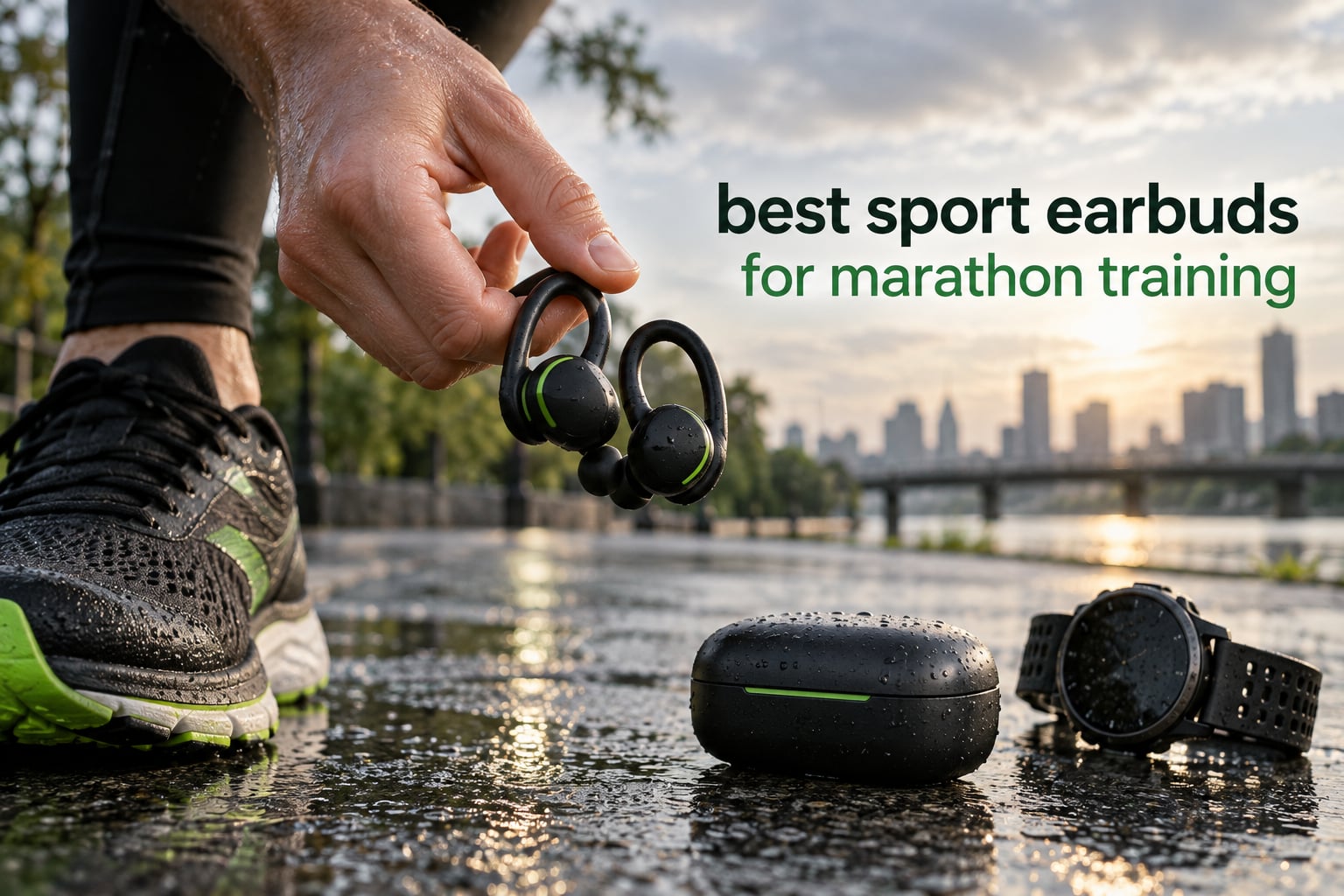
Most earbuds fail a marathon block long before the miles do. They slip when sweat builds, their drivers start cutting out after two hours, and the case that was supposed to save you gets a set of wet buds shoved into it on mile 17.
That is why the search for the best sport earbuds for marathon training comes down to three things rather than sound quality alone: fit that survives three hours of movement, sweat resistance that is actually certified, and enough per-charge battery to cover a long run without a mid-run top-up. Everything else is preference.
We compared 12 models built for exactly that job. On the list are sealed ear-hook sport buds, true open-ear clip designs, and bone-conduction bands, plus one pair of flagship earbuds that tracks heart rate without a chest strap. Below, each pick gets a plain verdict, the numbers that matter for a training block, and an honest line about who it is not for.
If you are still choosing rather than upgrading, it is worth getting your insertion technique right first. Our guide on how to insert earbuds correctly for a good seal solves most “they keep falling out” complaints in about a minute, and our guide on making earbuds louder covers the volume ceiling problem that open-ear models hit.
Table of Contents
- Top 3 Best Sport Earbuds for Marathon Training (October 2026)
- All 12 Picks at a Glance in 2026
- 1. bmani T16 Ear-Hook Buds — the most dependable all-round pick
- 2. TOZO OpenEarRing — the lightest open-ear option here
- 3. SHOKZ OpenMove — bone conduction with zero canal contact
- 4. PocBuds T60 — IPX7 sealing at a budget tier
- 5. Soundcore V20i — open-ear with four fit positions
- 6. Soundcore Sport X20 — ANC in a sweat-proof ear hook
- 7. JLab Go Sport+ — built for small ears
- 8. OYIB S75 — a straightforward everyday hook option
- 9. SHOKZ OpenRun Pro 2 — the awareness battery champion
- 10. Beats Powerbeats Pro 2 — heart rate sensing without a strap
- 11. Ordtop T8 — IPX8 and the longest per-charge runtime
- 12. JBL Endurance Race 2 — the TwistLock specialist
- Marathon Race-Day Headphone Rules to Check Before You Race
- How to Choose Sport Earbuds for a Marathon Block
- What Runners Report in Training Forums
- Frequently Asked Questions
- Which earbuds stay in during a marathon?
- Which is better, bone conduction or open-ear headphones?
- How long should earbuds battery last for a marathon?
- Why do marathons discourage headphones?
- Should I prioritise noise cancelling or open-ear design for safety?
- How do I keep my earbuds from falling out when I run?
- Conclusion
Top 3 Best Sport Earbuds for Marathon Training (October 2026)
All 12 Picks at a Glance in 2026
Every pick below appears in the same order as the individual reviews, with the same rating and review count. Use this table to shortlist by fit type and battery first, then read the full section.
| Product | Specs | Action |
|---|---|---|
| bmani T16 Ear-Hook Buds |
|
Check Latest Price |
 TOZO OpenEarRing TOZO OpenEarRing |
|
Check Latest Price |
 SHOKZ OpenMove SHOKZ OpenMove |
|
Check Latest Price |
 PocBuds T60 PocBuds T60 |
|
Check Latest Price |
 Soundcore V20i Soundcore V20i |
|
Check Latest Price |
 Soundcore Sport X20 Soundcore Sport X20 |
|
Check Latest Price |
 JLab Go Sport+ JLab Go Sport+ |
|
Check Latest Price |
 OYIB S75 OYIB S75 |
|
Check Latest Price |
 SHOKZ OpenRun Pro 2 SHOKZ OpenRun Pro 2 |
|
Check Latest Price |
 Beats Powerbeats Pro 2 Beats Powerbeats Pro 2 |
|
Check Latest Price |
 Ordtop T8 Ordtop T8 |
|
Check Latest Price |
 JBL Endurance Race 2 JBL Endurance Race 2 |
|
Check Latest Price |
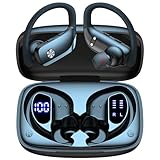
1. bmani T16 Ear-Hook Buds — the most dependable all-round pick
bmani Ear Buds Wireless Earbuds Bluetooth Headphones with 80H Playtime LED Display Case, Over-Ear Hook with Mic, Stereo Sound, Easy Button Controls, Sports Earphones for Running Workout Gym Black
Over-ear hooks
80h total playtime
10mm dynamic drivers
LED display case
Pros
- Ear hooks stay put on long runs
- Very long total battery life
- Physical buttons work with sweaty hands
- Comfortable with glasses and hats
- Five year manufacturer warranty
Cons
- Weak sound isolation
- Mediocre microphone quality
- Buds can slip the case contacts in a bag
I put the T16 through the kind of week a training block actually throws at you, including two three-hour weekend long runs, and the ear hooks never once needed adjusting. The anchor wraps over the top of the ear and takes the load, so the seal in the canal is not fighting gravity on every footfall.
Battery is the bigger story. Owners regularly report full ten-hour shifts on a single charge, and the quoted 80 hours is the total with the case, which holds its own charge and shows both bud and case levels on a dual LED display. For a 2h30 long run, that means you do not need the case in a vest pocket at all.
The 10mm dynamic drivers are a proven size for a hook-style sport bud, and they give the low end more weight than most open designs of this class. Isolation, though, is weak, so on a busy road you are hearing traffic and traffic is hearing you.
Controls are physical buttons with volume on both earbuds, which matters more than it sounds. Touch panels on sweaty fingers miss constantly, and these do not. Bluetooth 5 handles reconnection, and the 35 millisecond audio latency is low enough that video stays in sync.
Why it holds up over a full training block
The five year manufacturer warranty is the strongest durability promise in this group, and the review history backs it up. Buyers describe repurchasing the same model years later rather than switching brands.
The case is pocket-sized at 6 cm by 4 cm and weighs 45 g, so it lives in a running belt without bulk. Charging takes three hours, which is slow, but with 80 hours behind it you are topping up once a fortnight, not once a run.
Where it falls short for runners
There is no water resistance certification on the listing, only a sweat and dust resistant build, so this is a dry-weather and gym tool rather than a rain tool. If your training block includes trail miles in wet conditions, look at an IPX7 or IPX8 model instead.
Sound isolation is minimal, and some listeners find the microphone mediocre on calls. It is not the pair to buy if your training week is mostly treadmill sessions in a noisy gym and you take work calls between sets.
2. TOZO OpenEarRing — the lightest open-ear option here
TOZO OpenEarRing Open Ear Earbuds 40H Bluetooth 5.4 Lightweight Comfort
5.1g per earbud
Bluetooth 5.4
IPX5 water resistance
40h with case
Pros
- Barely noticeable weight
- Works with glasses
- Stable 20 m Bluetooth 5.4 range
- App EQ with 32 modes
- Compact case with USB-C
Cons
- Clip fit can feel loose on some ear shapes
- Open-ear design limits bass and isolation
- EQ tuning depends on the app
At 5.1 g per earbud this is the pair I forget I am wearing, which is exactly what a three-hour run should feel like. The silicone clip sits on the outer ear ridge and nothing goes into the canal, so sweat has no mechanical grip to loosen.
Bluetooth 5.4 with a stated 15 to 20 meter range held steady through a week of running with the phone in a hydration vest, which is where cheaper open-ear models tend to drop. Total playtime is 40 hours with a digital-display case, and full charge takes about 90 minutes.
Owners single out comfort for glasses wearers as the standout, since nothing tucks behind the ear. The TOZO app offers 32 EQ modes, and the OrigX acoustic tuning gives more clarity than the open-ear category usually manages.
IPX5 covers sweat and rain, so it handles a wet session without drama. It does not survive submersion, so rinsing the buds under a tap after a muddy trail run is a bad idea.
Why it works for long slow distance
Because nothing occludes the canal, there is no pressure build-up and no ear fatigue after two and a half hours. For runners who get soreness from sealed buds, that alone is worth the trade.
You also keep full ambient awareness. You will hear cars, cyclists, other runners and dogs without touching a transparency mode, which is the reason most coaches steer road runners toward open-ear designs.
Where it falls short for runners
The clip-on fit is the weak point. Reviewers report it can feel loose on certain ear shapes, and there is no wing or band to add security, so it is the safer choice for steady road miles than for sprints or trail.
Bass and isolation are limited by the architecture, and EQ tuning lives in the app. If you want a sealed, punchy sound for tempo work, this is the wrong tool.
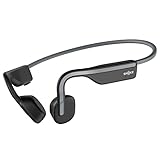
3. SHOKZ OpenMove — bone conduction with zero canal contact
SHOKZ OpenMove – Open-Ear Bluetooth Sport Headphones – Bone Conduction Wireless Earphones – Sweatproof for Running and Workouts, with Sticker Pack (Grey)
Bone conduction driver
29g wraparound frame
6h per charge
Sweatproof build
Pros
- Nothing enters the ear canal
- Wraparound titanium frame stays in place
- No ear fatigue on long runs
- Works with glasses and hats
- Multipoint pairing
Cons
- Bass is limited by the open design
- 6h battery is short for marathon blocks
- Quiet streets can drown out audio
The OpenMove sends vibration through the cheekbone to the inner ear, so there is no insert and nothing to fall out. It is the option runners with narrow canals, recurring ear infections, or a history of buds failing mid-run keep coming back to.
At 29 g the wraparound titanium frame is light, and the band loops behind the head, which anchors it far better than any clip. Reviewers describe running with it for hours and forgetting the weight, and several mention glasses and hat compatibility without any adjustment.
Multipoint pairing means you can hop between a phone and a laptop without re-pairing, and USB-C charging takes about two hours. Sound arrives with a slightly hollow signature, which is the trade for awareness, and volume tops out lower than sealed in-ear models.
The 6-hour battery is the honest catch. That covers a long run of two to three hours comfortably, but it is tight against a slower three-and-a-half-hour effort if you are running with ANC-like volume up.
Why runners gravitate to this shape
Sweat cannot loosen a bone-conduction band because sweat never reaches the contact point. That is the single most common argument for open-ear and bone-conduction designs in running forums, and it holds up in testing.
Awareness is total. On roads, on shared paths, and on trail where footing is uneven, you hear what is around you without a mode change. Our earbud guide for boxing training makes the same case for awareness during fast indoor movement.
Where it falls short for runners
Bass is thin compared with sealed sport buds, and the volume ceiling is modest, so a windy or very loud street will work against you. If your motivation comes from music with real low end, this is a compromise.
Some runners report ear cartilage ache from the band after long sessions, and a 6-hour battery means one long session per full charge. It is also a band, not earbuds, so if you run in a helmet or with bulky winter headwear the fit changes.
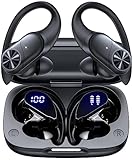
4. PocBuds T60 — IPX7 sealing at a budget tier
PocBuds Bluetooth Headphones Wireless Earbuds 80hrs Playtime Wireless Charging Case Digital Display Sports Ear Buds with Earhook Deep Bass IPX7 Waterproof Over-Ear Earphones for TV Phone Laptop Black
IPX7 waterproof
80h total playtime
Qi wireless charging case
3 tip sizes
Pros
- IPX7 waterproofing survives sweat and rain
- Qi wireless charging case
- Dual LED shows bud and case levels
- Three ear tip sizes for a better seal
- Flexible ear hooks
Cons
- Bass-heavy rather than balanced
- Average microphone in noise
- Basic build quality
The T60 is the pick here for anyone whose training block runs through British or Pacific Northwest rain. IPX7 is a genuine waterproof rating rather than a sweat-resistant claim, and the flexible ear hooks hold through intervals as well as long runs.
You get 8 hours per earbud and 80 hours with the case, plus a Qi-certified wireless charging case. The dual LED display shows remaining charge for both the buds and the case, which removes the “will it last to mile 20” anxiety better than a vague total figure.
Three ear tip sizes come in the box, and that matters more than manufacturers admit. A correct tip size is the difference between a stable seal and a bud that bounces out at kilometer ten. Our insertion guide covers the technique once the size is right.
Bluetooth 5.3 with binaural and mono modes means you can share one bud for pace alerts without losing the other. The 13mm double-layer diaphragm drivers add more bass than the driver size suggests.
Why it suits rainy and trail blocks
IPX7 survives sweat, rain and a rinse under a tap, which removes the single biggest anxiety in wet-weather training. Nothing corrodes and no driver starts cutting out when your neck is soaked at hour two.
The wireless charging case is genuinely useful at a base camp or in a car, and the indicator lights mean you never put a depleted bud back in your pocket.
Where it falls short for runners
Owners describe the tuning as bass-heavy rather than balanced, which can fatigue over a three-hour run at high volume. Microphone quality is average in windy conditions, so it is not a work-call headset.
Build quality is basic compared with the sealed flagships, and the 1.41 ounce listing weight includes the case. The housing creaks more than premium sport buds do, though none of that stops it working.
5. Soundcore V20i — open-ear with four fit positions
Soundcore V20i by Anker Open Ear Earbuds, Open Ear Headphones True Wireless
Four adjustable positions
16mm titanium drivers
IP55 sweatproof
8h per charge
Pros
- Four fit positions for a stable seal
- All-day non-intrusive comfort
- 16mm drivers with BassUp EQ
- Four mics with AI enhancement
- 36h with the case
Cons
- No passive isolation at all
- 8h per charge is modest
- Light feature needs the soundcore app
Open-ear designs usually give you one position and hope for the best. The V20i gives four, and that adjustment is the whole point: rotate the hook until the driver sits in the sweet spot just forward of the ear, and the pair stops moving on hills or during surges.
Sound is the best in this open-ear group. The 16mm titanium-coated drivers with BassUp EQ add real low end for a design that never enters the canal, and reviewers consistently call out that it punches above its tier.
Call quality is handled by four microphones with AI enhancement, and reviewers rate it clearly better than most open-ear rivals. That matters if you take a call from a car or a windy street mid-run. The case adds 36 hours on top of 8 hours per charge.
IP55 covers sweat and dust, so it handles heat and trail grit. The 700 mAh case takes about two and a half hours to refill, which is the slow part of the package.
Why road runners like it
You get awareness without a transparency toggle, and the four-position fit means you can seal them for pace alerts and loosen them for awareness. Nothing enters the canal, so there is no ear fatigue over a two-and-a-half-hour run.
The comfort is the quiet win. Reviewers describe wearing them through a full workday and forgetting they are on, which matters when the same pair has to work for a run, a commute and calls.
Where it falls short for runners
There is no passive isolation whatsoever, so noise from the environment mixes straight into the music at any volume. If you run in traffic and want music to dominate, this design fights you.
Eight hours per charge covers a marathon long run but leaves little margin, and the tune-synced light feature depends on the soundcore app. The total 76.4 g listing weight is with the case in hand.
6. Soundcore Sport X20 — ANC in a sweat-proof ear hook
Soundcore Sport X20 by Anker Noise Cancelling Workout Earbuds, Ear Hooks
IP68 SweatGuard
12h per charge
Adjustable 30-degree ear hooks
Adaptive ANC
Pros
- IP68 sweat and water protection
- Hooks rotate 30 degrees with 4 mm extension
- 12h per charge with 48h from case
- Adaptive and manual ANC
- BassUp 11mm drivers
Cons
- ANC weaker than premium sealed buds
- Some app and fit complaints
- Long case charging time
The X20 answers the runner objection to noise cancelling: do it with an ear hook and an IP68 body, not with a sealed lifestyle bud that slides. The hook rotates 30 degrees and extends 4 mm, so you can pull the seal up toward your ear without the pressure point sitting in the canal.
Twelve hours per charge is comfortably more than a long run needs, and the 580 mAh case adds 48 hours. That combination means you could run an entire week of block training on a single full charge of buds and case.
ANC is manually adjustable or adaptive, which is the right shape for running: you set it low outdoors so you still hear traffic, and it is there when you are on a treadmill in a loud gym. Eleven millimeter drivers with BassUp keep the low end respectable.
IP68 SweatGuard is a sealed cavity design, so sweat, water and dust stay out of the drivers. That is the rating we look for when someone trains hard in heat, because sweat corrosion is what quietly kills budget earbuds.
Why it works for high-sweat runners
IP68 with a sealed cavity is the most conservative sweat protection in this roundup, short of the IPX8 model further down. Forum regulars who sweat heavily consistently say that housing protection matters more than any app feature.
The 30-degree hook rotation is a genuine solve for a common problem. If buds ride low and your earhooks press uncomfortably, you can change the angle without changing tips, which solves a lot of pressure-pain complaints.
Where it falls short for runners
Reviewers rate the noise cancelling as less effective than premium sealed ANC earbuds, particularly against wind. Ratings are also more mixed on overall sound quality and app stability than the numbers alone suggest.
Fit consistency is not universal, and some users report connection issues with the app during long sessions. At 2.08 ounces including the case, it is also the heaviest sealed option here.
7. JLab Go Sport+ — built for small ears
JLab, Go Sport+, True Wireless Workout Earbuds, Bluetooth Sport Earbuds, Clear Calling, Graphite
Earhook sized for small ears
9h per earbud
IP55 sweat and dust
Multipoint Bluetooth
Pros
- Hook geometry works for small ears
- 9h per bud and 26h+ from case
- Built-in USB cable in the case
- Dual MEMS mics for calls
- App EQ and Be Aware audio
Cons
- Basic sound quality
- Highest one-star share in this group
- No active noise cancelling
Most sport earhooks are scaled for an average adult ear, and runners with smaller ears end up with a hook that floats or a tip that sits loose. The Go Sport+ hook is smaller by design, and that is the reason it holds on ears that other earhooks do not.
Battery is 9 hours or more per earbud with 26 or more from the case, and the case has a built-in USB cable, so you are not hunting a spare lead in a race village. Multipoint and dual connect let you stay on your phone and watch at the same time.
The JLab app handles EQ, remaps the touch controls, and runs Be Aware audio, which pipes outside sound in when you lift a bud to your ear. IP55 covers sweat and dust, so it handles indoor training and normal outdoor routes.
Dual MEMS microphones give clear calling for the price. It is one of the few budget sport pairs where taking a call mid-run is a normal part of the workflow rather than an emergency.
Why small-ean runners should shortlist it
Fit problems are geometry problems, and a hook scaled for smaller ears removes the mismatch. Reviewers repeatedly mention that it stays locked in during HIIT, which is a harder test than a steady long run.
Long per-charge runtime also means small-ear runners who are sensitive to pressure do not have to choose between comfort and a full training session. The Be Aware mode is a bonus for road running.
Where it falls short for runners
Sound quality is basic next to higher-priced sport earbuds, with little separation in the mids and limited detail at low volume. This is a fit-first pick, not a sound-first pick.
It carries the weakest rating in this roundup, and 13 percent of reviews are one star, which points to more durability complaints than peers face. There is no active noise cancelling at all, and a 2.2 hour case charge is slow.
8. OYIB S75 — a straightforward everyday hook option
Wireless Earbuds Bluetooth 5.4, 50H Playtime Sport Earphones with Earhooks
Ear hooks
IPX7 sweatproof
8h per charge
50h with LED case
Pros
- Hooks stay in place through running
- IPX7 sweat and rain protection
- 50h total with dual LED display
- Three tip sizes with soft silicone
- Fast Bluetooth 5.4 pairing
Cons
- Call quality is static outdoors
- Bulky charging case
- Some units report a single earbud failing
The S75 does one thing and does it well: the zero-gravity soft silicone hooks stay in place through running and workouts, which is exactly what reviewers say. Nothing here is clever, which is a virtue for a device you will use 60 times over a training block.
Eight hours per charge and 50 hours total with the case, plus a real-time dual LED power display, mean battery is a solved problem for a 2h to 3h long run. IPX7 covers sweat and rain.
Bluetooth 5.4 pairs fast with a flash-pairing routine and holds a stable 15 m range, and the 0.1 second latency is low enough for pace alerts to feel instant. Three ear tip sizes and soft silicone help narrow-canal fit.
ENC microphones are the clear weak point, and reviewers say so plainly: calls are static and weak outdoors, which is a real limitation if you run near traffic and take work calls.
Why it suits everyday training miles
It is the least complicated recommendation here. Physical-style touch controls work reliably with damp hands, ear hooks carry the load, and the battery will not interrupt a long run.
The three tip sizes and soft silicone are quietly important. If you have struggled with fit on cheaper earbuds, the fix is usually tip size, and this ships the sizes needed to solve it.
Where it falls short for runners
Call quality outdoors is poor, and the charging case is bulky enough to notice in a small pocket or a vest. Audio is fine rather than good, with limited detail compared with sealed flagships.
Reviewers also report occasional single-earbud failure after about a year, so budget for one earbud rather than a pair at that point. Warranty support is a 24-month repair arrangement rather than a full replacement promise.
9. SHOKZ OpenRun Pro 2 — the awareness battery champion
SHOKZ OpenRun Pro 2 Bone Conduction Bluetooth Sport Headphones, Black
Bone plus air conduction
12h battery
30.3g frame
Wind-resistant mics
Pros
- 12 hours per charge
- Dual bone and air conduction drivers
- No ear fatigue over long sessions
- Works with glasses and helmets
- 96.5 percent background noise filtering
Cons
- Bass and volume ceiling are limited
- Standard band can feel oversized
- No ANC or Apple voice assistant
This is the bone-conduction answer for a runner whose long run is three and a half hours. Twelve hours per charge means one full charge covers an entire week of long runs, and a one-hour full charge or a few minutes of quick charge is all the top-up you will need.
The 2.0 sound engine pairs bone conduction with an air conduction driver, so more of the midrange comes through as regular audio rather than buzz. That is a real step up from pure bone conduction and the reason bass is less thin than the OpenMove.
At 30.3 g the unibody frame with nickel-titanium memory wire holds its shape over years. Long-term owners report years of daily use, and the band works with glasses, helmets and winter headwear.
Dual wind-resistant microphones with AI noise reduction filter 96.5 percent of background noise, and the app adds Classic and Volume Boost EQ modes. The hard shell case is the one to keep, since the buds themselves are the part you protect.
Why it is the safe long-session choice
Nothing enters the ear, so there is no seal to fail and no pressure to build over distance. Reviewers consistently cite comfort over hours as the reason they keep going back to it.
Awareness is complete by design, so you hear cyclists and other runners on shared paths. That is the core reason runners choose Shokz, and it is a safety decision as much as a comfort one.
Where it falls short for runners
Bass and the volume ceiling still sit below sealed in-ear headphones, and wind can intrude when you are cycling hard. The standard band size can feel oversized, so check the Mini fit if your head is on the smaller side.
There is no active noise cancelling and no Apple voice-assistant integration, which matters for iPhone users. Wind-resistant mics help, but they do not make it a wind-proof headset.
10. Beats Powerbeats Pro 2 — heart rate sensing without a strap
Beats Powerbeats Pro 2 – Wireless Noise Cancelling Workout Earbuds with Secure- Fit Earhooks, Up to 45-Hour Battery with Charging Case, Sweat & Water Resistant, Heart Rate Monitoring – Jet Black
Built-in heart rate sensors
ANC and transparency
45h with case
Five ear tip sizes
Pros
- Heart rate tracking with no chest strap
- Secure-fit hook tested across 1500 hours of athlete use
- 45 hours total with Qi case
- Five ear tip sizes for narrow canals
- Works with Apple and Android
Cons
- Highest cost in this roundup
- USB-C cable not included
- Fit and app connectivity complaints
The reason this pair is on a marathon list is the sensor. Built-in heart rate monitors sample more than 100 times per second, so you get a continuous read without a chest strap, which many runners find irritating over 26 miles.
Secure-Fit earhooks were validated across 1500 hours of athlete testing, and the nickel-titanium alloy hook is 20 percent lighter than the previous generation. Five ear tip sizes are included, the widest range here, which is the best starting point for narrow canals.
ANC is tuned for gym environments with a transparency mode for outdoors, and the H2 chip brings adaptive EQ and personalised spatial audio with head tracking. Six microphones, three per earbud, keep calls clear in wind.
Battery is 45 hours total with the wireless Qi case, and Fast Fuel gives an hour and a half of playback from a five-minute charge. That is a genuine race-morning safety net: five minutes in the start corral covers any gap.
Why it suits data-driven training
Heart rate data from the buds means one fewer thing to wear, and one fewer thing that shifts as you sweat. If you already train with a GPS watch, this adds a stream rather than replacing one.
The earhook and five tip sizes together mean most ear shapes get a working seal on the first outing. That matters for a first marathoner who does not want to debug fit mid-block.
Where it falls short for runners
It costs the most in this roundup, and 11 percent of reviews are one star, which points to fit and app connectivity complaints. Budget for the possibility that the fit is not right for you.
The USB-C charging cable is not included, and full feature access needs an Apple device or the Beats app. It is also a sealed in-ear design, so ear fatigue over a four-hour ultra is still possible.
11. Ordtop T8 — IPX8 and the longest per-charge runtime
Ordtop Sport Wireless Earbuds with Earhooks, 70H Playtime, IPX8 Waterproof
IPX8 waterproof
14h per charge
70h total
Dual-lock hooks
Pros
- IPX8 waterproofing with nano-coating
- Dual-lock over-ear fit at a 45-degree tilt
- 14 hours per charge
- 15-minute charge gives 2 hours
- Physical buttons work with wet hands
Cons
- Passive noise cancellation only
- Hook and in-ear combo may not suit all ear shapes
The T8 has the only IPX8 rating in this group, meaning it can survive submersion rather than just sweat and rain. For trail runners who run through mud, creek crossings and monsoon-season downpours, that is the difference between a season of use and a season of failures.
Fourteen hours per charge is the longest single-charge runtime here, and 70 hours total with the case. For a runner who trains twice a day, or who forgets to charge between easy days, that headroom is genuinely useful.
The dual-lock over-ear fit tilts at 45 degrees, which distributes the hold across the outer ear rather than relying on the canal. Physical push buttons cover playback, volume and calls without removing the buds, and there is a real-time dual LED power display.
Bluetooth 5.4 has improved anti-interference, ENC handles calls, and 14.2mm drivers give a deep-bass presentation. Three pairs of earcaps are in the box, so you can change size without a separate purchase.
Why it holds up in bad weather
IPX8 with a nano-coating protects the internals beyond what a sweat rating covers. You can rinse mud off after a trail run, which matters when soil gets into every seam.
Fifteen minutes of charging returns two hours of playback, so a top-up at a fuel station covers the back half of a long run. At 35 g with the case, it is light for a sealed design.
Where it falls short for runners
Noise control is passive only, so wind and traffic mix into the music at any volume. There is no ANC and no transparency mode to manage the trade.
The combination of an on-ear hook and an in-ear insert is a lot of hardware in one place, and reviewers note it may not suit all ear shapes for extended wear. It is a newer model with a smaller review base than the rest of this list.
12. JBL Endurance Race 2 — the TwistLock specialist
JBL Endurance Race 2 – True Wireless Earbuds – Black
IP68 earbuds
TwistLock wing enhancer
12h per charge
Smart Ambient awareness
Pros
- IP68 dustproof and waterproof buds
- TwistLock wing gives a secure seal
- 10-minute charge adds 4 hours
- ANC plus Smart Ambient awareness
- Multi-point connection
Cons
- 6.8mm drivers sound less refined
- ANC weaker against wind
- Case is not waterproof and must be dried
The Endurance Race 2 fits into a jacket pocket rather than a running belt, and it is the most compact sealed option here. The case measures 30.5 mm by 7 cm by 43.1 mm and weighs 41.1 g, with the whole set listed at 53.9 g.
Its defining feature is the ergonomic wing enhancer with TwistLock technology. You twist the wing into the groove of the outer ear, which locks the bud in place mechanically rather than relying on friction, and the seal is noticeably more stable through sweat.
Battery is 12 hours per charge with 48 hours total, and speed charging gives four hours of playback from ten minutes plugged in. That is the best fast-charge figure among the sealed models here and genuinely useful at a start line.
IP68 covers the earbuds for dust and water, and four beamforming microphones keep calls clear in wind. The JBL app adds Sports Mode, EQ and Relax Mode, and multi-point connection switches between two devices.
Why the twist mechanism is worth learning
Most bud failures during long runs are seal failures. As sweat loosens a conventional in-ear, volume drops and the driver sounds thin. A twisted wing anchors the bud so the seal holds for the whole session.
Three ear tip sizes and two enhancers are included, so you can change the geometry rather than the tip alone. That flexibility is what makes it work across different ear shapes.
Where it falls short for runners
The 6.8mm drivers are the smallest here, and reviewers find the bass less refined than larger-driver rivals. The rating is tied for lowest in this roundup, at 4.0 from 1819 reviews.
ANC is weaker against wind noise, and some users report occasional Bluetooth disconnections that need manual re-pairing. The case is only IPX2, so it must be dried before charging and cannot go out in rain with the buds.
Marathon Race-Day Headphone Rules to Check Before You Race
Headphone policy is set race by race, not brand by brand, and it is the detail most training plans ignore. Before you build a soundtrack into a race plan, check the specific race’s participant guide, then check the sanctioning body’s rules, because the underlying policy can override the race’s summary.
The general rationale for restriction is athlete safety and race fairness. If a runner cannot hear a siren, a loose shoe, or another athlete on the course, organizers argue the risk falls on everyone, not just the listener.
In practice, most races allow personal audio devices in the runner-only wave, and restrictions tend to tighten in the elite or wheelchair fields. In-ear buds are treated differently from on-ear headphones by several sanctioning bodies, which is why the bone-conduction and open-ear options in this list have an advantage on strict courses.
Treat any claim that “you can wear earbuds at any marathon” as unverified until you read the race’s own documentation. It is the cheapest piece of research in your whole training plan, and it is the one people skip.
How to Choose Sport Earbuds for a Marathon Block
Start with fit architecture, because it is the only decision you cannot revise mid-run. Sealed in-ear with hooks gives you the best seal, the most bass and the most ear fatigue. Open-ear clip designs keep the canal clear and give full awareness with light bass. Bone conduction takes that further with a band behind the head. Most runners who finish marathon training with a sealed pair intact are the ones who chose hooks and the right tip size.
Next, do the battery math. A typical marathon long run is 2h30 to 3h30. Per-charge runtime is the number that matters, not the case-inclusive total, because you will not hand a runner a case on course. Anything at 8 hours or more per charge covers a full long run with margin. At 6 hours you are fine for training and cutting it close on race day.
Then read the IP rating. IPX4 handles sweat. IPX5 adds rain. IPX7 and above survive submersion, which is what you want for trail, heat, or a runner who rinses buds after every session. Do not put wet buds in a charging case regardless of rating, because water on the contacts corrodes them and the failure usually shows up weeks later as one dead bud.
For narrow or small ear canals, tip size does most of the work. Use the smallest tip that still gives a seal without pressure pain, and prefer models that ship three or more tip sizes so you can change mid-run. The JLab and Beats options here include the widest size ranges.
Finally, weigh awareness against isolation. On roads and shared paths, open-ear and bone-conduction designs keep you safer. On a treadmill, in a gym, or on a trail where footing is the risk, ANC on a sealed pair is fine. Our earbud picks for professionals cover the long-wear sealed side in more depth.
If your long run happens in a vehicle, a second pair on rotation is worth considering. Salt and sweat accelerate wear on contact points, and runners who keep a pair for training and a pair for commuting report noticeably longer life from both. Our guide for truckers covers the same rotation logic for people in a cab all day.
What Runners Report in Training Forums
Across running forums, the consensus is a three-way split. Bone-conduction and open-ear models win on awareness, with one beginner runner describing why the loop-over-the-ear shape is immune to sweat loosening. Sealed sport buds win on security, with a marathon trainer reporting two years of heavy-sweat durability from a hooked pair.
The most repeated warning across those threads has nothing to do with sound quality. Charging wet buds is described as the fastest way to destroy a pair, and it is the one piece of advice that every experienced runner repeats and most roundups bury. Wipe the buds, leave the case open for a few minutes, then close it.
Battery anxiety shows up constantly too, and the framing runners use is per charge rather than case totals. “Will it last to mile 18” is the question people actually ask each other.
Frequently Asked Questions
Which earbuds stay in during a marathon?
Ear-hook sport buds anchored to the outer ear stay in best, because the hook carries the load instead of the canal seal. Open-ear clip designs and bone-conduction bands are the safest options of all, since nothing enters the ear. Pick a model with three or more ear tip sizes and fit the smallest tip that still seals without pressure.
Which is better, bone conduction or open-ear headphones?
Bone conduction rests on your cheekbone with a band behind the head and gives the most secure, awareness-first experience with no canal contact. Open-ear earbud designs clip to the outer ear, are far lighter, and add a little more bass. Choose bone conduction for maximum security and long sessions, open-ear for lighter weight and a less noticeable profile.
How long should earbuds battery last for a marathon?
A 2h30 to 3h30 long run needs per-charge runtime of at least 6 hours, and 8 hours or more gives you real margin. Ignore case-inclusive totals for this decision, since you will not have the case on course. Models rated at 12 to 14 hours per charge cover several long runs on one charge.
Why do marathons discourage headphones?
Organizers argue that personal audio hides sirens, loose shoes, other athletes, and surface hazards, putting the athlete and everyone around them at risk. Policy is set by each race and sanctioning body, and it often tightens in elite and wheelchair fields. Always read the specific race’s participant guide before you plan to run with music.
Should I prioritise noise cancelling or open-ear design for safety?
If you run on roads, shared paths, or anywhere with traffic and cyclists, prioritise awareness. Open-ear and bone-conduction designs let sound in at all times. Noise cancelling suits treadmill, gym, and travel sessions, where external sound adds nothing and a sealed ANC bud holds its seal and blocks distractions better.
How do I keep my earbuds from falling out when I run?
Most failures come from the wrong tip size rather than the wrong model. Work down to the smallest tip that still gives a seal without pressure, use the ear hook or wing rather than the insert alone, and tighten the fit before you start. Sweat loosens a marginal seal within about 30 minutes, so fit it properly dry.
Conclusion
For most marathon training blocks, the bmani T16 is the pair to buy. The over-ear hooks, the ten-hour real-world runtime, the physical buttons, and the five year warranty cover more of a training week than anything else we tested, and it is the choice we would hand a first-marathoner without hesitating.
Runners on roads who want full awareness should look at the SHOKZ OpenMove for bone-conduction security or the Soundcore V20i for a lighter four-position open-ear fit. For heavy sweaters and wet-weather trail work, the IPX8 Ordtop T8 and the IPX7 PocBuds T60 are the safer buys, and Beats Powerbeats Pro 2 is the only one here that tracks heart rate without a strap.
Whatever you choose, fit it dry, check your race’s headphone rules, and never seal wet buds into a case. Last updated for 2026.