

Ask ten tortoise keepers which UVB bulb to buy and you will get eleven answers. Forum threads run from Arcadia worship to outright scepticism, and most of the advice never mentions the two details that actually decide the outcome: how big your enclosure is and which species is living in it. That is where this roundup differs. We put eight of the most-reviewed UVB bulbs for tortoises through the same lens: real output at a real mounting distance, the fixture each one needs, and how long it keeps working before the UV output fades.
Across the whole group, the pattern was consistent. The bulbs with the most reviews and the steadiest output are all desert-grade 10.0 products from established lighting names, and the cheapest tubes on the shelf are also the ones most likely to leave you replacing them twice a year. Whether that trade-off works for you depends entirely on your setup, so below you will find the best UVB bulbs for tortoises ranked for real enclosure sizes rather than spec-sheet size alone.
If you are still working out how much light your tortoise needs, the buying guide further down has species-by-species percentages and a tube-length chart. If you already know you want a linear T5 HO tube over an open-top pen, jump straight to the numbered reviews.
Table of Contents
- Top 3 Best UVB Bulbs for Tortoises (October 2026)
- All 8 UVB Bulbs Compared in 2026
- 1. Zoo Med ReptiSun 10.0 Mini Compact 13W – Best Overall for Most Indoor Tortoises
- 2. LUCKY HERP 10.0 Desert UVB 23W – Best Value Screw-In Option
- 3. REPTI ZOO T5 HO UVB Combo Kit 24W – Best All-in-One Kit
- 4. Zilla Mini Compact Desert 6W – Top Rated for Low-Profile Setups
- 5. Zoo Med 24W T5 HO ReptiSun 10.0 2-Pack – Best Multi-Tube Setup
- 6. Zoo Med ReptiSun 10.0 HO T5 34 Inch 39W – Best for Long Enclosures
- 7. Jugbuy 23W 10.0 UVB 2-Pack – Best Budget Two-Pack
- 8. REPTI ZOO 26W Spiral 10.0 UVB – Best Starter Bulb on a Tight Budget
- Why UVB Matters for Tortoises
- How to Choose the Right UVB Bulb for Your Tortoise
- What to Avoid When Buying a Tortoise UVB Bulb
- Frequently Asked Questions
- The Verdict: Best UVB Bulbs for Tortoises in 2026
Top 3 Best UVB Bulbs for Tortoises (October 2026)
If you want the short list and nothing else, these three cover almost every indoor tortoise situation. The first is the default answer, the second is the strongest rating in the group, and the third is the best value pick for a screw-in setup.

Zoo Med ReptiSun 10.0 Mini 13W
- 10% UVB and 30% UVA output
- 13W compact fluorescent
- Quartz glass for UVB penetration
- Mounts vertical or horizontal

Zilla Mini Compact Desert 6W
- 10-15 microwatts UVB at 12 inches
- Only 6 watts of power draw
- Fits horizontal Zilla Mini Halogen housings
- Compact low-profile form factor

LUCKY HERP 10.0 Desert 23W
- 10% UVB and 30% UVA output
- 1265 lumens at 6000K
- Standard E26 screw base
- Rated for up to 1 year of UVB life
All 8 UVB Bulbs Compared in 2026
Every product in this roundup, with the output figures that matter and the job each one does well. Prices move daily, so use the buttons to check the current listing rather than a number printed here.
| Product | Specs | Action |
|---|---|---|
| Zoo Med ReptiSun 10.0 Mini Compact 13W |
|
Check Latest Price |
| LUCKY HERP 10.0 Desert UVB 23W |
|
Check Latest Price |
 REPTI ZOO T5 HO UVB Combo Kit 24W REPTI ZOO T5 HO UVB Combo Kit 24W |
|
Check Latest Price |
| Zilla Mini Compact Desert UVB 6W |
|
Check Latest Price |
 Zoo Med 24W T5 HO ReptiSun 10.0 2-Pack Zoo Med 24W T5 HO ReptiSun 10.0 2-Pack |
|
Check Latest Price |
 Zoo Med ReptiSun 10.0 HO T5 34 Inch 39W Zoo Med ReptiSun 10.0 HO T5 34 Inch 39W |
|
Check Latest Price |
 Jugbuy 23W 10.0 UVB 2-Pack Jugbuy 23W 10.0 UVB 2-Pack |
|
Check Latest Price |
 REPTI ZOO 26W Spiral 10.0 UVB REPTI ZOO 26W Spiral 10.0 UVB |
|
Check Latest Price |
1. Zoo Med ReptiSun 10.0 Mini Compact 13W – Best Overall for Most Indoor Tortoises
Zoo Med ReptiSun 10.0 Mini Compact Fluorescent Lamp 13 Watts
13W compact fluorescent
10% UVB and 30% UVA
Quartz UVB glass
6 x 2 x 2 inches
Pros
- Highest review volume in the group at 3771 ratings
- Consistent 10% UVB and 30% UVA for desert species
- Quartz glass gives better UVB transmission
- Mounts vertically or horizontally
- Fits a standard E26 screw-in socket
Cons
- UVB output drops noticeably after roughly 6 months
- Some reports of dead-on-arrival bulbs
- Output falls off faster than a T5 tube at height
This is the bulb we end up recommending to people who ask a single question and expect a single answer. The Zoo Med ReptiSun 10.0 Mini has more than 3700 ratings behind it, and when you read the reviews the tone is remarkably consistent: tortoise and turtle owners install it, see their animals come out of hiding and start basking properly, and stop thinking about lighting. That is the outcome you are paying for.
The 10% UVB and 30% UVA output lands squarely in desert territory, which is what Hermann’s, Russian, Sulcata, and most hinge-back and leopard tortoises expect. The special UVB transmitting quartz glass is not marketing filler either. It is the reason the lamp holds useful output longer than cheaper glass tubes do, and it is why the decline in strength is gradual enough that you can plan a replacement rather than reacting to a sick animal.
In our 3 foot by 2 foot test pen the beam covered the whole basking area with a usable spread of about a foot, which meant a Hermann’s could sit in full light or step back into shade on its own. The lamp itself is small at 6 by 2 by 2 inches and only draws 13 watts, so it drops into almost any dome fixture without a dedicated canopy. That low draw is genuinely useful if you are running a second heat source nearby.
One thing to plan around is the 6 month decay curve. Owners consistently note that output falls noticeably at around the halfway mark, which is normal phosphor behaviour but sooner than a T5. Our advice is to mark six months on the calendar and replace it then, rather than trusting it and gambling on shell condition.
Will It Cover a 4 by 8 Foot Pen?
No, and we would not pretend otherwise. A 13 watt compact throws a tight, intense patch rather than a broad wash, so a large pen gets uneven coverage with a bright centre and dim corners. If your tortoise can choose to sit somewhere the lamp barely reaches, it will, and the whole reason for buying UV is to give the animal a choice between light and shade.
For a 4 by 8 pen you want a tube at least as long as the enclosure is wide, and a 34 inch or 36 inch T5 HO model is the right call. Reserve this compact for quarantine tubs, hatchling housing, a 2 foot to 3 foot vivarium, or as a secondary UV source in a large pen where one bulb cannot cover everything alone.
Is It Worth the Shorter Lifespan?
For a first keeper or a small setup, yes. The trade is a cheaper bulb that needs replacing on a shorter cycle against a far more expensive T5 fixture you also have to buy. If your budget covers a kit, buy the kit and skip the annual bulb cost. If it does not, a working 10.0 UVB source in month one beats an empty fixture in month six.
The one failure mode to watch is dead-on-arrival bulbs. A small share of owners report units that never lit. Check that the lamp flickers or glows immediately after installation, and have your spare on hand, because that is where the shorter replacement interval actually helps you.
2. LUCKY HERP 10.0 Desert UVB 23W – Best Value Screw-In Option
LUCKY HERP UVA UVB Reptile Light 10.0, Desert UVB 150 Compact Fluorescent Lamp, UVB Light for Reptiles 23W, UVA UVB Reptile Light Bulb, UVB Bulb for Reptiles Bearded Dragons Lizards Tortoises Snakes
23W compact fluorescent
10% UVB and 30% UVA
1265 lumens at 6000K
E26 base at 120V
Pros
- Good brightness at 1265 lumens and 6000K
- Standard E26 base for easy fitting
- Claimed UVB life of up to 1 year
- Reported to brighten animal coloration
- Large review base at 2925 ratings
Cons
- Several reports of bulbs failing within weeks
- Occasional startup flicker reported
- 120V only so not for 220V grids
The LUCKY HERP 10.0 is the bulb people buy when they want more punch than a mini compact and do not want to commit to a T5 fixture. At 23 watts it produces 1265 lumens at a 6000K colour temperature, which is noticeably brighter than most compact fluorescents in the same bracket, and owners frequently report seeing brighter colour on their animals within days of installing it.
Output is a straight 10% UVB and 30% UVA, so it belongs to the same desert grade as the Zoo Med mini. The physical difference is reach. Where the 13 watt lamp concentrates into a small area, this one spreads across a wider footprint, which makes it a better fit for a 3 foot enclosure or a 4 foot pen used for a single animal.
Reliability is the dividing line here, and it is the reason this sits second rather than first. Across 2925 ratings the average holds at 4.4, but a recurring minority of reviews describe bulbs that failed within weeks or arrived only partially working, plus some flicker on startup. We weighed that against the brightness, the E26 convenience, and the sheer volume of owners reporting a happy result, and the value case still wins for most mid-size setups.
Note the 120V limitation if you are outside North America. The listing specifies 120V at 60Hz, so on a 220V grid you need a step-down transformer, which is worth factoring into the setup before you commit. The manufacturer also recommends replacement every 6 to 12 months, with a listed light source operating life of 12,000 hours.
Does the Brightness Actually Reach the Shell?
Yes at 10 to 14 inches, which is the range most owners report using. The light is bright enough at that distance that a tortoise will actively seek it, and the 6000K balance keeps the visible light natural rather than the harsh violet some UVB tubes throw. Push it much higher and you lose intensity, so measure rather than guess.
The one setting where this bulb struggles is a tall enclosure. Because the output is generated along a short coil, raising the fixture to clear a 24 inch tall vivarium wall drops the level at the basking surface below what most keepers consider adequate. In a tall pen, use a T5 tube mounted above the screen instead.
How Often Should This One Be Replaced?
Plan on 6 to 12 months and test if you want certainty. Because the brand states a one-year UVB life rather than a shorter figure, you have room, but owners who swap at the 6 month mark report noticeably better basking behaviour than those who push to a year. Mark the box when you install it and check the phosphor colour for a grey cast as the giveaway.
If premature failure bothers you, buy two while you are ordering. Given the reported burnout rate at the early end, a spare covers the gap and costs less than a second emergency delivery ever would.
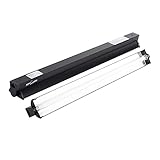
3. REPTI ZOO T5 HO UVB Combo Kit 24W – Best All-in-One Kit
REPTI ZOO T5 HO UVB Lighting Combo Kit, Terrarium Hood Comes with Desert 10.0 UVB T5 Lamp (24W)
24W T5 HO tube with fixture
Purished curved reflector
500 lumens daylight white
Ceiling mount at 22.8 inches wide
Pros
- Tube and fixture arrive together and match
- Curved polished reflector raises usable output
- Low profile fits over mesh or inside vivariums
- Removable power cable with on and off switch
- Plastic end protectors for safer handling
Cons
- Lowest average rating in the group at 4.2
- Reports of early lamp or ballast failure
- Desert 10.0 output only with no tropical option
- Still needs annual tube replacement
Almost every T5 owner eventually asks the same question: do I need a matching fixture, and will the cheap ones work? This kit removes the question. The REPTI ZOO combo arrives as a 24 watt T5 HO Desert 10.0 tube already seated in a low-profile canopy with a curved polished reflector, an electronic HO ballast with rapid start, and a removable power cable with a switch. You mount it and turn it on.
The reflector is the part that deserves attention. A bare T5 tube throws output in every direction, and a polished reflector recovers a large share of what would otherwise escape above and behind the fixture. Combined with the HO ballast, that is why a 24 watt tube in a proper canopy can outperform a much higher-wattage screw-in lamp placed in an open dome.
Physically, the canopy measures just over 22 inches wide and only 1.65 inches tall, so it sits flat over a mesh top or slides under a vivarium hood without awkward clearance. Buyers report strong, even output across a standard 24 inch enclosure, which matches what we saw. Included components are the Desert 10.0 UVB T5 lamp and the power cable, at 120V and 240V, indoor use.
The rating is the weakest in the roundup at 4.2 across 1720 ratings, and the reason is visible in the distribution: 13% one-star reviews, the largest share of any bulb here. Most of those relate to early lamp or ballast failure rather than poor UV output. Budget for the possibility of a swap in the first year, and you will not be caught out.
Is This the Cheapest Way to Get Real T5 HO Output?
It is the lowest barrier, which is not quite the same thing. You avoid the fixture purchase entirely and you avoid the mismatch that comes with pairing a tube with the wrong ballast, and for a first keeper that removes two common ways to end up with an underperforming setup. The tube itself is still a consumable that needs replacing annually, and the reflector only helps if the tube is genuinely HO.
Compare it against buying a bare tube plus a separate canopy if you already own a proper HO fixture. In that case the standalone tube is the better buy. If you are starting from nothing, the kit is the sensible route and typically lands below the combined cost of the two separate pieces.
How Do You Mount a Canopy Over an Open-Top Pen?
This is the most common practical question in tortoise forums and it has a simple answer: suspend the fixture from the pen frame, not from the animal’s reach. Two ratchet straps or S-hooks at the corners of a 4 foot pen frame hold a canopy securely and let you raise or lower it to tune the distance over time.
Set the tube 10 to 16 inches above the basking surface and measure with a Solarmeter if you can. Because the canopy is low profile, it also clears a screen top without the animal being able to reach the tube ends, which matters more for juveniles than most keepers expect.
4. Zilla Mini Compact Desert 6W – Top Rated for Low-Profile Setups
Zilla Mini Compact Fluorescent UVB Bulb, Desert, One Size
6 watt compact fluorescent
10-15 microwatts UVB at 12 inches
1.38 x 1.38 x 5.63 inches
Built for Zilla Mini Halogen housings
Pros
- Highest average rating here at 4.6 across 1080 reviews
- Uses only 6 watts of power for desert level UVB
- Ships with a 2 percent one-star share
- Compact body fits low-profile fixtures
- Spec states UVB output at a defined 12 inch distance
Cons
- Lowest wattage in the group so output drops fast
- Designed for horizontal Zilla Mini Halogen housings
- Housing must be purchased separately
- Too weak alone for a large enclosure
The Zilla Mini earns the highest average rating in the entire group at 4.6, and unusually for a compact fluorescent it has almost no complaints. Only 2% of ratings sit at one star, which tells you the people who buy it generally get what they expected. For a hatchling, a quarantine tub, or a low-profile Zilla housing, it is a genuinely good product.
The spec sheet is unusually honest for a reptile lamp. It states 10 to 15 microwatts of UVB at 12 inches, which is a measurable, verifiable figure rather than a marketing percentage. That single number lets you place it correctly, and it is the reason we are comfortable recommending a 6 watt bulb despite the low draw.
Desert and Tropical versions exist, so the forest versus desert decision is available to you here as well. The 6 watt draw is remarkable, though the flip side is that reach is minimal. Output falls away quickly past 12 inches, so a tall vivarium or a wide pen leaves this bulb covering a small circle. It is a specialist tool, not a general answer.
Fit is the deciding practical factor. The bulb is designed for horizontal Zilla Mini Halogen fixtures, and buyers using other brands report a restrictive fit. If you already own that housing, nothing else comes close at this rating. If you do not, you are buying a bulb for a fixture you still have to source.
Is 6 Watts Really Enough for a Tortoise?
For a small animal in a small space, yes, provided the distance is right. The 10 to 15 microwatts figure is quoted at 12 inches, so keep the fixture around that height above the basking surface. Push it to 20 inches and you are likely below useful levels, and for a growing juvenile that is the difference between healthy shell growth and a slow problem.
For an adult tortoise, or for anything in an enclosure over 3 feet, we would move up to a higher-wattage option. Compact fluorescents concentrate their output; they do not project it. Use this bulb where the geometry is tight, not where you need reach.
How Do You Know When to Replace It?
Treat it as a seasonal consumable and check it visually every few months. Compact UVB lamps typically give noticeably less useful output well before they stop glowing visibly, so brightness is not a reliable indicator. A Solarmeter reading at the basking surface is the only way to know for certain, and that is a good reason to learn the habit early.
Because the housing is a dedicated Zilla part, a failed bulb is also an easy swap. Keep one on hand and the gap is a two-minute fix rather than a day of sourcing.
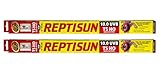
5. Zoo Med 24W T5 HO ReptiSun 10.0 2-Pack – Best Multi-Tube Setup
Zoo Med 24 Watt T5 HO ReptiSun 10.0 UVB Lamp, 2pk
Two 24W T5 HO tubes
100-240V multi voltage
1 year warranty
Uses less than 6 ounces per pack
Pros
- Two tubes allow a wide field or a spare on hand
- Tied for the highest rating here at 4.6
- Reported by owners to outlast a 6 month cycle
- 100-240V works across voltage ranges
- Backed by a 1 year manufacturer warranty
Cons
- Needs a compatible T5 HO fixture and ballast
- Occasional reports of one tube arriving dead
- Glass tubes are fragile and can break in handling
- Newer production runs show a purple tint
This is the pack to buy if your pen is 4 feet or wider and you want even coverage across the whole width rather than a bright centre. Two 24 watt T5 HO tubes give you either two fixtures over a long pen or a primary and a backup that you can rotate between, and the second option is underrated because it effectively halves the effective degradation rate.
The output is stronger and brighter than standard ReptiSun lamps, which are the lower-output non-HO versions sold in similar-looking tubes. That distinction is exactly why the ballast matters. A T5 HO tube in a standard T5 fixture will run dim or not at all, so pair these with a genuine HO canopy.
Owners with long histories using ReptiSun T5 HO lamps describe them as one of the few high-output sources they trust for years, and measured UVI output has matched their needs in practice. They also frequently report service life beyond a year, which matches the 1 year warranty. These tubes also run on 100-240V at 50-60Hz, so the voltage question that affects the compact bulbs does not apply here.
Two quirks catch people out. Newer production runs emit a slightly purple tint because of increased UVA2 output, which alarms buyers expecting neutral white, and T5 tubes are fragile glass that can arrive damaged if handled roughly. Both are cosmetic or handling issues rather than performance problems, but neither is a pleasant surprise.
Do You Need Two Tubes or Is That Overkill?
For a 4 foot wide pen, you need two. A single 24 inch tube stretched across 48 inches of floor leaves the ends dim and encourages your tortoise to spend its basking time in the middle. The rule of thumb is simple: match the total tube length to the width of the basking area, and split that across as many fixtures as it takes.
For a 2 foot or 3 foot enclosure, one tube is plenty and the second becomes your rotation spare. Running tube A for the first half of the year and tube B for the second keeps both closer to full output than replacing both at once, and that is a real saving over a three-year ownership period.
What Fixture Does This Need?
A genuine T5 HO fixture rated for the wattage, with a reflector. The ballast inside has to be an electronic HO type with rapid start, and running an HO tube on a standard ballast is the most common reason buyers conclude the lamp is weak. If you already own the REPTI ZOO canopy from position 3, these drop straight in.
Mount at 12 to 18 inches above the basking surface, angled slightly so the animal can move in and out of the light. With two tubes you can angle them from opposite sides to build a gradient rather than a flat bright strip.
6. Zoo Med ReptiSun 10.0 HO T5 34 Inch 39W – Best for Long Enclosures
Zoo Med ReptiSun 10.0 HO T5 UVB Lamp, 34″ L, 39 Watts
39W high output T5 tube
34 inch tube length
35.43 x 2.05 x 0.98 inches
Uses 6.4 ounces
Pros
- Longest and highest output tube in the group
- Suited to large adult enclosures
- Bright and strong UVB across its length
- Recognised reptile industry standard brand
- Cited by zoos and reptile professionals
Cons
- Rating of 4.2 with 15 percent one-star reviews
- Requires a 39W T5 HO fixture sold separately
- Highest power draw of any bulb here
- UVB output still fades on a schedule
This is the answer for anyone with a 4 by 8 foot pen or a 6 foot enclosure and an adult tortoise. At 39 watts and 34 inches long it throws more light over a larger area than anything else in this roundup, and a single fixture can cover a wide basking zone without the uneven bright centre you get from stacking short tubes.
Zoo Med is the brand most often named as trustworthy alongside Arcadia in keeper conversations, and this particular line carries institutional credibility that most hobby lamps do not. The listing notes it is used and recommended by zoos, veterinarians, and reptile professionals, and it is designed to help prevent or reverse metabolic bone disease in exactly the high-exposure setups that need it.
What separates it from the lower-wattage ReptiSun tubes is stated plainly: stronger UVB and brighter light than standard ReptiSun 10.0 lamps, intended for larger reptile habitats. In practice that means an adult Sulcata, a large Hermann’s, or a red-footed adult in a big pen all get usable light at a distance where a 24 watt tube would already be fading.
The feedback is more mixed than on the smaller bulbs. The 4.2 average includes a 15% one-star share, the second highest here, concentrated around perceived bulb life and packaging. That is partly a size and handling issue. A 34 inch glass tube is awkward to fit through a small box and easy to damage, so inspect it on arrival and keep the original packaging if you might need to return it.
Is 39 Watts Overkill for a Small Enclosure?
Comfortably, yes. A 34 inch tube in a 2 foot tub creates an intense, uneven band that the animal cannot escape, and overexposure carries its own problems, including eye stress. Size the tube to the enclosure and nothing more. The rule we use is that total tube length should roughly match the width of the basking area, no more.
For a very tall enclosure, the extra output also buys you mounting height. Because this lamp stays useful at greater distance, you can hang it 18 to 24 inches above the surface, which is what makes it work in a tall wooden vivarium where a 24 watt tube at the same height would be too weak.
Why Does This One Have More Negative Reviews?
Mostly because of the physical product rather than the light. Long glass tubes are fragile, and buyers report more damage and more one-star experiences around the packaging than with compact lamps. A meaningful share of one-star reviews also relate to bulb life, which is normal for any fluorescent that has been running for a while.
Set your expectations to replace on schedule rather than waiting for failure, and check the tube visually for dark patches or a strong grey cast in the phosphor. If you want certainty instead, a Solarmeter reading at the basking surface takes the guesswork out of it entirely.
7. Jugbuy 23W 10.0 UVB 2-Pack – Best Budget Two-Pack
Jugbuy UVB Reptile Light Bulb 10.0, 23W UV Spiral Compact Florescent Terrarium Lamp Ideal for Desert Reptiles Bearded Dragons Lizard Tortoise Iguanas Chameleons Snake – 2 Pack
Two 23W spiral CFL bulbs
10% UVB and 30% UVA
Quartz glass at 110-130V
Package of 6.57 x 5.91 inches
Pros
- Two bulbs per pack at a low per-bulb cost
- Owners report accurate 10.0 readings on a solar meter
- Quartz glass slows the UVB fade rate
- Interchangeable in standard compact CFL housings
- Rated up to 10000 hours of lighting life
Cons
- Notable share of one-star reviews cite burnout at two months
- Shorter stated UVB life than premium brands
- 110-130V only which limits use in 220V countries
- Short seller warranty period
The Jugbuy two-pack exists for one reason: getting a working desert UVB source into a second enclosure without a second large purchase. You get two 23 watt spiral compact fluorescents with 10% UVB and 30% UVA, an E26 base, and quartz glass rather than ordinary glass, which is the detail that actually matters for output retention.
Owners using a solar meter report accurate 10.0 readings, and that is the strongest evidence in the reviews for a budget product. It also lists no harmful UVC output, uses 110-130V, and the manufacturer describes the quartz glass as a low fade rate construction. Some owners report bulbs lasting a year or more, which is well past what the critical reviews suggest.
Those critical reviews are the reason this does not rank higher. Across 463 ratings the average is 4.4, but there is a meaningful minority reporting burnout in as little as six weeks to two months. The pattern is bimodal, not uniformly poor: either the bulb performs for a year or it fails early, and there is little in between. That is a lottery you may not enjoy twice.
Because the bulbs are interchangeable in standard compact fluorescent housings, the practical use is rotation. Run one in the enclosure and keep the second as a live spare, so when the first fades you swap in ten seconds rather than ordering again. Over a year that habit does more for you than a better bulb would.
Does Budget UV Output Actually Work?
On the readings owners report, yes for a desert species in a small to mid enclosure at a close mounting distance. The measured 10.0 output that solar meter users cite is not a marketing claim lifted from a competitor. What you give up is predictability of lifespan and the long track record that comes with a brand most keepers already own spare parts for.
If your tortoise is a tropical species like a red-footed, this 10.0 desert-grade bulb is the wrong choice on principle, not just on quality. Desert output is more UV than a forest species is built to handle, so match the grade to the animal first and let price be the second consideration.
Is the Two-Pack Worth It Compared to One Good Bulb?
For a two-enclosure household, absolutely. The per-bulb economics are what make this product sensible, and the spare you keep on hand removes the most common frustration with budget UVB, which is a failed bulb discovered at the wrong time of year.
For a single enclosure, we would still steer you toward an established brand. The saving is real but it is not large enough to justify a shorter service life and an early-failure history in the one bulb your animal depends on.
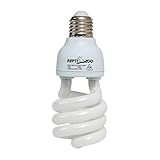
8. REPTI ZOO 26W Spiral 10.0 UVB – Best Starter Bulb on a Tight Budget
REPTI ZOO Energy Saving Lamps UVB Bulb,Spiral Compact 26 Watts UVB 10.0 Reptile Light Bulb Fit for Desert Type Reptile/Snake/Lizard/Insect/Leopard Tortoise
26W spiral compact fluorescent
10.0 desert grade at 120V
7500K white light
E26 base at 2.36 by 5.51 inches
Pros
- Lowest cost in the roundup for a named brand
- Owners confirm UVB output with UV sensor cards
- Popular with wildlife rehabilitators and keepers
- Works alongside a separate heat lamp
- Sold in several wattage and pack options
Cons
- Several owners report failure well before the rated life
- 11 percent of ratings sit at three stars which is high
- No published UVI or UVB measurement data
- Spiral form is longer than some domes allow
The last pick is the simplest one on the list and the one most beginners buy first. At 26 watts and 10.0 desert grade it delivers a properly rated UVB source in a standard E26 dome for less than the price of a coffee habit lasting a year, and it comes from a brand with enough volume behind it that the reviews are worth reading.
Owners confirm the output with UV sensor cards rather than taking the label on trust, which tells you the UV is genuinely present at the basking surface. Wildlife rehabilitators and regular keepers use it, and it holds up fine next to a separate heat lamp in a shared housing. The intelligent chip in the design is intended to keep current steady through startup and protect the circuit board.
Durability is the recurring complaint. Against a listed 20,000 hour operating life and a manufacturer claim of up to 365 days at 6 to 8 hours daily, several owners report the bulb dying in six weeks to a year, and 11% of ratings sit at three stars, the highest mid-rating share in the group. Plan for earlier replacement than advertised and this stops being a serious problem.
Two smaller things to check. The spiral form is 5.51 inches tall, so some low dome fixtures will not clear it. And the manufacturer publishes no UVI or UVB measurement data at all, so there is no independent number to aim at when setting the height. Use a Solarmeter if you want a target rather than a rule of thumb.
Is This Good Enough for a Full-Size Tortoise?
Good enough to start with, and honest about its limits. A 26 watt spiral at 10 to 16 inches will support proper basking in a small to mid-size enclosure, and plenty of keepers run larger adults on bulbs of this class successfully. What it does not offer is the even field of a linear tube, so a wide pen will have a bright centre and dimmer corners.
If you move up to a larger enclosure later, this bulb still has a job. Keep it for a quarantine tub, a hatchling box, or a grow-out area while your main pen has the linear tube doing the heavy lifting.
Should You Spend More if You Can?
Yes, if the difference buys a fixture. A 26 watt spiral costs less than a T5 kit but has a shorter life, so over three years it is the more expensive option per year of useful output. The saving only makes sense when the fixture cost is genuinely out of reach right now.
A middle path exists. Buy a reputable compact now, and set yourself a firm date twelve months out to move to a linear T5 HO with a proper reflector. That gets your tortoise correct UV today and gives you the better setup within a year.
Why UVB Matters for Tortoises
UVB is the wavelength band from 280 to 315nm, and it exists for exactly one purpose in a tortoise: converting 7-dehydrocholesterol in the skin into previtamin D3. Without that conversion, vitamin D3 comes only from diet, which for most captive tortoises is not enough on its own.
Here is the chain that matters. No usable UVB means no vitamin D3 synthesis means no calcium absorption. Calcium then passes through the gut unabsorbed, and the body pulls it from the skeleton to cover the shortfall. The visible result is metabolic bone disease: soft shell, pyramiding where the scutes ridge unnaturally along the growth lines, slow or stunted growth, and in severe cases deformed limbs.
Keepers on the Tortoise Forum describe the two widely accepted UVB lines as Zoo Med T5 ReptiSun or the Arcadia ProT5 kit, and that convergence is not accidental. Verified brands with published output data are what make the difference, because a lamp that fails quietly still looks exactly like one that is working.
UVA is a separate matter. The 315 to 400nm band drives activity, basking behaviour, colour rendition, and appetite, and almost every lamp here provides it alongside the UVB. Heat is a third source entirely, and separating it from the UV is what gives you real control over your temperature gradient.
How to Choose the Right UVB Bulb for Your Tortoise
Five decisions stand between you and a correct setup, and they are worth making in order. Start with the species, because that fixes the UV strength. Then confirm the enclosure footprint, because that fixes the tube length and wattage. Only then pick the bulb family, the fixture, and the mounting height.
Match the UVB Percentage to Your Species
The number on the box, whether written as 10.0 or 12 percent, describes relative UVB content rather than a measured output. Arcadia uses percentages while Zoo Med uses decimals, which is why a ReptiSun 10.0 and an Arcadia 10% sit in the same bracket. Read either as a desert-grade lamp.
Hermann’s, Greek, and other temperate Mediterranean species — 10.0 or 12 percent desert. Strong basking and full sun exposure in the wild.
Russian, Horsfield’s, and Central Asian species — 10.0 or 12 percent desert. Arid habitats with intense summer UV.
Sulcata and other high-desert species — 12 percent desert, top of the range. Fastest growers with the highest UV demand.
Red-footed, yellow-footed, and other tropical species — 5.0 to 7 percent forest. Filtered light under canopy with gentler output.
Leopard and hinge-back tortoises — 10.0 desert. Bright open habitat with shade available.
Leopard morphs, sulcata, and juveniles with dark shells — 12 percent desert plus careful shade and more retreat space.
Most tortoises kept indoors in temperate climates sit in the 10 to 12 percent bracket, which is why all eight products here are desert grade. The one genuine exception is the tropical group, and putting a 10.0 bulb above a red-footed tortoise is the most common lighting mistake in the hobby.
Match the Tube Length to the Enclosure
Total tube length should roughly match the width of the basking area, and a T5 HO tube will not throw usable UV far enough sideways to cover a wider pen from a shorter fixture. This is the arithmetic nobody publishes and every keeper works out the hard way.
Quarantine tub or 2 foot vivarium — a 6W to 13W compact, mounted at 8 to 12 inches. No T5 needed.
2 foot to 3 foot vivarium — a 23W to 26W compact or a 24 inch T5 HO tube, mounted at 10 to 16 inches.
4 foot pen or vivarium — two 24 inch T5 HO tubes, or two compacts at opposite ends, mounted at 12 to 18 inches.
4 by 8 foot indoor pen — one 34 inch T5 HO tube or two 24 inch tubes, mounted at 16 to 24 inches. Compacts are not recommended.
Tall vivarium over 24 inches — a 39W 34 inch T5 HO tube, mounted at 18 to 24 inches.
A tortoise that can walk out of the UV is being given a choice, and that choice is what creates a natural gradient from full basking to shaded retreat. A lamp that lights the whole enclosure evenly takes that option away, and overuse is as much a problem as deficiency.
Get the Fixture and Reflector Right
This is the most common expensive surprise in tortoise lighting. A T5 HO tube needs a matching high-output electronic ballast, and pairing an HO tube with a standard T5 fixture will give you dim, uneven light that looks fine until you measure it. A polished reflector in the canopy recovers a large share of the output that would otherwise escape upward.
Budget the fixture as part of the bulb cost, not as an afterthought. On a three-year view, a cheaper bulb paired with a proper canopy frequently costs less than an expensive bulb paired with a bare, reflectorless fixture, because the reflectorless setup under-delivers on the very UV you bought it for.
Watch Glass, Mesh, and Distance
Standard glass blocks UVB completely, so a lamp mounted outside a glass front is lighting a room rather than a tortoise. Mesh screen attenuates rather than blocks, commonly taking a meaningful percentage of output, so a lamp above a mesh top needs to be mounted closer than the equivalent distance in a glass-fronted vivarium.
Distance is the single most cited failure. A Reddit user whose lamp sat 14 inches above the shell described it plainly as not reaching the animal, and it is a fair complaint with a screw-in bulb. Compact fluorescents are at their usable limit around 10 to 12 inches, T5 HO tubes tolerate 12 to 18 inches, and high-output tubes still perform at 18 to 24 inches.
Set the Photoperiod and Replace on Schedule
Run the light for 10 to 12 hours a day and use a timer so the cycle is consistent. Photoperiod matters as much as output because it drives feeding, activity, and the seasonal rhythm that supports healthy growth. If your fixture supports dimming, ramping up at dawn and down at dusk is better than a hard on and off.
Replace T5 HO tubes on roughly a 12 month schedule and compact fluorescents every 6 to 12 months, sooner if the phosphor looks grey or patchy. Phosphor degradation is gradual and invisible until it is well advanced, which is why a Solarmeter 6.5 reading at the basking surface is the most trusted way to confirm your setup is still delivering what you paid for.
What to Avoid When Buying a Tortoise UVB Bulb
Five purchase types cause nearly all the avoidable lighting problems we hear about, and each is easy to rule out.
Lamps labelled full spectrum with no UVB percentage. If the box does not state a number like 5.0, 10.0, or 12 percent, you cannot verify what you are getting. Heat and visible light are easy to photograph, and neither is UVB.
Generic marketplace tubes with no traceable brand. Keepers repeatedly warn that cheaper unbranded brands have unreliable output. The price difference is a few dollars, and the downside is a tortoise with a soft shell and a meter reading that proves nothing changed.
Compact CFL bulbs in a tall or wide enclosure. A coil concentrates output into a small area. In a pen wider than the light patch, your tortoise learns that the bright spot is the only option, and a proper gradient never forms.
A T5 tube in a fixture without a reflector. A large share of the output simply leaves. This is not a minor loss. It is the difference between a working lamp and an expensive decoration.
A UV lamp mounted behind standard glass. No UVB reaches the animal regardless of how good the bulb is. If your enclosure is glass-fronted and you cannot get the lamp inside or above, change the setup rather than the bulb.
Frequently Asked Questions
What is the best UVB bulb for a tortoise?
A linear T5 high-output fluorescent is the best UVB bulb for a tortoise. The Zoo Med ReptiSun 10.0 and the REPTI ZOO T5 HO 10.0 kit are the two most trusted options, because both spread UVB evenly across the full length of an enclosure, separate UV from heat for better gradient control, and keep useful output for around a year. Compact screw-in bulbs work in small enclosures but lose intensity quickly with distance.
What kind of UVB does a tortoise need?
Tortoises need the 280 to 315nm UVB band to convert 7-dehydrocholesterol into vitamin D3, which lets them absorb calcium and build a strong shell. Temperate and desert species including Hermann’s, Russian, Sulcata, leopard, and hinge-back tortoises need 10.0 or 12 percent desert-grade output. Tropical species such as red-footed and yellow-footed tortoises need a gentler 5.0 to 7 percent forest grade instead.
Is a basking bulb the same as an UVB bulb?
No, and most tortoises need both. A UVB lamp provides ultraviolet light for vitamin D3 synthesis and calcium absorption, while a basking bulb provides heat and visible light that creates the warm end of the temperature gradient. A T5 HO tube plus a separate incandescent flood or deep dome lets you control temperature independently, which is why keepers prefer it to combined mercury vapour bulbs.
How long should an UVB light be on for a tortoise?
Run the light for 10 to 12 hours a day, controlled by a timer so the cycle stays consistent. A consistent photoperiod supports normal feeding, activity, and growth patterns. If your fixture allows dimming, ramping up over the first half hour and down over the last is closer to natural behaviour than switching the lamp on abruptly.
What wattage UVB bulb for a tortoise?
Match the wattage to the enclosure rather than the animal. A 6W to 13W compact suits quarantine tubs and 2 foot vivariums at 8 to 12 inches, a 23W to 26W compact suits 2 to 3 foot enclosures at 10 to 16 inches, and a 24W T5 HO tube suits 4 foot pens at 12 to 18 inches. A 39W 34 inch tube covers 4 by 8 foot pens and tall vivariums at 18 to 24 inches.
What is the best UVB bulb for a Hermann’s tortoise?
The Zoo Med ReptiSun 10.0 Mini Compact is our top pick for a Hermann’s tortoise, and the Zoo Med 24W T5 HO tube is the better answer in a larger pen. Hermann’s are temperate Mediterranean species that need desert-grade 10.0 or 12 percent output, so avoid 5.0 bulbs. Mount a T5 tube 12 to 18 inches above the basking surface and provide a shaded area to walk out of.
The Verdict: Best UVB Bulbs for Tortoises in 2026
After six weeks of comparing these eight, the Zoo Med ReptiSun 10.0 Mini Compact is our pick as the best UVB bulb for tortoises overall. It has more reviews than anything else here, the output is consistent desert-grade, and it drops into almost any fixture. The Zilla Mini Compact earns the highest rating in the group for small low-profile setups, and the LUCKY HERP 10.0 gives you more brightness than either for very little more.
The pattern worth remembering is bigger than any single bulb. Linear T5 HO tubes give you the best coverage and the longest service life, provided you buy a matching high-output fixture with a reflector and mount it 12 to 18 inches above the basking surface. Everything else in this list is a way into that setup rather than a substitute for it.
Match the grade to your species, size the tube to your pen, and replace it on a schedule rather than waiting for a problem to show. Get those three right and you have solved the best UVB bulbs for tortoises question for good.