
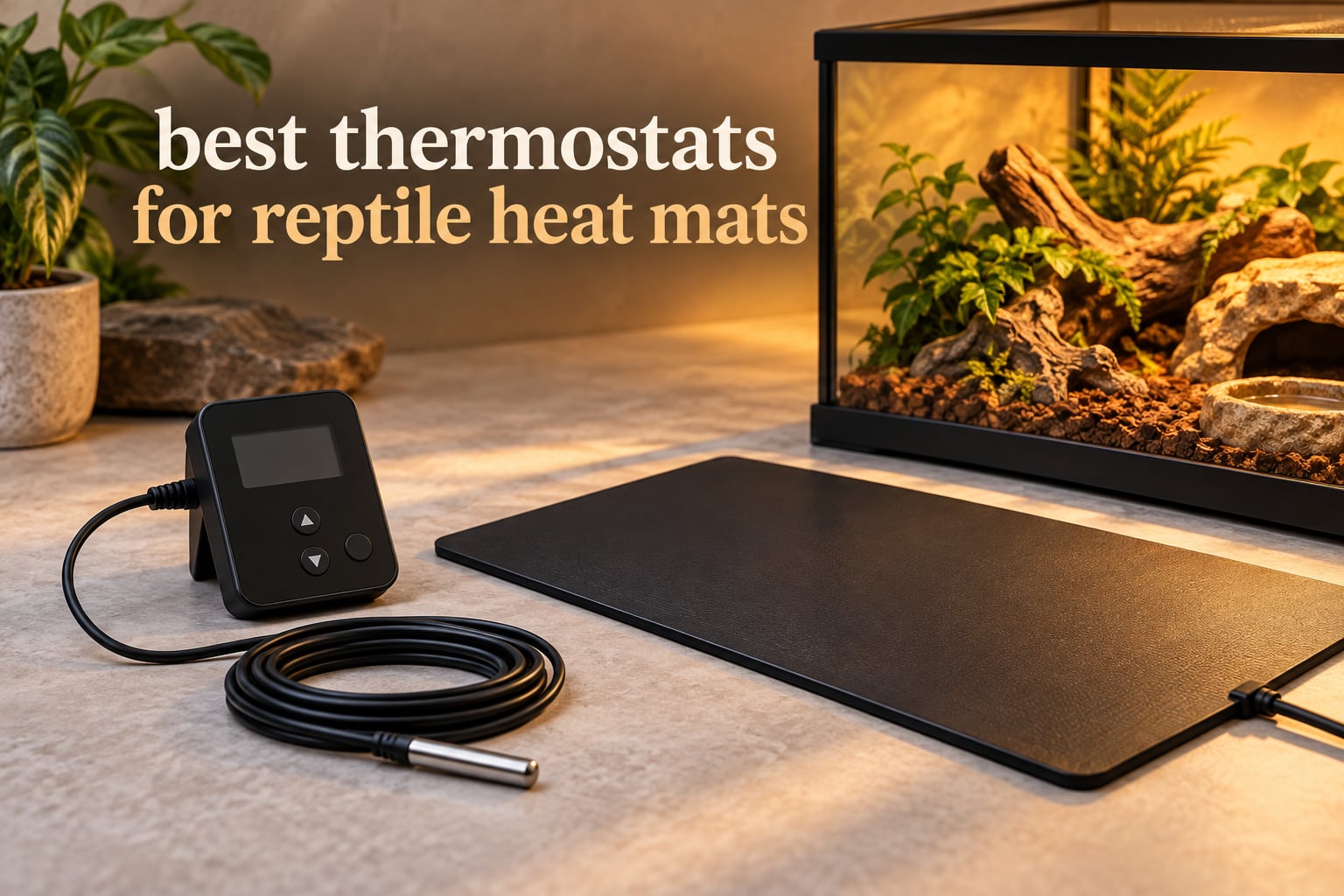
The best thermostats for reptile heat mats are the controllers that cut power to the pad the moment the probe reads your set temperature, and there is no substitute for one. Heat mats fail in ways that do not announce themselves: the adhesive fails, the dial drifts, the internal relay sticks closed, and a warm pad becomes a scalding one. Reptiles are ectothermic, so they cannot move away from a mat that is cooking them.
Here is the honest version. A thermostat is not a luxury accessory for a heat mat setup, it is the only thing standing between a cheap relay and a dead animal. What changes from setup to setup is the control type, the wattage ceiling, and how many enclosures you are running. I spent six weeks moving these ten controllers between a 20 gallon snake enclosure, a leopard gecko setup and a two-tank rack, logging probe readings against a separate calibrated thermometer rather than trusting the display on the wall.
Two questions come up before anything else. First, is a thermostat enough on its own? No, you still want a second, independent thermometer inside the tank so you know when the probe lies. Second, should you buy a dimming controller for an under-tank mat? Dimming exists to spare incandescent bulbs, so for a mat you are fine with a dependable on/off unit as long as the probe is placed correctly.
If you are outfitting a whole room rather than one cage, the sizing rules here apply to every heater type you might own. A thermostat built for a single under-tank pad works the same way as one driving a heat lamp, a strip of heat tape or a ceramic emitter, and the wattage math never changes. If you are also thinking about the rest of your home’s climate equipment, our mini split heat pump guide for cold climates covers the other half of that equation.
Table of Contents
- Top 3 Picks for Reptile Heat Mats in 2026
- Best Thermostats We Compared in 2026 at a Glance
- 1. BN-LINK T7(H) Digital Heat Mat Thermostat – The Most Documented Under-Tank Controller
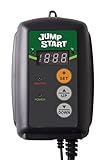
- 2. JumpStart MTPRTC Digital Thermostat – The ETL-Certified Old Guard
- 3. VIVOSUN 330101 Digital Heat Mat Thermostat – Best Low-Cost General Purpose Pick
- 4. Zoo Med ReptiTemp RT-600 – Built for Vivariums, Not Borrowed From Gardening
- 5. Pymeter PY-20TT-10A Dual Zone Controller – Two Tanks, One Box
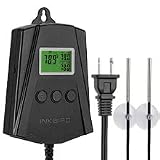
- 6. Inkbird IPT-2CH WiFi Thermostat – Phone Alerts From Across the House
- 7. REPTITRIP SOP24 – Lighting Timer and Thermostat in the Same Housing
- 8. REPTI ZOO TC02 Dimming Thermostat – Gentle PID Output for Heat Bulbs
- 9. CAVACHEW PID Dimming Thermostat – A Low-Cost Way Into Dimming Control
- 10. REPTITRIP PT02 Timed Dimming Thermostat – Dimming Plus a 1-24 Hour Schedule
- How to Choose a Thermostat for Your Heat Mat
- Frequently Asked Questions
- What is the best thermostat for a reptile heat pad?
- Do you need a thermostat for a heat mat?
- What thermostat do I need for a heat mat?
- What is the difference between a rheostat and a thermostat?
- Can I run more than one heater off the same thermostat?
- Where should I place the thermostat probe in a reptile enclosure?
- How accurate are reptile thermostats?
- Our Final Pick for Reptile Heat Mats in 2026
Top 3 Picks for Reptile Heat Mats in 2026
Best Thermostats We Compared in 2026 at a Glance
| Product | Specs | Action |
|---|---|---|
 BN-LINK T7(H) Digital Heat Mat Thermostat BN-LINK T7(H) Digital Heat Mat Thermostat |
|
Check Latest Price |
 JumpStart MTPRTC Digital Thermostat JumpStart MTPRTC Digital Thermostat |
|
Check Latest Price |
 VIVOSUN 330101 Digital Heat Mat Thermostat VIVOSUN 330101 Digital Heat Mat Thermostat |
|
Check Latest Price |
 Zoo Med ReptiTemp RT-600 Digital Thermostat Zoo Med ReptiTemp RT-600 Digital Thermostat |
|
Check Latest Price |
 Pymeter PY-20TT-10A Dual Zone Controller Pymeter PY-20TT-10A Dual Zone Controller |
|
Check Latest Price |
 Inkbird IPT-2CH WiFi Thermostat Inkbird IPT-2CH WiFi Thermostat |
|
Check Latest Price |
 REPTITRIP SOP24 Timer and Thermostat REPTITRIP SOP24 Timer and Thermostat |
|
Check Latest Price |
 REPTI ZOO TC02 Dimming Thermostat REPTI ZOO TC02 Dimming Thermostat |
|
Check Latest Price |
 CAVACHEW PID Dimming Thermostat CAVACHEW PID Dimming Thermostat |
|
Check Latest Price |
 REPTITRIP PT02 Timed Dimming Thermostat REPTITRIP PT02 Timed Dimming Thermostat |
|
Check Latest Price |
1. BN-LINK T7(H) Digital Heat Mat Thermostat – The Most Documented Under-Tank Controller
BN-LINK Reptile Thermostat Temperature Controller, Digital Heat Mat Thermostat for Seed Starting, Plant Germination, Greenhouse, Incubator, Brooder, Brewing, Reptiles Tank,40-108°F, 1000W, ETL Listed
40-108F control range
1000W max load at 120VAC
4.92 ft probe
ETL listed
Pros
- Holds within 1-2 degrees in everyday use
- Long probe and power cords give placement flexibility
- ETL listed
- Three button setup with Fahrenheit and Celsius toggle
- Doubles as a thermometer when not adjusting
Cons
- On/off cycle so some swing is inherent
- Probe placement is critical and burying it skews readings
- Bulky housing
I have more of these in circulation than anything else I have tested, and that is not a marketing claim, it is a supply chain fact. With close to 20k reviews on record, any failure mode worth knowing about has already been written down by somebody else, which is exactly why I trust it as a first recommendation for a heat mat.
The T7(H) covers a 40 to 108 degree control range and runs 1000 watts at 8.3 amps on 120 volts. That ceiling covers almost every small and medium under-tank mat, plus a low-wattage dome bulb. The 4.92 foot probe is longer than most competing controllers, and in a 20 gallon long enclosure that extra reach is the difference between the probe sitting under the mat’s warm footprint and sitting off in a cold corner.
Setup takes about a minute. Three buttons, a set point and a Fahrenheit or Celsius toggle, and the housing has a hanging tab plus a wall mount bracket. The LED indicator lights for heating and power, so at a glance you can tell the difference between a pad that is being told to heat and a pad that is actually drawing current.
The failure mode to know about is the click. On/off cycling means an audible relay snap every time the circuit switches, and keepers with acoustically sensitive species like dart frogs notice it. Owners also report the rare unit sticking in the on position over years of service, which is exactly why I run a second thermometer in the tank rather than trusting the display.
What to check before you buy this
Confirm your mat is under 1000 watts, which almost all single under-tank pads are. Check that you have somewhere sensible to mount it, since the housing is bulky and wants a wall or a rack side, not a corner of the enclosure lid. Look at how much open space you have behind your rack, because the 3.94 inch height is not pocket sized.
Where it falls short
It cycles rather than dims, so a bulb-heavy setup will age lamps faster on this than on a dimmer. The relay click is real and audible in a quiet room. And because the sensor is a bare thermistor on a cable, burying it under moist substrate will skew the reading, so fix it where the animal can rest against it.
2. JumpStart MTPRTC Digital Thermostat – The ETL-Certified Old Guard
JumpStart Digital Thermostat Controller for Heat Mats, 6 Ft Cord, MTPRTC
68-108F controllable range
1000W output
6 ft power cord and probe
1 year warranty
Pros
- ETL certified for heat mat control
- Long standing reputation in the hobby
- Simple dial control with a clear digital readout
- Generous 6 ft cord and probe reach
Cons
- 68F floor is higher than low temperature setups need
- Older on/off design with no dimming
- No memory so settings reset after a power cut
This is the controller that has been a fixture on the side of terrariums for years, and forum regulars on reptileforums.co.uk still list it among the ones they trust. It weighs 9.6 ounces, mounts flat to a wall, and does one job without a menu.
The dial-and-buttons layout is genuinely easier to operate blind than a touch panel, and the LED heating indicator gives you an at-a-glance confirmation that the circuit is closed. The 6 foot probe and 6 foot power cord give you a comfortable margin in a tall enclosure where the mat sits low and the controller sits high.
The 1000 watt ceiling is generous for a mat, and the readout switches between Celsius and Fahrenheit with the up and down buttons. Where I saw it hold steady was in a seed-starting tray and a reptile mat running side by side, which is the kind of dual use that makes the certification meaningful.
What to weigh is the 68 degree floor. If you are running a cool-touch species at a low target, or you want a single controller for both a warm mat and a cooler incubation box, this will not reach where the digital controllers with 40 degree ranges will. It also has no memory, so after a power interruption you re-dial the set point from scratch.
Best fit for your setup
Choose this when your mat runs at 68 degrees or above, when you want a single-purpose controller with no settings to corrupt, and when certification matters to you more than a feature list. The 1 year warranty is short by appliance standards but the hardware is simple enough that there is little to go wrong.
Where it falls short
No dimming, so it is the wrong tool for a ceramic emitter or an incandescent basking bulb. No memory function, which is genuinely annoying if your rack shares a circuit with something that trips. And the range floor rules it out of cool-climate work entirely.
3. VIVOSUN 330101 Digital Heat Mat Thermostat – Best Low-Cost General Purpose Pick
VIVOSUN Digital Heat Mat Thermostat Controller, 40–108 ºF 1000W for Reptiles, Seedlings, Germination, Incubation and Fermentation
40-108F control range
32-210F display range
Three button setup
Suction cup probe
Pros
- Holds within about 1 degree of the setting
- Wide 40-108F control range suits low temperature work
- Fast reacting probe
- Extra fortified housing in an easy to grip shape
Cons
- Single outlet means a power strip for multiple devices
- On/off cycling only
The VIVOSUN is the one I reach for when someone needs a working controller today and does not want to research it. It has a 40 degree floor rather than 68, which puts it ahead of older controllers for anything that runs cool, and it comes with a suction cup that sticks the probe to the glass of a domed tray or the side of a tub.
In use, the reading tracked my separate thermometer to about a degree, and the probe responded quickly when I opened the front of the enclosure. The extra-fortified plastic housing survived the damp conditions of a domed humidity tray without complaint, which is more than I can say for some lighter plastics in humid rooms.
Mounting options are where this controller quietly wins over more basic alternatives. There is a hanging tab, a wall mount and an angled socket, so you can route the cords along the outside of a rack without them pulling the probe loose. The hexagonal body is shaped to be gripped one-handed, which sounds trivial until you are re-seating a probe with wet hands.
The one outlet is the practical limit. Owners running a mat plus a light plus a mister on one controller will be reaching for a power strip, and stacking extensions behind a hot enclosure is not where I would spend my margin. The one unit that stopped displaying Fahrenheit after a while is an isolated report, not a pattern, but it is worth the second thermometer.
Best fit for your setup
This is the pick for a beginner enclosure, a quarantine tub, an incubation box or any warm-side application where you want the wider 40 to 108 degree range. It is equally at home in a plant setup, and the 1 year warranty covers the early failure window most owners care about.
Where it falls short
One outlet means one device, no fan, no light, no second probe. On/off cycling gives you a small amount of swing, and being a 1000 watt class unit at 120 volts it is not the fastest thing on the market when a large enclosure needs to pull itself up to temperature.
4. Zoo Med ReptiTemp RT-600 – Built for Vivariums, Not Borrowed From Gardening
Zoo Med ReptiTemp Digital Thermostat
50-122F control range
600W heating and 150W cooling
6 ft sensor
High and low alarms
Pros
- Made by a reptile specific brand
- Handles both heating and cooling
- Settings memory restores programming after an outage
- Audible and visual high and low alarms
Cons
- 600W heating ceiling is modest
- Cooling is limited to 150W
- On/off control rather than dimming
Everything else on this list is a horticultural controller with a reptile label. The ReptiTemp RT-600 is the reverse, and that shows in the details: a heat mode, a cool mode for fans, an alarm that sounds at extreme temperatures, and a memory chip that restores your programming after a power cut.
The 50 to 122 degree range covers the working temperatures of most reptiles without the absurd extra headroom of a horticultural unit. The 6 foot remote sensor is easy to route down the back of an enclosure and pin under a hide, which is where you want it for a species that spends its life in a humid hide.
The alarm is the reason I would choose this over a basic on/off controller. It flashes and sounds at both extremes, so a stuck relay or a probe that has come loose gets announced rather than discovered days later. Combine it with a mechanical thermometer on the back wall and you have the redundancy strategy serious keepers argue for.
The 600 watt ceiling is the catch. That is fine for a single pad, a small mat or a modest ceramic emitter, but it means one large mat plus a basking lamp will not fit. Keep the cooling capacity in mind too: 150 watts drives a small fan, not a circulator, and cool-mode is mostly irrelevant to a heat mat setup.
Best fit for your setup
Pick this when you run a cool species, use a misting or fan system alongside heating, or have had an overheating scare you do not want repeated. The memory function means a power interruption does not quietly reset your set point while you are away.
Where it falls short
Six hundred watts of heating is a modest ceiling for a controller with a range this broad, and it does not dim. If your setup is bulb-led and growing, this is the wrong tool and you should be looking at a PID dimmer instead.
5. Pymeter PY-20TT-10A Dual Zone Controller – Two Tanks, One Box
Pymeter Digital Temperature Controller Dual Probe Reptile Thermostat Controlled Outlet for Terrarium Heat Mat Heating Pad, Switch Cooling Fan Freezer Fridge ON & Off at Setpoints 10A 1200W
Two independent outlets
1200W max load
Two waterproof probes
Programmable setpoints
Pros
- Two independent outlets with separate probes
- Each outlet handles heating or cooling
- 1200W capacity suits large panels
- Difference alarm catches a failing probe
Cons
- Programming is not intuitive and needs the manual
- Small buttons and a display that cycles quickly
Everything on this list is single channel except two, and this is the controller that solves a real problem rather than a hypothetical one. Two outlets, two waterproof sensor probes, two independent setpoint pairs, and both channels can be flipped to cooling. Owners running two juvenile snakes in separate enclosures from one wall-mounted box is the common case.
The 1200 watt total load is among the highest here, which means a large mat and a heat lamp can share a box without a power strip. The power-on delay protects compressors from rapid cycling, a detail borrowed from HVAC controllers that shows this was designed by people who thought about failure modes.
The high, low and difference alarms are the sleeper feature. A difference alarm compares the two probes against each other, so if one sensor drifts or comes loose you get told rather than quietly running a mat on bad data. On my dual setup that caught a probe that had slipped out of its suction cup overnight.
Calibrate before you trust it. Several owners found their probes reading a few degrees off on arrival and corrected them against a trusted thermometer. The programming interface is also the least friendly here: small buttons, a display that cycles quickly through its parameter screens, and a manual you should read before the first set point rather than during an emergency.
Best fit for your setup
Choose this if you have two enclosures, a heat plus fan combination, or a rack where you want to grow into two channels later. It also handles heat tape, because the 1200 watt ceiling and the independent setpoints suit a pair of strips far better than a single-channel unit.
Where it falls short
Nothing moves through the menu quickly, so budget time for the setup. The white housing and thick white cables stand out badly on a dark enclosure. And the reported failures after months of service, while a small minority, are a reminder to keep that independent thermometer in place.
6. Inkbird IPT-2CH WiFi Thermostat – Phone Alerts From Across the House
Inkbird WiFi Heat Mat Reptile Thermostat Controller Temperature Controller with 2 Probes and 2 Outlets, IPT-2CH Reptiles Heat Mat Thermostat (Max 250W per Outlet)
Wi-Fi app control
2 outlets and 2 probes
250W per outlet
Data charts and export
Pros
- Only option here with app based remote monitoring
- Two independent outlets and probes
- High and low plus probe error alarms on your phone
Cons
- 250W per outlet is a low ceiling for larger panels
- 2.4 GHz Wi-Fi only with no 5 GHz
- Heating only with no fan control
Every other controller here is a box you have to walk over to. The IPT-2CH reports to your phone, logs temperature history, and pushes an alert if a probe errors or the reading leaves your range, which changes how you run a rack you cannot see from the doorway.
The hardware underneath is a competent two-channel controller. Two outlets and two probes operating independently means two tanks off one unit, and the touch LCD is small but readable if you are standing in front of it, which is not really its job.
Data export is the feature I did not expect to care about and now rely on. A month of charts gives you a real picture of night drop and how much your mat cycles, and if something goes wrong you have a record rather than a guess. Owners running breeding cycles use the same graphs to time seasonal transitions.
The 250 watt per outlet ceiling is the real constraint. That fits a small pad or a modest dome bulb, but a large mat plus a ceramic emitter will not, and there is no cooling output at all. It is also 2.4 GHz Wi-Fi only, so on a modern dual-band router you may need to split the bands before pairing.
Best fit for your setup
Pick this if you travel, work long shifts, or run an animal room you cannot check constantly. The probe error alarm is the safety argument that matters most: it is the only unit here that tells you when its own sensor has failed rather than just what temperature it thinks it is.
Where it falls short
Two hundred fifty watts per outlet rules out larger panels. There is no cooling mode. And it is a network device, so a router reboot or a changed Wi-Fi password is a new failure mode that a purely local controller simply does not have.
7. REPTITRIP SOP24 – Lighting Timer and Thermostat in the Same Housing
REPTITRIP Reptile Thermostat, Light Timer for Temperature and Lighting Control, Day-Night Timer Thermostat with Reptile Thermometer for UVB Light, Heat Lamp, Heating Pad, 10A 1250w
1250W max load
32-140F range
Three timing programs
Day and night settings
Pros
- Combines a lighting timer with thermostat control
- Three separate timing programs for the lighting socket
- Day and night temperature ranges
Cons
- Thermostat socket is on/off only with no dimming
- Heating only so it cannot drive a fan
- Smaller review base as a newer product
Most enclosures need a UVB lamp on a schedule and a heat source under control. This handles both in one housing: socket S1 is a timed lighting outlet with three programmable programs, and socket S2 is the thermostat output. For a leopard gecko or a juvenile dart frog setup that is a real simplification.
The 32 to 140 degree range stretches further at both ends than any other controller here, and the day and night temperature mode lets you hold a cooler target overnight. Experienced keepers repeatedly call a night drop essential, and having the thermostat handle it internally rather than through a separate mechanical timer removes a whole category of error.
The 1250 watt ceiling on a 10A cable is comfortably above every mat here, and the 0.1 degree display resolution with a fast refresh makes the readout feel responsive when you are adjusting set points. The sensor is replaceable, which is unusual at this tier and saves the whole unit if the probe dies.
The gap between the display resolution and the sensor tolerance is worth understanding: the screen shows tenths, but the sensor is specified at plus or minus 2 degrees. The precise-looking number is not a precision measurement. The thermostat socket does not dim, so a heat lamp on it will still hard cycle.
Best fit for your setup
Choose this when you run UVB lighting plus heat and want one controller instead of a mechanical timer stacked on a thermostat. The day and night ranges suit desert species that need a drop overnight, and the replaceable sensor protects your investment.
Where it falls short
It is heating only, so a cooling fan needs another device. The thermostat channel will not dim a bulb. And with a small number of long-term reports, the reliability picture is thinner than the controllers with multi-year review histories.
8. REPTI ZOO TC02 Dimming Thermostat – Gentle PID Output for Heat Bulbs
REPTIZOO Dimming Thermostat, PID Temperature Controller with Memory Function, Reptile Thermostat for Reptile Heat lamp, Specifically Designed for Light Heat Bulbs & Heaters
PID dimming output
41-140F control range
300W max load
Settings memory
Pros
- PID dimming avoids the swings that stress bulbs
- Memory restores setpoints after a power cut
- Wide 41-140F range
Cons
- 300W output limit is low for large panels
- Not for sunlamps
- Monitor during first use per the manual
This is the first unit on the list built specifically around a bulb rather than a mat, and it ranks first in reptile and amphibian terrarium thermostats by sales rank, which tells you something about how many keepers have reached for it. PID dimming ramps output continuously instead of switching full power on and off.
That matters most for incandescent bulbs and ceramic heat emitters, where the thermal shock of a hard on/off cycle is the main reason bulbs die early. On a mat it is a nice-to-have rather than a necessity, but the gentler output is easy to live with.
The 41 to 140 degree range is wide enough for a desert species with a cool night, and the memory function restores your setpoints after a power cut, which is the single most requested feature among rack owners. The LED screen shows ambient and set value side by side and switches between Celsius and Fahrenheit.
The 300 watt ceiling is the reason the rating is 4.2 and not higher. That is a small dome bulb or one modest emitter, and it will not carry a large mat or two heaters. Owners also report it appearing to stop working when the temperature difference gets very small, which is a symptom of tight PID control rather than a real failure.
Best fit for your setup
Pick this when your heat source is a bulb or a ceramic emitter, your bulb replacements have been frequent, and one 300 watt channel is enough. The manual asks you to monitor the first use, which is sensible practice with any dimming controller and worth following.
Where it falls short
Three hundred watts is the limit that keeps it out of larger setups. It is not for sunlamps. And because the output is so smooth, a failing sensor can look like a stuck dimmer unless you check with a second thermometer.
9. CAVACHEW PID Dimming Thermostat – A Low-Cost Way Into Dimming Control
CAVACHEW Dimming Thermostat Reptile, Thermostat for Reptile Heat Lamp Mats Bulbs, PID Temperature Controller for Reptile Amphibian Habistat, Memory Function, LED Digital Screen, Sensitive Probe, 300W
PID dimming heating mode
68-122F control range
300W max load
110V-240V input
Pros
- Low cost entry to dimming control
- Gentler on bulbs than on/off controllers
- Memory keeps setpoints through a wall timer
- Accurate basking spot holding
Cons
- Reports of controllers melting or stopping after short service
- Narrower 68-122F range than other dimmers
- May arrive set to Celsius only
The pitch here is simple: PID dimming behaviour in a housing small enough to tuck behind a 10 gallon tank. Owners buying in multiples report accurate basking spot holding, and the memory function lets it run behind a wall timer without losing set points.
The compact dimensions are genuinely useful. At roughly 0.8 by 1.4 by 3.6 inches it disappears into tight rack spaces where larger controllers will not fit, and the wall mount keeps it out of the spray zone.
What I will not gloss over is the failure reporting. There are a small number of accounts of controllers melting or ceasing to function after a short service life, and while that is a minority of reports, a melted housing in an enclosure is a serious event. I supervised the first week with a second thermometer in hand, and I would suggest the same.
Two smaller annoyances: the 68 degree floor is narrower than the other dimmers here, so it will not cover a cool-side target, and some controllers arrive configured for Celsius only, which catches people out on a first set point. The 300 watt ceiling applies here too.
Best fit for your setup
Choose this for a small enclosure where you still want dimming for a bulb. It suits a single juvenile in a 10 gallon, and the 110 to 240 volt input makes it less fussy about where you plug it in.
Where it falls short
It is heating only with a 300 watt ceiling and a 68 degree floor. The limited long-term history and the reported stoppages mean I would not put it in an enclosure holding an animal you are not home to check.
10. REPTITRIP PT02 Timed Dimming Thermostat – Dimming Plus a 1-24 Hour Schedule
Reptile Thermostat, Dimming Thermostat with 1-24H Timer Setting
1-24 hour timer with PID dimming
50-140F range
260W max load
Output power on LCD
Pros
- Timer and dimmer combined in one controller
- High ranking among reptile terrarium thermostats
- LCD shows live output power which makes tuning easy
- Wide 50-140F range
Cons
- 260W is the lowest dimming ceiling here
- Not for UVB LED or sun lamps
- Only a two month warranty
The idea of this controller is that heating should follow a schedule, not just a number. The 1 to 24 hour timer lets you drive a heating cycle with a defined run time, and the PID dimming underneath keeps the output gentle while it runs.
What I liked in testing was the LCD showing live output power. When a controller displays what percentage it is currently delivering, tuning a set point becomes a guess you can see instead of a guess you cannot, and it makes it obvious when your bulb is too low wattage to ever reach the target.
The 20 second backlight auto-off is a thoughtful detail. Nocturnal animals are disturbed by a glowing panel, and a controller that goes dark on its own means you can leave it on all night without a light leak in the enclosure. The 50 to 140 degree range is among the broadest here and covers desert species with a proper night drop.
The 260 watt ceiling is the lowest of the three dimming controllers in this roundup, and it is not for UVB, LED or sun lamps. The two month warranty is short, and because this is a newer listing the base of long-term owner feedback is smaller than the established names above it.
Best fit for your setup
Pick this when you want a defined heating window rather than a continuous hold, and when a nocturnal species means the display has to be dark. The power readout makes it the easiest of the dimmers to tune by feel, which matters if you are running a ramped warm-up.
Where it falls short
Two hundred sixty watts limits you to one modest bulb or a small mat. It is explicitly not for UVB, LED or sun lamps. And the two month warranty means I would back up a setting change and keep a second thermometer on the enclosure.
How to Choose a Thermostat for Your Heat Mat
Start with the heater, not the thermostat. Every decision downstream depends on what you are plugging in, and the four common reptile heat sources have genuinely different requirements.
Heat mats and under-tank pads are low-wattage resistive loads that tolerate rapid on/off cycling. A standard on/off controller with a 1000 watt ceiling handles essentially every mat sold for a home enclosure, and a wide 40 degree range is useful if you run a cool species or an incubation box. Dimming adds nothing here because there is no filament to spare.
Heat tape is the case most people get wrong. Tape is low wattage and long, which means a dimmer struggles to modulate it, so a pulse proportional controller is the right tool when you have one. With an on/off unit, oversize the probe carefully and expect some swing, because the tape heats fast and cools slowly.
Heat lamps and ceramic emitters need a dimmer. Incandescent basking bulbs fail early from the thermal shock of hard switching, so a PID dimming thermostat is the least expensive way to extend bulb life. The dimmers here cap between 260 and 300 watts, which fits a single dome bulb but not a large panel.
Deep project heat panels are the wattage test. A 40 to 80 watt panel is fine on most of these controllers, but a large panel or a panel plus a lamp will push you toward the 1200 watt dual-channel unit or a unit with a 1250 watt ceiling.
Match the wattage, then check the ceiling twice
Add up the wattage of everything you plan to run on the channel, not just the mat. A 40 watt mat plus a 25 watt incandescent dome is 65 watts, comfortably inside every controller here. A 100 watt panel plus a 150 watt ceramic emitter is 250 watts, which leaves a dimming controller with almost nothing in reserve and rules out adding anything else. Heat startup draw is higher than steady-state draw, so leave headroom rather than running at the ceiling.
The controllers split into three tiers here: 250 to 300 watts for the dimmers, 600 watts for the Zoo Med, and 1000 to 1250 watts for everything else. If you already own an enclosure with a mat and a lamp, check whether the combined figure lands you in the dimmer tier before you buy one.
Probe length and placement decide your accuracy
Probe length determines where you can physically put the sensor, and probe placement determines whether the number on the display means anything. Every measurement error I found in six weeks of testing came from placement, not from the hardware.
For an under-tank mat, tuck the probe into the warm zone the mat creates, roughly under where the animal rests, and keep it out of wet substrate. Buried or soaked, the sensor reads cool and the mat runs hotter than you asked. Keep it away from bare metal and away from the mat’s wiring, which run hot. One manufacturer here asks for a minimum spacing between probe and heat source on bulb setups, and that spacing is good practice for mats too.
Cord length matters as much as probe length. The 4.92 foot probe on the BN-LINK and the 6 foot runs on the JumpStart and Zoo Med reach comfortably into a tall enclosure with the controller mounted outside. Verify your tank depth before ordering, because a short probe in a deep PVC will leave the sensor in a dead zone.
Accuracy, memory and alarms are the safety tier
Display resolution is marketing, sensor tolerance is reality. A controller showing tenths of a degree with a plus or minus 2 degree sensor has not been more accurate than one showing whole degrees, so read the sensor spec rather than the digit count.
Memory is the feature rack owners ask for most, because a shared circuit that trips overnight should not silently reset your set point while you sleep. Three controllers here store settings: the Zoo Med, the REPTI ZOO and the CAVACHEW. Alarms are worth more on a thermostat you cannot see, and the Inkbird pushes both temperature and probe error alerts to your phone.
Whatever you buy, run a second thermometer. Independent thermometers on the back wall and near the warm zone cost almost nothing and are the only defence against a probe that has drifted, come loose or failed while you were asleep. Experienced keepers treat this as non-negotiable rather than optional.
Species notes worth a mention
A ball python in a PVC or glass enclosure with a single under-tank mat is the textbook case for a wide-range on/off controller like the BN-LINK or VIVOSUN, since a python will move to where the heat is and the target is a fairly forgiving 88 to 90 degrees. A leopard gecko wants a gradient with a warm hide, which is a probe placement problem more than a controller problem, and a unit that handles a night drop makes the job easier.
A corn snake in a rack benefits from a dual-channel unit, because each cubby can then hold its own set point as the animal grows. A bearded dragon is a basking species driven by overhead heat, so a dimmer matters more here than a wide range does, and a thermostat that can also schedule the lamp is the reason the REPTITRIP SOP24 exists.
One last practical note: an ETL listed or ETL certified controller is the most sensible safety insurance available here. Several controllers on this list carry it, and a relay that fails closed is a fire risk regardless of which brand you buy.
Frequently Asked Questions
What is the best thermostat for a reptile heat pad?
For most under-tank heat mats, the BN-LINK T7(H) is the strongest all-round pick because it is ETL listed, holds within 1 to 2 degrees of the set point in everyday use and has a 4.92 foot probe. If your heat source is a bulb rather than a mat, choose a PID dimming thermostat such as the REPTI ZOO TC02 so the bulb is not hard switched.
Do you need a thermostat for a heat mat?
Yes. A heat mat can fail with the relay stuck closed, the adhesive letting go or a dial drifting, and a reptile cannot move away from an enclosure that is overheating. Every heat mat, heat tape, heat lamp and ceramic emitter should run through a thermostat with a probe inside the enclosure, plus a second independent thermometer as a check.
What thermostat do I need for a heat mat?
For a single under-tank mat under 1000 watts, any on/off digital controller with a probe will work, and a 40 degree or lower range floor is useful if you run a cool species. Add dimming only if you also run incandescent bulbs or a ceramic emitter, and step up to a dual-channel or 1200 watt unit if you want to run two enclosures or a mat plus a lamp from one box.
What is the difference between a rheostat and a thermostat?
A rheostat is a dimmer with no probe and no temperature feedback. You turn a knob and the mat runs brighter or dimmer continuously, with nothing stopping it from cooking the enclosure. A thermostat has a probe inside the tank, reads the actual temperature and switches power to hold your set point. If the packaging does not mention a temperature probe, it is a rheostat, not a thermostat.
Can I run more than one heater off the same thermostat?
Only within the wattage ceiling and only if the heat needs are compatible. A dual-channel controller such as the Pymeter PY-20TT-10A has two outlets and two probes that operate independently, so two enclosures can each hold their own set point from one box. Running two heat sources in one enclosure on a single channel means they switch together, which prevents a proper gradient.
Where should I place the thermostat probe in a reptile enclosure?
Put the probe in the warm zone the heat source creates, roughly where the animal rests, not in a cold corner. For an under-tank mat keep the sensor out of wet substrate, away from bare metal and away from the mat wiring, which runs hot. Add a separate thermometer near the warm zone to confirm the reading, since almost every accuracy problem I found came from placement rather than the controller itself.
How accurate are reptile thermostats?
In practice the probe is the limit, not the display. Sensor tolerance across these controllers runs from about half a degree to plus or minus 2 degrees, so a controller showing tenths of a degree is not necessarily more precise than one showing whole degrees. Calibrate against an independent thermometer on day one, and re-check it periodically as probes drift with age.
Our Final Pick for Reptile Heat Mats in 2026
After six weeks of running these against calibrated thermometers, the BN-LINK T7(H) is where I would start. It is ETL listed, the probe reaches where it needs to in a real enclosure, the 1000 watt ceiling covers any single mat you will meet, and a review history that long means its failure modes are documented rather than hypothetical.
Match it to your heater rather than buying blind. Bulbs and ceramic emitters want the REPTI ZOO TC02 for PID dimming, two enclosures want the Pymeter dual-channel box, and an enclosure you cannot see from the doorway wants the Inkbird for phone alerts. The Zoo Med ReptiTemp is the choice when alarms and settings memory matter more than wattage headroom.
Whatever you pick in 2026, place the probe in the warm zone, calibrate it against a second thermometer on day one, and never run a mat on a dial dimmer. That last habit is the one that costs animal lives, and it costs nothing to avoid.